

.svg)
B2B technology content: writing for every audience
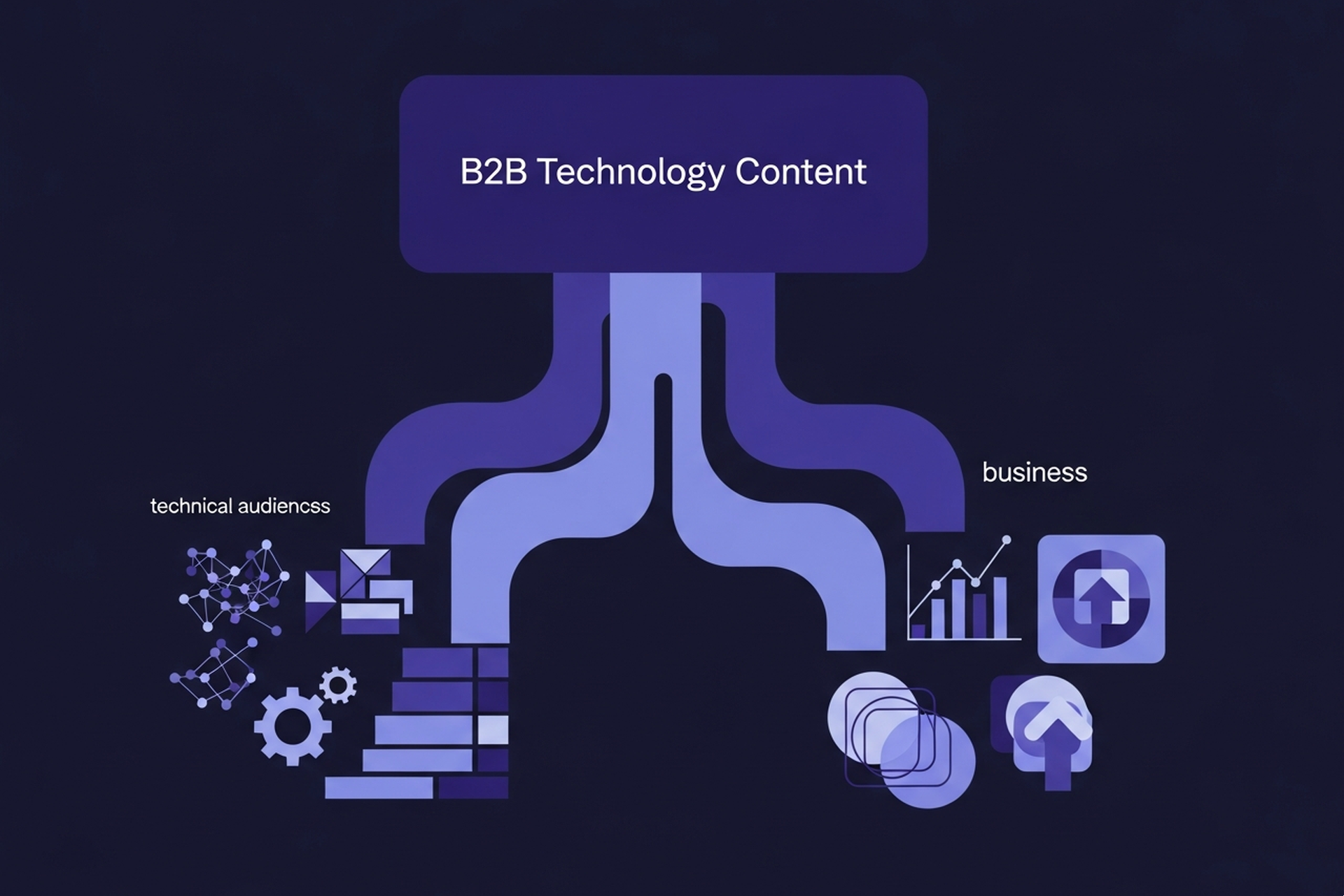
Technology buyers do not read content in isolation. A single purchase decision typically involves a software engineer who needs to evaluate APIs, a director of operations who needs to justify budget, and a CISO who wants to know about data handling. Each person reads with different goals. If your content is written for only one of them, the others disengage or, worse, form objections no one addresses.
Writing effective b2b technology content is not about picking a reading level and sticking to it. It is about structuring content so each audience finds what they need, without one group feeling talked down to or the other feeling lost.
Why most tech content fails mixed audiences
The default failure mode in technology content marketing is writing for a single reader type. Developer-focused companies write deeply technical content that business buyers cannot parse. Enterprise sales teams publish high-level thought leadership that says nothing specific enough to satisfy a technical evaluator.
Neither approach builds the kind of trust that moves a deal forward. According to Forrester, 68% of B2B buyers prefer to research independently before engaging with sales, and they are assembling their own picture from whatever content is available (Forrester, 2023 B2B Buying Study). If your content only answers half the committee's questions, the other half fills the gap with competitor content.
The solution is not to write one watered-down piece that tries to please everyone equally. It is to write content with a clear primary audience and a deliberate structure that gives secondary audiences what they need without burying the lede for the primary reader.
Understanding your technology buyer committee
Before writing, map the roles that typically appear in your deals. For most B2B technology purchases, the committee includes:
- A technical evaluator (engineer, architect, or IT lead) who cares about implementation details, integrations, security posture, and how much work adoption requires
- A business champion (product manager, operations lead, or department head) who cares about time-to-value, workflow fit, and whether the tool solves the problem they own
- A budget holder (VP, director, or CFO) who needs a clear ROI story and wants to know what the category risk looks like if they do nothing
- An end user who cares about day-to-day usability and whether adoption will create new friction in their workflow
Each role enters the content experience at a different point in the buying journey, asks different questions, and is satisfied by different formats. Your technical buyer content strategy should map each content asset to the role it is primarily serving, then layer in enough context for adjacent roles to stay engaged.
Structuring content for multiple readers
The most practical technique for mixed-audience content is layered structure: write the primary insight at the top, then give readers two paths forward. Business buyers can read the summary, narrative sections, and outcome-focused headings. Technical readers can go deeper into subsections that detail implementation, architecture, or data handling.
This does not mean burying technical content or wrapping it in an executive summary layer that feels like a disclaimer. It means sequencing the document thoughtfully.
Lead with the problem, not the solution
Every piece of technology content should open with the problem the reader recognizes, not the technology that solves it. A business buyer reading about API rate limiting does not care about the technical architecture first. They care that their team is spending hours on manual workarounds because their current system cannot handle request volume at scale.
Open with that. Once the reader has confirmed this is their problem, they are ready to engage with how you solve it.
Use plain language in structure, technical language in detail
Headings, subheadings, and summary sentences should be written in plain language so any committee member can navigate the document. The body paragraphs under a technical subheading can and should use precise technical language. This lets a business buyer skim the structure and read the narrative sections, while a technical evaluator reads everything and trusts that you have not oversimplified what matters to them.
Avoid the reverse pattern, which is technical headings over vague body copy. That alienates both groups: engineers see headings that promise depth and find nothing, while business buyers cannot even orient from the structure.
Place technical depth in dedicated subsections
If you are writing a piece primarily for business buyers about, say, choosing a data integration platform, include a subsection titled "How the integration works" or "Security and data handling." Do not spread technical detail across the whole piece. Concentrated technical sections let engineers jump directly to what they need. A business buyer who wants to read the whole piece can choose to engage with that section or skip it without losing the thread of the main argument.
Writing at the right level of abstraction
One of the persistent problems in technology content marketing is using technical vocabulary as a shorthand for expertise. Listing acronyms and framework names does not demonstrate that you understand the problem. It signals that you are writing for an audience that already knows what you know, which means you are not explaining anything.
The right level of abstraction depends on the primary audience for the piece. If you are writing a deep-dive integration guide, you can and should use precise technical language. If you are writing a buyer's guide or a strategy post, your job is to make the technical concepts accessible to people who are smart but not specialists.
A useful test: after writing a technically dense paragraph, ask whether a skilled professional in an adjacent field (say, a product manager who works closely with engineers) could follow the argument without stopping to Google terms. If the answer is no, either simplify the language or add a brief contextual explanation the first time you use each term. Do not define terms condescendingly. Do it functionally: "webhook (an automatic notification your system sends when an event occurs)" rather than "a webhook is defined as..."
The role of SEO in technology content
A good B2B content marketing strategy for technology companies treats SEO as an audience signal, not just a ranking tactic. The queries your buyers type into search engines tell you where they are in the decision process and what vocabulary they use to describe the problem.
Technical evaluators search with technical vocabulary: "how to batch API requests," "rate limiting best practices," "Postgres connection pooling." Business champions search with problem vocabulary: "how to reduce manual data entry," "best tools for sales workflow automation." Budget holders search with outcomes vocabulary: "ROI of marketing automation," "cost of data silos."
Each keyword cluster corresponds to a different audience and a different content type. Mapping your content plan to these clusters ensures you are building assets for each committee member, not accidentally writing everything for one role. This is the foundation of solid SaaS SEO: matching content format and depth to the intent behind the query, not just the keyword volume.
Common mistakes in tech b2b content strategy
Hiding the business value in technical detail
Engineers writing content about their own product default to describing how the system works. That is useful, but it buries the reason a business buyer would care. Every technical content piece should include at least one paragraph that translates the technical behavior into a business outcome. "Our system processes events asynchronously" should be followed by: "which means your team does not wait for long-running jobs to complete before moving on to the next task."
Using jargon as a credibility signal
Technology companies sometimes load content with industry terms to sound authoritative. The effect on non-technical readers is the opposite: they feel excluded and move on. Authority comes from specificity, not vocabulary. Specific numbers, real customer outcomes, and concrete examples build more credibility than any amount of technical terminology.
Writing thought leadership that says nothing specific
The flip side of over-technical content is vague "thought leadership" that describes trends without making any specific claims. Readers across all roles share one expectation: they want content that helps them do something or decide something. A post that says only "personalization is increasingly important in B2B marketing" is not useful to anyone. A post that explains which personalization tactics actually move pipeline at different funnel stages, with data from specific studies, is useful to a business champion and credible to a technical reader.
Building a mixed-audience content program
The practical output of all this is a content calendar organized around buyer roles and funnel stages, not just topics. For every topic cluster, you should be able to answer: which role is the primary reader for this piece, and which role is the secondary reader?
Some pieces will be primarily for technical evaluators with business context layered in. Others will be primarily for business champions with a technical subsection. A few will be business-case documents aimed almost entirely at budget holders. This is what a mature B2B content tactics program looks like in practice: intentional coverage of the whole committee, not just the audience that is easiest to write for.
According to the Content Marketing Institute's 2024 B2B Content Marketing Report, 58% of the most successful B2B content marketers say they always or frequently create content for specific audience segments (CMI, B2B Content Marketing Report 2024). Among the least successful, only 19% do the same. Audience specificity is not a nice-to-have. It separates programs that build pipeline from programs that generate traffic without outcomes.
The companies that get technology content right are the ones that resist the urge to write for an imagined average reader. They write for real people with real roles, specific concerns, and different tolerances for technical depth, and they build a system that serves all of them without treating any one as an afterthought.
Recommended Posts





.svg)