

.svg)
Blog Content Strategy: A Complete Guide to SEO Growth | ClusterMagic


Blog Content Strategy: A Complete Guide to SEO Growth
Most teams that struggle with SEO aren't short on content. They're short on structure. They publish posts regularly, cover a range of topics, and still wonder why organic traffic refuses to grow. The problem is almost always the same: no coherent blog content strategy connecting the work.
A real blog content strategy isn't a content calendar or a list of keywords. It's a system that aligns what you write with what your audience searches for, what your business needs, and how search engines understand your authority on a topic. This guide walks you through how to build one, from research to execution.
What Is a Blog Content Strategy (and Why Most Are Broken)
A blog content strategy is a documented plan that defines what topics you cover, why you cover them, and how each piece connects to the others. Done well, it turns a loose collection of posts into a coherent body of work that builds topical authority over time.
Most blog strategies fail because they treat content as a series of independent articles. Each post is researched in isolation, written for a single keyword, and published without regard for how it fits alongside anything else. Search engines reward topical depth, not topical breadth, so scattering across too many subjects leaves you ranking weakly for everything. Understanding what topical authority is and how it's built is the foundation of any effective cluster strategy.
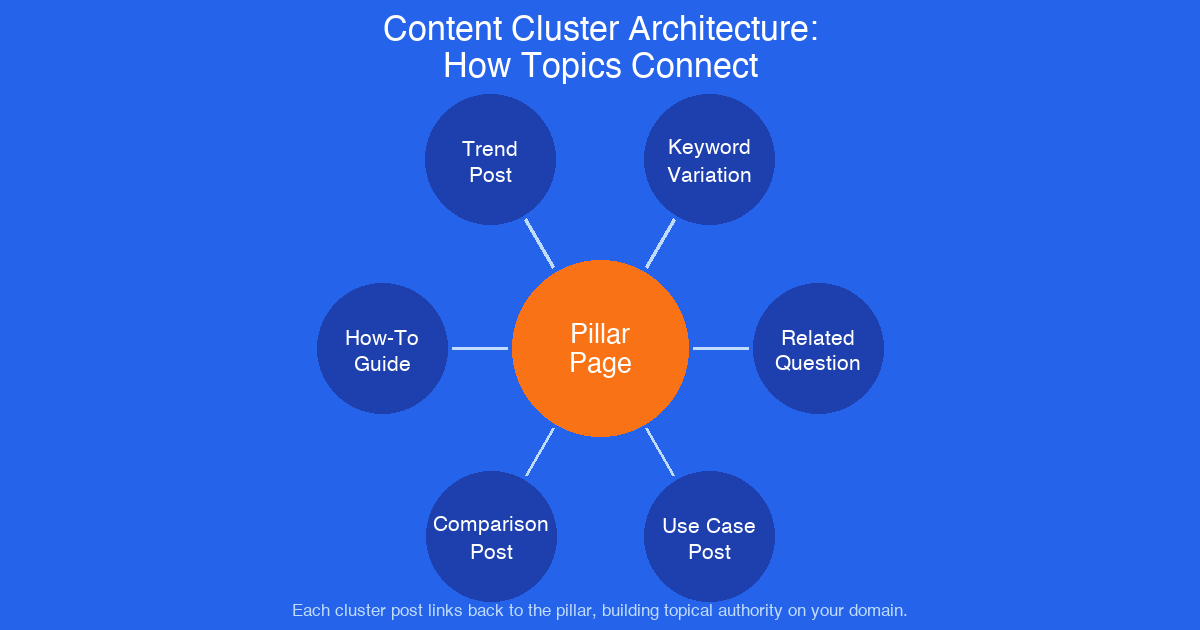
The fix is a cluster-based approach. Instead of chasing individual keywords, you organize content around core topics, publish a pillar page that covers the topic comprehensively, and build supporting posts that go deep on specific subtopics. Every post in the cluster links back to the pillar. The result is a content architecture that signals genuine expertise to search engines.
Step 1: Define Your Topical Focus
Before you write a single word, decide which topics your blog will own. This is a strategic decision, not a content decision. Your topics should sit at the intersection of what your audience searches for and what your business can credibly cover.
Start by listing the core problems your customers face. Then ask which of those problems you can address with more depth and consistency than competitors. Narrower is almost always better. A SaaS tool for content teams that dominates three or four topics will outperform a blog that touches twenty topics at surface level.
Once you have your core topics, each one becomes a content cluster. Each cluster gets a pillar page (a long, comprehensive guide on the broad topic) and a set of supporting posts (each targeting a specific, related keyword). If you need help identifying which clusters your competitors own and where the gaps are, a structured content gap analysis surfaces those opportunities quickly.
Step 2: Do Keyword Research That Supports Your Blog Strategy for SEO
Keyword research for a blog strategy isn't about finding the highest-volume terms you can target. It's about finding the right terms at the right funnel stage and organizing them so they reinforce each other.
For each content cluster, you need:
- One primary keyword for the pillar page (usually high volume, broad, competitive)
- Supporting keywords for cluster posts (more specific, lower competition, higher intent)
- A clear sense of search intent for each term (informational, navigational, commercial)
Tools like Ahrefs and Semrush are the standard options for this work. What matters most is that you map every keyword to a specific piece of content before you start writing, so there's no duplication and no orphaned posts targeting terms that don't fit your clusters.
Pay attention to intent mismatches. A keyword like "best content planning tools" signals someone evaluating options, not learning the basics. Publishing a beginner's guide for that term wastes the work. Match the format and depth of each post to what searchers at that stage actually need.
Step 3: Build Your Editorial Calendar Around Clusters
An editorial calendar is where strategy becomes execution. Most teams use it as a simple publishing schedule. Used properly, it's a coordination system that ensures each cluster gets built out in the right order, at a pace your team can sustain.
A few principles that make this work:
Publish pillar pages before cluster posts. Search engines need the pillar in place to understand what the supporting posts connect to. Launching cluster posts first means they sit without the internal linking structure that gives them context.
Batch content within clusters. Publishing several posts for the same cluster in a short window sends a strong topical signal. Spreading them out over months dilutes that signal.
Prioritize based on search volume and production cost. Some clusters will deliver faster results because the keywords are less competitive. Others will take longer but matter more to the business. Your calendar should reflect both considerations, not just what's easiest to write.
HubSpot's editorial calendar templates and Asana's content planning templates are solid starting points if you're building yours from scratch.
How to Create a Blog Strategy That Scales With Your Team
Strategy doesn't scale if it only lives in one person's head. The teams that grow organic traffic consistently are the ones that have documented their process so anyone can execute it.
Two documents do most of the work here.
Content Briefs
A content brief translates strategy into instructions a writer can act on. It specifies the primary keyword, target word count, required sections, internal and external linking requirements, and the search intent the post must satisfy. Writers shouldn't have to make strategic decisions. The brief makes those decisions for them. If your team doesn't have a consistent brief format, a content brief template removes the guesswork.
An Internal Linking Map
Internal links are what turn individual posts into a cluster. Every supporting post should link to the pillar page. The pillar page should link to supporting posts as they're published. A simple spreadsheet that maps which posts link to which is enough. Without it, posts get published with no internal links, and the cluster architecture never fully forms.
If you want to skip the manual setup and get started with a cluster-based blog strategy built for your site, ClusterMagic handles this end to end.
Step 4: Measure What Matters
A blog content strategy is a long-term investment. Most posts won't rank on page one within the first few weeks. The right metrics tell you whether the strategy is working before rankings move.
Track these at the cluster level, not just the post level:
- Organic impressions and clicks via Google Search Console (tells you if Google is indexing and surfacing the cluster)
- Average position for your target keywords (trends matter more than point-in-time snapshots)
- Crawl coverage (are all cluster posts being indexed and crawled regularly)
- Conversions from organic (are the right people finding the content, not just any people)
If a cluster is getting impressions but no clicks, the issue is usually title and meta description. If posts are indexed but not ranking, the issue is usually authority (not enough internal or external links pointing to the cluster) or intent mismatch.
Revisit your oldest cluster posts every six months. Search intent shifts, competitors update their content, and Google periodically re-evaluates what ranks for a term. A structured review process catches these issues before traffic declines, rather than after.
Common Blog Strategy Mistakes (and How to Fix Them)
Even well-intentioned strategies break down in predictable ways. The most common:
Publishing without a cluster structure. Random posts on unrelated topics tell search engines your site has no expertise in anything. Group everything into clusters, even retroactively.
Targeting keywords that are too competitive too early. New blogs with low domain authority will not rank for head terms against established sites. Start with long-tail, lower-competition terms that have clear intent, build authority, then move up.
Skipping content briefs. Without briefs, writers optimize for readability and ignore SEO. The post might be excellent and still fail to rank because it doesn't hit the structural requirements search engines reward.
No internal linking discipline. Publishing posts with no internal links means your cluster never coheres. Link every post to its pillar on the day it publishes.
Treating strategy as a one-time setup. A blog content strategy needs quarterly reviews. Topics saturate, search behavior shifts, and your business priorities change. Strategy that doesn't adapt stops working.
Putting It Together: Your Blog Content Strategy Checklist
Before you write your next post, confirm you have these in place:
- Core topics defined (two to four clusters to start)
- Pillar page and keyword map for each cluster
- Editorial calendar with cluster posts batched and sequenced
- Content briefs for every upcoming post
- Internal linking map with pillar pages already published
- Performance tracking set up in Google Search Console
If you're building strategy for a SaaS product or a small content team with limited bandwidth, the principles are the same. The SaaS content marketing playbook covers how to apply the cluster model when you're working with constrained resources.
If you'd rather have someone build and manage that structure for you, ClusterMagic handles the full topic cluster workflow from keyword research through to published content. A strong blog content strategy isn't about publishing more. It's about publishing smarter, with every post building on the ones before it. Structure makes that possible.
Recommended Posts





.svg)