

.svg)
Content Clusters SEO: The Complete Strategy Guide | ClusterMagic

Most content programs stall for the same reason: publishing never stops, but rankings barely move. Individual posts accumulate, keyword counts grow, and yet organic traffic stays flat. The problem usually isn't the writing. It's the architecture. Content clusters for SEO fix that architecture problem by replacing a scattered collection of posts with a structured, interconnected system that search engines can actually interpret as authority.
This guide covers how content clusters work, why the pillar-and-cluster model outperforms traditional keyword-by-keyword content production, and how to build one that compounds in value over time.
What Are Content Clusters in SEO?
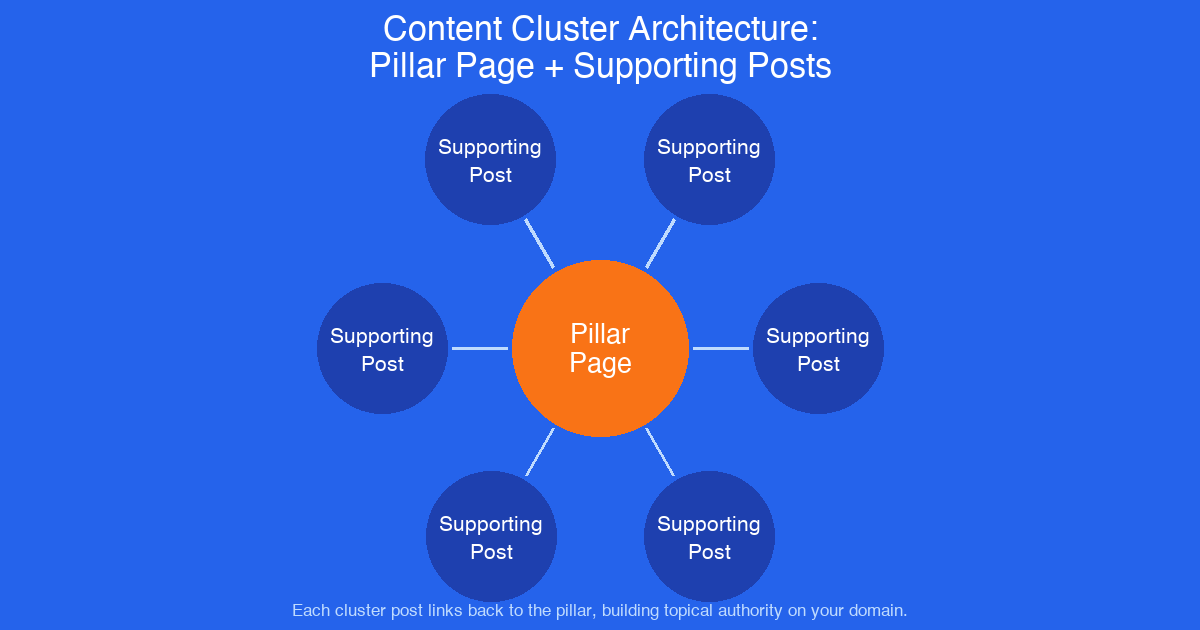
A content cluster is a group of thematically related pages organized around a single central topic. At the center sits the pillar page, a comprehensive resource that covers a broad subject at strategic depth. Around it sit cluster pages, focused articles that each explore one specific subtopic in detail. Every cluster page links back to the pillar. The pillar links out to each cluster page. When relevant, cluster pages link to each other.
This structure does three things simultaneously. It tells search engines what your site is about in unambiguous terms. It passes link authority from supporting content up to your most important page. And it gives readers a navigational system that encourages them to explore more of what you've published.
The core insight is architectural: the same content published as isolated posts is much less powerful than the same content published as an interconnected cluster. The words don't change. The structure does.
Pillar Pages vs. Cluster Pages
A pillar page is not just a long post. It's a strategic hub, designed to cover the full scope of a topic without going so deep on any subtopic that it eliminates the need for supporting articles. Think of it as an authoritative overview that explicitly invites the reader to go deeper through linked cluster content.
Cluster pages are the opposite of the pillar in one key way: each one is deliberately narrow. A cluster page covers one subtopic, answers one type of question, targets one search intent. Its job is to be the best resource on that specific slice of the subject, not to be comprehensive across the whole topic.
The combination is what creates authority. The pillar signals breadth. The cluster pages signal depth. Together, they signal that your site genuinely knows this subject, rather than having scraped the surface.
Why Content Cluster Strategy Outperforms Keyword-by-Keyword SEO
The traditional approach to SEO content treated every keyword as its own isolated battle. Write one page per keyword, optimize it, and hope it ranks. That model worked reasonably well when Google evaluated pages as standalone units. It stopped working as Google's algorithms became better at evaluating sites as a whole.
Google now assesses topical authority, the degree to which a site comprehensively covers a subject area, not just whether an individual page is well-optimized. A site with fifteen tightly linked posts on a subject will outrank a site with one very polished post on the same keyword, assuming everything else is comparable.
The keyword-by-keyword model also creates a structural problem: keyword cannibalization. When you write multiple posts that target slightly different versions of the same query, those pages compete with each other in search results. Search engines have to guess which one to rank, and they often guess wrong. Content clusters prevent this by assigning each keyword cluster to a single page and making the hierarchy explicit through internal linking.
The Compounding Effect
Clusters don't just rank better at launch, they get stronger over time. As you add cluster pages, each new piece reinforces the pillar's authority and fills in gaps that searchers might otherwise find elsewhere. Properly maintained clusters have been shown to generate significantly more organic traffic than standalone posts, and they maintain rankings far longer because the authority signal is structural rather than content-specific.
This compounding effect is why pillar pages and topic clusters work especially well for teams that can commit to publishing consistently within a defined subject area. The first three cluster pages produce modest results. By the time you've built out ten to fifteen focused articles, the architecture starts to visibly outperform what competitors with more backlinks are publishing. If you want to get started with ClusterMagic and have this structure built for your site, that's exactly what the service is designed to do.
How to Build a Content Cluster Strategy
Step 1: Choose Your Pillar Topic
Your pillar topic should be a broad, high-value subject that sits at the center of what your business does. It needs to be broad enough to support eight to twelve cluster pages, but specific enough that you can genuinely claim authority on it. "Marketing" is too broad. "Content strategy for SaaS teams" is about right.
A useful test: can you name ten specific subtopics, questions, or use cases that a thorough resource on this subject would need to cover? If yes, you have a viable pillar topic. If you struggle to name five, the topic is probably too narrow to support a real cluster.
For teams already producing content, your content gap analysis is the fastest way to identify where a cluster structure already exists in your existing posts or where one should be built from scratch.
Step 2: Map the Full Topic Territory
Before writing anything, map every subtopic, question, and use case that belongs within your chosen subject area. This is not a keyword list. It's a topic map, a structured picture of everything a comprehensive resource on this subject would need to cover.
Inputs that build a strong topic map:
- People Also Ask boxes in Google for your main keyword
- Autocomplete suggestions when you type your keyword and related terms
- Community forums and Q&A sites where your audience asks questions
- Search Console data showing what queries already bring traffic to your site
- Your own customer conversations, where real questions surface that keyword tools miss
Once the map is built, run it against your existing content. Pages you've already published that cover subtopics on the map can be pulled into the cluster. Gaps in the map become your publishing queue.
Step 3: Create or Designate Your Pillar Page
The pillar page is the most important piece of content in the cluster. It should:
- Cover the full scope of the topic at strategic depth, not surface level, but not exhaustive on any single subtopic
- Include a navigational structure (a table of contents or clear H2 sections) so readers can scan and find what they're looking for
- Link explicitly to each cluster page using descriptive anchor text that reinforces the relationship
- Target the broadest, highest-volume keyword in the cluster as its primary keyword
Pillar pages are not "set and forget" content. They should be updated regularly as new cluster pages are added and as the topic evolves. The pillar is a living document, not a one-time publication.
Step 4: Write Cluster Pages That Each Own One Subtopic
Each cluster page should target one primary keyword and address one specific search intent. The narrowness is intentional. A cluster page that tries to cover multiple angles competes with other cluster pages and blurs the signal you're sending to search engines about what each piece of content is for.
A strong cluster page:
- Targets a specific long-tail keyword with clear intent
- Links back to the pillar page with consistent, keyword-relevant anchor text
- Links to other relevant cluster pages where the connection is natural and useful to the reader
- Goes deeper on its specific subtopic than the pillar does, that's the whole point
When writing cluster pages, a well-constructed content brief template that specifies the primary keyword, target intent, internal link requirements, and key points to cover makes execution significantly more consistent, especially on teams where multiple writers are involved.
Step 5: Build and Maintain the Internal Link Structure
Internal linking is the mechanism that turns individual posts into an actual cluster. The structure is straightforward:
- The pillar links to every cluster page
- Every cluster page links back to the pillar
- Cluster pages link to each other when the connection is genuinely useful
Anchor text matters. Links from cluster pages back to the pillar should use anchor text that includes the pillar's primary keyword, not generic phrases like "click here" or "learn more." This passes relevance signal along with link equity.
As you add new cluster pages, update the pillar to include a link to each new piece. Keeping the pillar current as the cluster grows is what maintains the hub-and-spoke architecture that makes the structure work.
Content Cluster SEO: What to Measure
Rankings and Traffic by Cluster
Measure performance at the cluster level, not just the individual page level. Track rankings for the pillar's primary keyword and the primary keywords of each cluster page. Monitor organic traffic to the cluster as a whole, not just to the pillar.
You'll typically see early movement within a few weeks as Google indexes the internal link structure. More meaningful ranking improvements usually come within three to six months. The strongest gains compound over twelve or more months as the authority signal accumulates.
Topical Coverage Completeness
One practical metric clusters introduce is coverage completeness: what percentage of your topic map has been published? A cluster with twelve subtopics identified and eight published is 67% complete. That number drives your publishing queue and makes it easy to show progress toward a defined goal.
Tracking coverage also surfaces cannibalization risks early. If two cluster pages are targeting overlapping subtopics, you'll see it when you map them back to the topic territory, before it causes ranking confusion.
Engagement and Internal Navigation
Clusters improve user behavior metrics when they're built well. Readers who land on a cluster page and find relevant links to the pillar and related pages stay longer and visit more pages per session. Track time on page, pages per session, and scroll depth for cluster content. Improvement in these metrics confirms that the internal architecture is working as intended.
Google Analytics and Google Search Console together give you the core measurement stack: Search Console for keyword rankings and impressions, Analytics for on-site behavior after the click.
Common Mistakes That Undermine Clusters
Making the Pillar Too Narrow
A pillar page that only covers one angle of a topic doesn't generate enough natural link destinations for a real cluster. If you find yourself running out of subtopics after three or four cluster pages, the pillar topic is probably too specific. Broaden it, or recognize that what you have is a cluster page, not a pillar.
Publishing Cluster Pages Without Linking Back
A cluster page that doesn't link to the pillar is just a regular blog post. The SEO value of a content cluster comes from the internal link structure. Every cluster page must link back to the pillar, and the pillar must link out to every cluster page. Omitting these links breaks the architecture entirely.
Treating Clusters as One-Time Projects
Clusters are ongoing systems, not campaigns. The authority signal compounds as you add pages and update existing ones. A cluster that was published once and never touched again gradually loses competitive ground to clusters that are actively maintained and expanded. Build the infrastructure to revisit cluster content on a regular cadence.
Letting Cluster Pages Overlap
When two cluster pages cover the same subtopic from nearly identical angles, they compete with each other. One will rank and one won't, and neither will rank as well as a single consolidated page would. Map your cluster pages to distinct search intents before writing, not after. The content gap analysis step catches most overlap before it becomes a problem.
Content Clusters and AI Search
Building topical authority through content clusters now pays dividends in two places: traditional search results and AI-generated answers. When Google's AI Overviews or tools like Perplexity generate answers about a topic, they draw heavily on sites that demonstrate comprehensive coverage and clear authority.
A well-built cluster is essentially a structured argument that your site is the authority on a subject. The more completely your cluster covers a topic, the more frequently your content surfaces as a source in AI-generated summaries. This is sometimes called generative engine optimization (GEO), and it rewards the same behaviors that make content clusters effective for traditional SEO: depth, coherence, and comprehensive coverage.
The practical implication: build clusters with the depth and authority that would convince a knowledgeable human reader, not just the keyword density that once satisfied crawlers. Ahrefs' research on topical authority consistently shows that comprehensiveness of coverage, not raw backlink count, is the most reliable predictor of sustained rankings for competitive topics.
Building Your First Cluster
The most effective starting point is almost always a topic where you've already published two or three posts that naturally belong together. Take inventory, identify the posts that share thematic territory, and decide which one could serve as the pillar, either as-is or with expansion. Then map the subtopics around it and fill the gaps.
That's the core loop: map the territory, designate or create the pillar, fill the cluster, link everything together, measure at the cluster level, and expand over time. It's straightforward in principle, and the compounding returns are real. If you'd rather have this done for you, ClusterMagic builds and manages topic clusters end-to-end, handling the keyword research, pillar and cluster content, and internal linking structure so you don't have to.
Content teams that commit to this architecture consistently, rather than one-off keyword chasing, end up with a content library that's worth more as a whole than the sum of its parts. That's what a content cluster strategy actually delivers: structure that makes every post you publish more valuable than it would have been alone.
External resources referenced in this guide:
- Semrush: Topic Clusters for SEO - practical overview of how to structure and build topic clusters
- Ahrefs: Topical Authority - how content clusters build ranking power over time
- Google Search Console - free tool for tracking keyword rankings and impressions
- Google Analytics - on-site behavior tracking for cluster engagement metrics
- Google AI Overviews announcement - context on how AI search surfaces authoritative content
- HubSpot: Pillar Pages, Topics, and Subtopics - original framework that popularized the pillar-cluster model
Recommended Posts





.svg)