

.svg)
How to Grow Organic Search Traffic: A Practical Framework
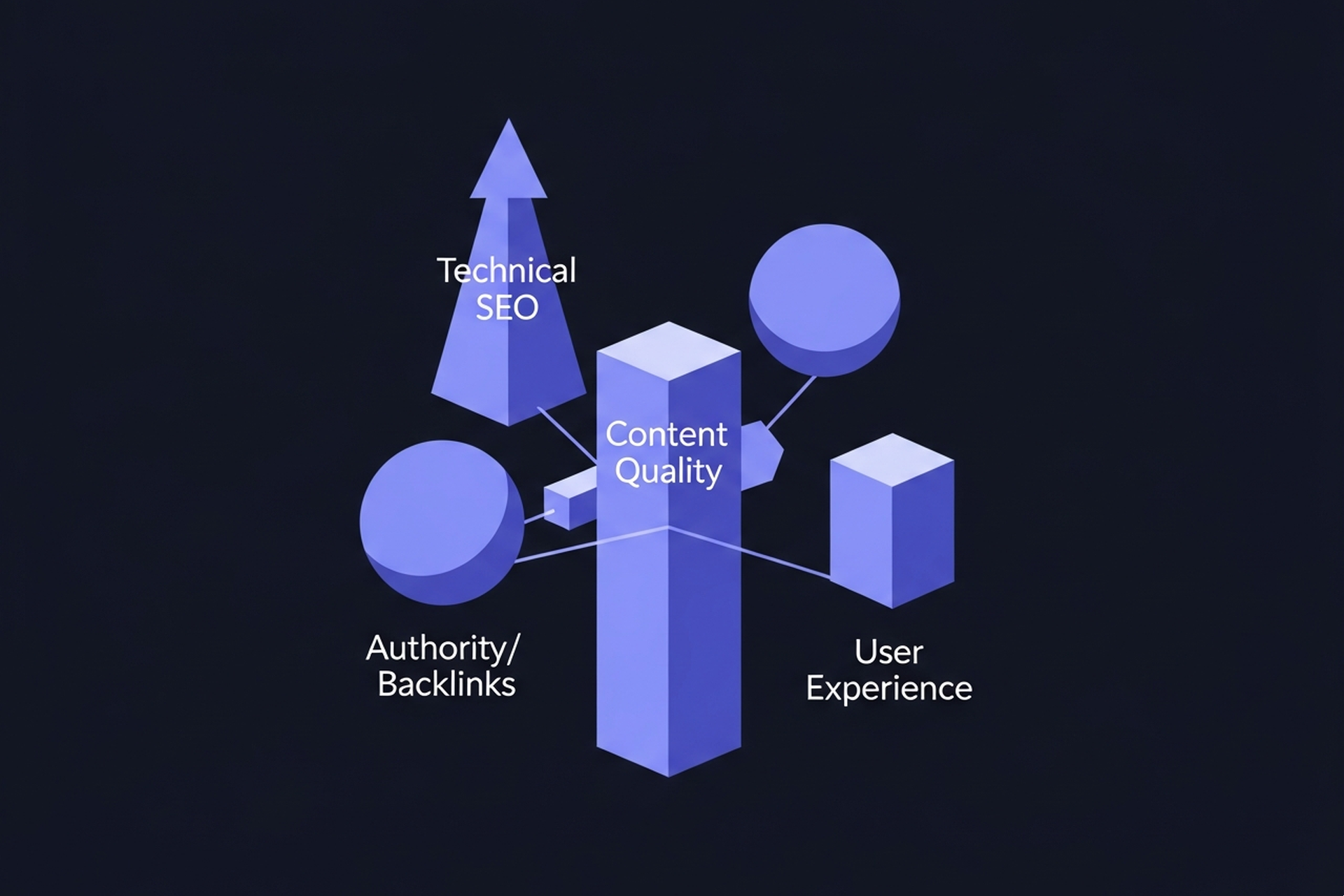
Most advice about growing organic search traffic reads like a list of things to eventually get around to. Do keyword research. Build backlinks. Fix technical issues.
It's not wrong, it's just not a framework. Without a structure for deciding what to work on first and how the pieces connect, teams end up doing everything sporadically and wondering why results are inconsistent.
This post lays out a four-lever framework for growing organic search traffic that content teams can actually use: where to start, what each lever controls, and how they interact.
Why Organic Search Traffic Works the Way It Does
Before getting into the framework, it's worth being clear about the underlying mechanic. Organic search traffic compounds. Each new post you rank adds to a base that doesn't go away when you stop paying. Each backlink you earn strengthens your authority across the whole domain.
Each technical improvement lifts the ceiling on what every page on your site can achieve. That compounding nature means the decisions you make early matter more than the specific tactics you execute. Building content around disconnected keywords, ignoring technical health, and publishing without a linking strategy all slow the compounding effect. Getting these foundations right accelerates everything that follows.
The four-lever framework is organized around the four variables that determine your organic search traffic ceiling.

Lever 1: Keyword Strategy
Keyword strategy is the first lever because it determines which traffic is even possible. You can execute everything else flawlessly and still fail to grow organic search traffic if you're targeting the wrong keywords.
The most common mistake is optimizing purely for volume. A 10,000 searches-per-month keyword that your site has no realistic chance of ranking for generates zero traffic. A 300 searches-per-month keyword where you can reach position 3 generates consistent, compounding clicks.
A practical keyword strategy includes three components:
Opportunity assessment: For each target keyword, compare its difficulty against your current domain authority. Tools like Ahrefs and Semrush provide difficulty scores that estimate how hard it is to rank. Set a realistic floor for what's achievable now and what to target in 6-12 months.
Intent mapping: Categorize keywords by what the searcher actually wants. Informational queries (how, what, why) warrant different content than commercial queries (best, compare, alternatives). Matching your content format to the dominant intent in the SERP is a prerequisite for ranking, not a nice-to-have.
Topic clustering: Group related keywords into clusters and plan content that covers the topic comprehensively rather than targeting each keyword in isolation. A cluster of 8-12 posts on the same topic builds more authority and ranks more keywords than 8-12 unconnected posts on different subjects.
Our guide to keyword research for content clusters covers the mechanics of building clusters from keyword data.
Lever 2: Content Architecture
Content architecture is how you organize and connect your posts. Most teams think about individual pieces. High-performing organic sites think about systems.
A strong content architecture has three characteristics:
Clear pillar structure: Every cluster has a pillar page that covers the topic broadly and links to cluster content. Cluster content covers specific subtopics and links back to the pillar. Search engines use this structure to understand the scope of your coverage on a topic.
Consistent internal linking: New posts link to relevant existing posts. Old posts get updated with links to new content. The network of internal links is how Google understands which pages are most important and how topics relate to each other.
Depth across the funnel: A strong content architecture covers top-of-funnel awareness queries, mid-funnel comparison and evaluation queries, and bottom-of-funnel decision queries. Traffic that enters at the top can be guided toward conversion with relevant content at each stage.
The 80/20 rule applies here: most organic traffic typically comes from 20% of your pages. Understanding which content is driving your existing traffic tells you where your architecture is already working and where it needs reinforcement.
Lever 3: Technical Health
Technical health is the ceiling lever. Strong keyword strategy and content architecture can only generate organic search traffic up to the ceiling your technical implementation allows. A slow, poorly structured, or incompletely indexed site suppresses what every piece of content can achieve.
The technical factors that most directly impact organic search traffic:
Crawlability: Search engines can only rank pages they can find and crawl. Broken links, misconfigured robots.txt files, redirect chains, and orphaned pages (not linked to from anywhere) all reduce the portion of your site that gets crawled and indexed.
Page speed: Google uses Core Web Vitals as a ranking signal. Slow pages rank lower and have worse engagement metrics, which further suppresses rankings. The threshold to aim for is a Largest Contentful Paint (LCP) under 2.5 seconds.
Mobile performance: The majority of searches happen on mobile. A site that performs poorly on mobile devices has a structural disadvantage in organic rankings.
Structured data: Schema markup doesn't directly boost rankings, but it helps search engines understand your content and can unlock rich result features like FAQ expansions, how-to steps, and review stars that improve click-through rates from the SERP.
A technical audit with Screaming Frog or a similar crawler surfaces the most common issues. Start with crawl errors and page speed before moving to more nuanced optimizations.
Lever 4: Authority Building
Domain and topical authority determine how competitive you can be for keywords at any given difficulty level. Authority is primarily built through backlinks from other sites, but the approach matters.
Chasing links as a number produces results that are fragile and often short-lived. Building authority around content that genuinely earns links produces results that compound.
The content types that consistently earn editorial backlinks without active outreach:
- Original research and data: Studies, surveys, and datasets that others cite as primary sources
- Definitive guides: Comprehensive resources that become reference points in your category
- Frameworks and models: Unique ways of thinking about a problem that practitioners want to reference
- Tools and calculators: Free utilities that other writers include in resource lists
The link-earning approach is slower than traditional outreach, but it builds authority through quality signals that are harder to replicate and less vulnerable to algorithm updates.
Beyond links, topical authority is built through breadth and depth of coverage. A site with 50 posts all consistently covering content strategy topics from multiple angles signals more topical authority than a site with 200 posts scattered across unrelated subjects.
How the Four Levers Interact
The framework works because the four levers are interdependent. Improving one in isolation has limited impact. Improving all four in coordination produces compounding results.
Here's how they reinforce each other:
- Keyword strategy without content architecture produces posts that rank individually but don't build cumulative authority on any topic
- Strong content architecture without keyword strategy means beautifully organized content targeting the wrong terms or the wrong intent
- Great content with technical problems means pages that exist but don't get fully indexed or ranked
- All three without authority means competing only for keywords where your current domain authority is sufficient
The sequence that works for most teams is:
- Fix critical technical issues first (they're blocking everything else)
- Define your keyword strategy and cluster structure
- Build content systematically within that structure
- Invest in link-earning content to lift authority as you grow
Setting Realistic Expectations
Organic search traffic growth takes time. The compounding dynamic that makes it so valuable in the long run is also what makes it frustrating in the short run. Most teams see meaningful results in 3-6 months and significant compounding effects in 12-18 months.
The sites that fail to grow organic search traffic consistently fall into the same patterns: publishing without a keyword strategy, ignoring technical issues, creating content in isolation rather than clusters, and abandoning the effort before the compounding kicks in.
The sites that succeed treat organic growth as infrastructure. They invest consistently across all four levers, measure what's working, and adjust based on data from Google Search Console rather than assumptions.
The Bottom Line
Growing organic search traffic isn't about finding the one tactic you're missing. It's about building all four levers to a level where they reinforce each other. Keyword strategy, content architecture, technical health, and authority building each have a ceiling. Raising all four is what moves the needle.
Start by auditing where you are on each lever. What's technically broken? What's your keyword coverage on your most important topics? How well-connected is your internal linking? What's your current domain authority and what kinds of keywords can you realistically rank for now?
The answers tell you where to invest first. For a broader look at growing traffic without paid spend, see our guide on how to increase website traffic organically.
Recommended Posts





.svg)