

.svg)
SaaS SEO: Technical and Content Strategies for Software Companies
Most SaaS companies treat SEO as a channel to turn on once everything else is running. That sequencing is backwards. Organic search is the one acquisition channel that compounds, meaning every month of investment raises the floor for future months. When you delay building that foundation, you pay for it twice: once when you finally start, and again in the months you spent acquiring customers at full paid-media rates.
This post covers the full SaaS SEO strategy: the technical work that makes your site rankable, the content architecture that builds authority, and the keyword frameworks that connect search intent to your actual buyers.
Why SEO for SaaS companies requires a different approach
SaaS is not like ecommerce or local business SEO. The buyer journey is longer, the product is often abstract, and the keywords that convert are rarely the ones with the highest search volume. A buyer searching "automate invoice approval" has very different intent from someone searching "invoice software," even though both touch the same product category.
According to Ahrefs' 2024 study on B2B search behavior, the majority of high-intent B2B searches have fewer than 1,000 monthly searches. That means a volume-first keyword strategy will consistently target the wrong audience. The searches that matter most for SaaS conversions are specific, problem-oriented queries that look small in a keyword tool but drive significant pipeline.
There is also the churn problem. SaaS companies need buyers to stay, not just convert. Content that attracts poorly qualified users because it ranks for a broad keyword creates a worse business outcome than content that attracts fewer, better-matched prospects. Your SEO strategy needs to be built for ICP alignment, not just traffic volume.
Finally, SaaS operates in categories that change. New competitors, new features, and new buyer vocabulary emerge constantly. Your SEO strategy needs to be a living system that updates as the category evolves, not a one-time keyword list written in a spreadsheet three years ago.
Technical foundations: what has to be right before content matters
Content strategy gets most of the attention in SaaS SEO, but content cannot overcome a broken technical foundation. If search engines cannot crawl, index, and understand your site, even excellent content will underperform.
Site architecture and crawlability
SaaS sites often sprawl in ways that create crawl problems. Marketing pages, app pages, help documentation, blog content, and landing pages accumulate over time with inconsistent URL structures and conflicting canonical signals. Google's Search Console crawl stats, available under Settings, will show you how often Googlebot visits and how many pages it successfully indexes. A site with thousands of URLs but only a few hundred indexed pages has an architecture problem that no amount of blog publishing will fix.
The core principles: use a flat URL structure for your most important content, consolidate duplicate pages with canonical tags, and make sure your sitemap reflects only the pages you actually want indexed. According to Google's own Search Central documentation, pages excluded from your sitemap but still linked internally will still be crawled. Audit your internal link structure to make sure you are not accidentally directing crawl budget toward pages you do not care about.
Page speed and Core Web Vitals
Google confirmed Core Web Vitals as a ranking factor in 2021, and they remain one of the clearest signals of page experience quality. For SaaS companies, the most common failure points are Largest Contentful Paint (LCP) caused by unoptimized hero images and heavy JavaScript bundles, and Cumulative Layout Shift (CLS) caused by embeds and fonts loading after the initial render.
According to Google's 2023 Web Almanac, fewer than 40% of websites pass all three Core Web Vitals thresholds. That means improving your scores, even from mediocre to good, puts you ahead of a significant portion of competitors in your category. Run PageSpeed Insights on your five highest-traffic pages. If any LCP score exceeds 2.5 seconds, that is where to start.
Indexing and structured data
SaaS companies with pricing pages, FAQ content, and how-to documentation have clear opportunities to add structured data markup that surfaces rich results in search. FAQ schema on support pages, HowTo schema on tutorial content, and Article schema on blog posts all tell search engines what kind of content each page contains. These do not guarantee rich result treatment, but they are table stakes for competing in categories where competitors have already implemented them.
Content architecture: building authority that compounds
Once the technical foundation is sound, content is where SaaS SEO either compounds or stalls. The difference between a content program that plateaus and one that keeps growing comes down to architecture.
Topic clusters and the pillar model
Random blog publishing produces almost no compounding value. A post on onboarding strategy, followed by one on churn metrics, followed by one on pricing models, even if all well-written, builds nothing. These posts sit in competition with each other and with every other site in the category, with no internal structure reinforcing any of them.
Topic clusters change this. A pillar page covers a broad subject in full, and a set of supporting posts each address a specific subtopic in depth, all linking back to the pillar and to each other. According to HubSpot's research on topic clusters, sites that restructured content around the pillar-cluster model saw a measurable improvement in both rankings and organic traffic within six months of implementation.
For content marketing for SaaS companies, this might mean a pillar page on "SaaS content marketing" with cluster posts covering content calendar templates, ROI measurement, case study formats, and blog strategy. Each piece is individually useful. Together, they signal topical authority on the entire subject.
The practical implication is that SaaS teams should narrow their focus. Five clusters covered with depth and good internal linking will almost always outrank fifteen clusters covered thinly. Pick the topics that most directly map to your buyer's problem vocabulary and build those out completely before expanding.
Matching content to funnel stage
SaaS buyers move through a predictable awareness arc: they recognize a problem, research solutions, compare options, and decide. Each stage requires different content. A content strategy for SaaS growth accounts for all three stages, not just the top.
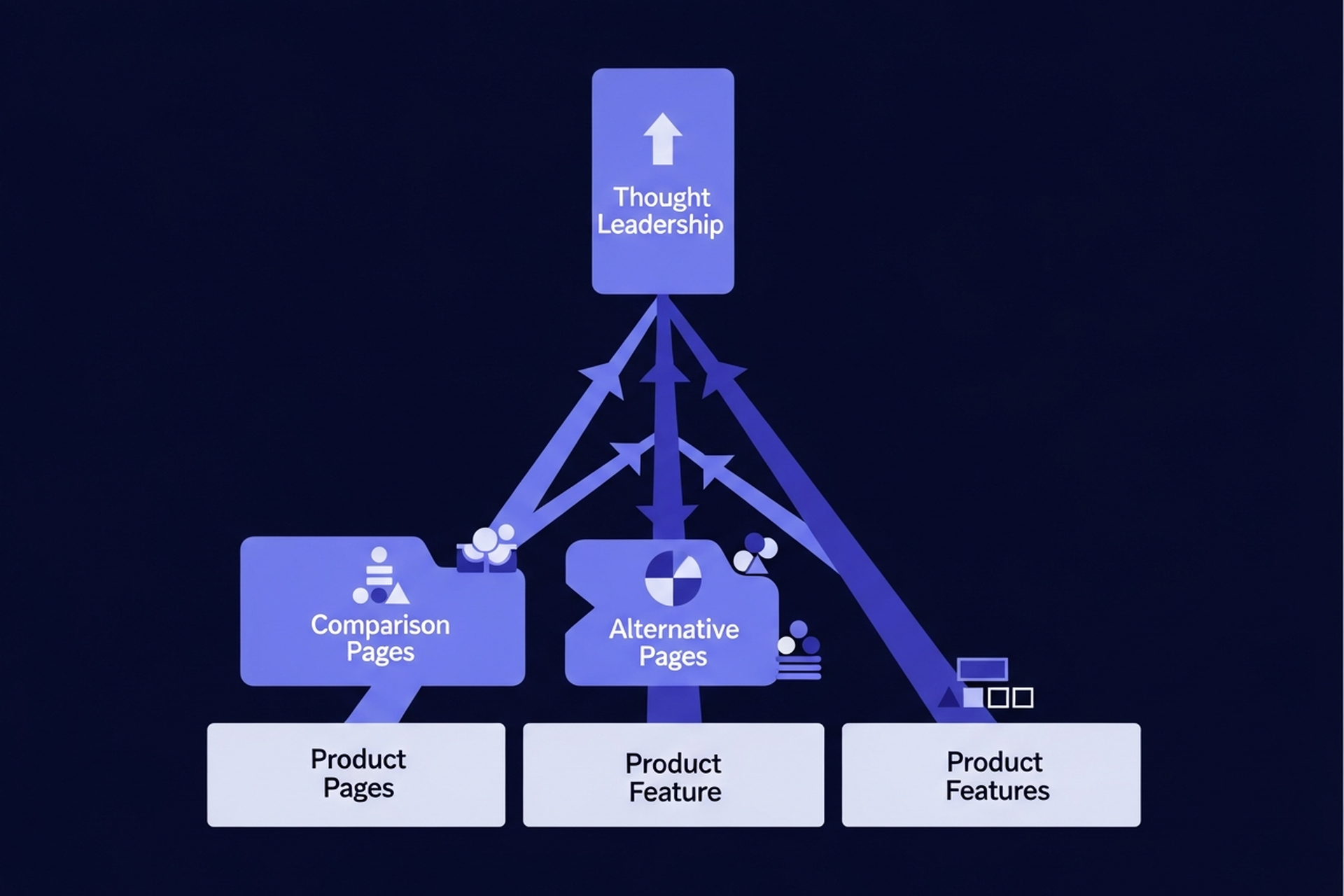
Top-of-funnel content answers the "what" and "why" questions buyers ask when they first recognize a problem. These posts generate traffic and brand awareness, but they rarely convert directly. Middle-of-funnel content covers "how" and "which" questions: how to evaluate solutions, which features matter, how other companies have solved this problem. Bottom-of-funnel content is explicitly comparative: "product A vs. product B," "[your product] alternatives," and use-case-specific landing pages for your highest-intent segments.
Most SaaS companies over-invest in top-of-funnel content and under-invest in bottom-of-funnel. According to research from Directive's SaaS content studies, BoFu content drives conversion rates two to three times higher than broad educational content. Comparison pages and alternative guides feel uncomfortable to publish because they explicitly acknowledge competitors, but that transparency is exactly what high-intent buyers are looking for.
Programmatic SEO for scalable coverage
When your product serves multiple verticals, use cases, or geographies, programmatic SEO is a way to create large amounts of targeted content without proportionally large content budgets. Programmatic pages are generated from structured data: if you serve ten industries and have ten product use cases, that is potentially one hundred landing pages, each targeting a specific combination of industry and use case.
The risk with programmatic approaches is thin content. Pages that offer no genuine value beyond keyword targeting get filtered out by Google's helpful content systems. The programmatic pages that work contain real data, real differentiators, and real utility for the specific audience they target. The template has to be good enough that each individual page is worth reading.
Keyword strategy: finding the queries your buyers actually use
Keyword research for SaaS is less about finding high-volume terms and more about mapping the full vocabulary your buyers use at each stage of their decision process. The goal is a keyword architecture that covers problem-aware queries, solution-aware queries, and brand-comparison queries across your main ICPs.
Using search intent to filter keywords
Search intent is the most important filter in SaaS keyword research. A keyword with 10,000 monthly searches but informational intent will bring students, journalists, and researchers to your site. A keyword with 500 monthly searches but commercial intent will bring buyers. Every keyword you target should be evaluated for the likely job the searcher is trying to do, and whether that job aligns with what your content can deliver.
Proper keyword research for content clusters groups keywords by intent and funnel stage before assigning them to content types. Informational keywords belong in blog content. Commercial and transactional keywords belong in landing pages, comparison pages, and product pages. Mixing intent within a single page, for example, trying to write one blog post that ranks for both an educational query and a buyer-intent query, almost never works well.
Long-tail keywords as the primary signal
For most SaaS companies, long-tail keywords with three to five words drive more qualified traffic than short-tail terms. "Marketing automation software" is a competitive, broad term dominated by category leaders. "Marketing automation for early-stage SaaS" is a specific query that a well-positioned company can rank for and that filters for a much more relevant audience.
According to Ahrefs' keyword research data, approximately 92% of all keywords receive fewer than ten monthly searches, and long-tail keywords collectively account for the majority of all search volume. For SaaS companies without the domain authority to compete for category-defining terms, the long tail is where organic acquisition actually happens.
Competitive gap analysis
Your competitor's ranking keywords reveal the demand your product exists to serve, organized by what search terms buyers actually use. Run a gap analysis comparing your site's ranking keywords against two or three direct competitors. The keywords they rank for that you do not represent both topic gaps in your content program and insight into buyer vocabulary you may not be using in your own writing.
This analysis is worth repeating every quarter. SaaS categories move fast, and new keyword clusters emerge as product capabilities evolve and buyer language shifts.
Measuring what matters in a SaaS SEO strategy
SEO is a long-cycle investment. According to Ahrefs' research on when content starts ranking, the average top-ten result is two or more years old. Most content takes six to twelve months to achieve its peak ranking position. That timeline creates a measurement problem: the metrics you can see in the short term (impressions, clicks, rankings) are leading indicators, but the outcomes you care about (pipeline, signups, revenue) lag by months.
The right approach is to track both. Short-term metrics like keyword ranking movement, click-through rate, and organic traffic by cluster tell you whether your strategy is gaining traction. Long-term metrics like content-influenced pipeline and organic signup rate tell you whether the investment is paying off in business terms. Running a SaaS SEO program without connecting it to revenue metrics is how teams spend two years optimizing for traffic that never converts.
Set ranking benchmarks for your target keywords at thirty, ninety, and one-hundred-eighty days after publication. Set organic traffic targets by cluster, not just site-wide. And connect your analytics to your CRM so you can see which content pieces are in the attribution path for deals that close.
Building a SaaS SEO strategy that compounds requires patience and architecture. The technical work removes friction, the content architecture builds authority, and the keyword framework ensures you are targeting buyers rather than traffic. None of those layers works well in isolation, but when all three are functioning, the result is an acquisition channel that improves every month without requiring proportionally more budget. That is the durable advantage organic search offers, and it is worth building correctly from the start.
Recommended Posts





.svg)