

.svg)
Buyer Persona Content Mapping: Write for People Who Buy

Most buyer persona content work fails for the same reason: the personas describe who someone is, not what they are trying to decide. A profile that opens with "Marketing Mary, 34, enjoys yoga and cold brew" tells your writers nothing useful about what to publish next. This guide walks through a decision-led approach to buyer persona content mapping that connects real humans to real search behavior, real keyword clusters, and real content formats. It is opinionated, and the opinion is that personality profiles belong in a drawer somewhere while your content calendar lives somewhere else entirely.
The problem with traditional persona documents
Walk into any marketing team and ask to see the personas. You will get a PDF with stock photos, age ranges, job titles, and a "day in the life" paragraph written by someone who has never met the customer. It is lovely, and it has almost no operational value.
The failure mode is that these documents describe identity instead of decisions. Identity is static, decisions are dynamic. The same VP of marketing shows up in search with three completely different mental states depending on whether she is researching a problem at 9am, evaluating vendors at 2pm, or trying to justify a purchase at 5pm.
One persona, three pieces of content, three keyword clusters, three formats. A static profile cannot tell you any of that.
The other failure is that demographic personas assume the reader's job title maps cleanly to the reader's question. It does not. A head of growth and a content lead might both search "how to build topical authority," but they want different answers and convert on different content.
What buyer persona content actually needs to capture
Useful buyer persona content lives at the intersection of three things: who the reader is, what they are trying to decide, and how they search when they are in that decision. Everything else is decoration.
Start with the decision. Before you write a word about demographics, list the actual buying decisions your customers make on the way to purchase. For a clustering tool it might look like: "Do I even have a content strategy problem? What kind of solution category fits? Which vendors should I shortlist? Which one do I pick? How do I justify this to my boss?" Five distinct decisions, five distinct content needs.
Then map the reader. Who tends to own each decision inside the account? A problem-aware search is often driven by the IC doing the work.
A vendor shortlist is often driven by the manager above them. A final approval is often driven by a director or VP. The same company, three different humans, three different search vocabularies.
Finally map the search behavior. What do these people actually type into Google when they are in each mental state? Pull it from real query data in the Search Console performance report, from sales call transcripts, and from customer interviews. Do not guess it from a whiteboard.
Decision stages beat demographic buckets
The shift from demographic personas to decision-led personas is the single biggest upgrade most content teams can make. It changes what you plan, what you write, and how you measure.
Here is what a decision-led persona row looks like compared to a traditional one.
| Approach | Unit of work | What you plan around |
|---|---|---|
| Demographic | "Marketing Mary, 34, B2B SaaS" | Topics Mary might like |
| Decision-led | "Content lead picking a clustering tool" | The exact question being asked |
The second row is actionable. You can sit down today and write a piece that helps a content lead compare clustering tools. You cannot write "a piece Mary might like." The first unit has a clear keyword cluster behind it. The second has vibes.
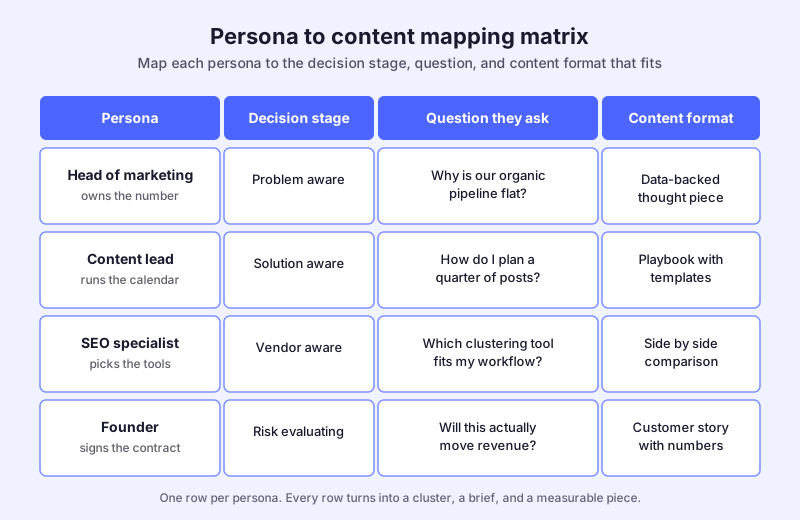
When you stop planning around demographic buckets and start planning around decisions, three good things happen. Your briefs get sharper because every piece has one reader in one state. Your keyword clusters get tighter because every cluster maps to one decision. Your measurement gets honest because you can tell which decisions are converting and which are not.
Building a decision-led persona from scratch
Here is the short version of how to build one that will actually hold up when your team tries to use it on Monday morning.
- List the buying decisions. Interview sales, read ten recent closed-won notes, and write down every discrete decision a buyer makes from first awareness to contract. Aim for five to seven.
- Name the human who owns each one. Not a demographic, a role plus a responsibility. "The marketing ops person who has to make the stack work" beats "Ops Olivia, 29."
- Capture the question in their words. Pull phrasing from sales calls, support tickets, community posts, and Search Console queries. Their language is almost never your marketing language.
- Map each question to a keyword cluster. Group the natural variations of that question into a cluster with one primary term and the supporting long tail around it.
- Choose one content format per cluster. A comparison question gets a comparison post. A "how do I justify this" question gets a customer story with numbers. Match the format to the job the reader is hiring the content to do.
If you cannot complete all five columns for a persona, you do not have a persona yet. You have a hunch. Go do more interviews.
Mapping personas to keywords and content formats
This is where most content plans quietly fall apart. Teams do great persona work, great keyword research, and great editorial planning, and then never connect the three. The persona deck sits on one shared drive, the keyword file sits on another, and the calendar lives in a third place with no line drawn between them.
The fix is to treat the persona, the cluster, and the format as a single object. One row in one sheet. When you are planning a quarter of content, every row starts with the question the reader is asking, continues with the keyword cluster that question maps to, and ends with the specific format you are going to ship. No orphan posts, no orphan personas.
This is also where tooling makes a real difference. Spreadsheets work until you have more than twenty clusters, and then the crosslinking gets ugly. Tools like ClusterMagic let you pull a topic, see the natural keyword clusters behind it, and assign each cluster to a persona and a format in one place, which keeps the three sides of the problem from drifting apart over time.
The point is not the tool, it is the single source of truth. Whatever you use, make sure the persona, the cluster, and the format live together.
A related trap: teams try to cover every persona in every post. That almost never works. A piece that tries to address the IC, the manager, and the VP in the same 1,500 words usually serves none of them well.
Pick one reader per piece. If you need to reach three people for the same decision, write three pieces and link them. Our walkthrough on how to ship a usable content brief your writers will actually follow gets into the single-reader rule in more detail.
Plugging personas into the content calendar
Decision-led personas earn their keep on the editorial calendar. Once each persona has a set of decision-stage questions and a keyword cluster behind each question, the calendar mostly builds itself. You are no longer staring at a blank grid wondering what to publish in week four of next quarter. You are picking which decision to tackle next.
The practical move is to tag every item in the calendar with the persona and the decision stage it serves. At the end of a quarter you can count, by persona, how many problem-aware pieces, how many solution-aware pieces, and how many vendor-evaluation pieces you shipped.
Almost every team finds the counts are wildly uneven, usually heavy on top of funnel for one or two personas and completely empty on everything else. That imbalance is the insight. It tells you exactly where to plan next.
If you are still building the calendar, our guide on how to plan and run an SEO content calendar covers the mechanics of turning persona and cluster data into a week-by-week schedule.
Measuring whether your persona mapping is working
The honest test of buyer persona content mapping is whether, six months in, the pieces tied to a specific persona and decision are actually outperforming the ones that were not. Track it directly.
Two metrics matter more than the rest.
- Assisted conversions by persona. Tag every post with the persona it serves. In GA4 or whatever analytics stack you run, look at how often pieces for each persona show up in conversion paths. If one persona is doing all the work, you have an imbalance worth investigating. A practical walkthrough of the new event model is in the Google Analytics 4 key events documentation.
- Decision-stage coverage. Count published pieces by decision stage for each persona. A healthy ratio is roughly 60 percent problem and solution aware, 30 percent vendor aware, 10 percent risk or justification. Most teams are 95 percent problem aware and nothing else.
Pair those with qualitative signal from sales. Ask the account executives which posts they find themselves sending to prospects most often. The pieces they forward are the pieces doing real work. The pieces they never mention are candidates for retirement or rewrites.
Sales transcript tools are useful here. Pulling question phrasing straight from recorded deal calls is one of the highest-signal moves a content team can make, and the raw material is usually sitting unused in your CRM.
Common mistakes to retire
A few traps show up in almost every persona refresh. They are worth naming so you can avoid them.
- Confusing audience size with revenue. The biggest persona by search volume is often not the one that drives the most pipeline. Weight your effort by revenue potential, not traffic potential.
- Writing for the persona that is easiest to describe. Internal teams gravitate toward the persona they know best, usually their own. That persona is almost never the one with the biggest content gap.
- Letting personas calcify. Buyer behavior shifts every year. A persona set that is three years old is probably three years out of date. Rebuild the decision list annually from fresh sales calls.
- Ignoring the "no-decision" decision. Many of your best prospects do not pick a competitor, they pick no tool at all. Content that addresses "why bother with this at all" often beats content that argues your vendor is best. The status quo is your real competition in most B2B markets, and it rarely shows up on the competitive landscape slide.
If you want a broader structural view of how personas fit into the rest of a content program, our content strategy framework guide walks through the full stack from research to measurement.
What this means for your next planning cycle
The next time your team plans a quarter of content, resist the urge to pull out the old persona deck. Pull five recent sales call transcripts, a list of top-converting pages, and a Search Console export instead. Write down every distinct question a buyer asked in those sources, group them by decision stage, and name the human who owns each decision.
That list is your new persona set. It will be uglier than the PDF you had before, and it will also be the first persona document your writers actually use, because every line on it maps to a real piece of content they can go write this week.
Buyer persona content mapping is an operations exercise, not a branding one. Treat it that way, tie every persona to a decision, a cluster, and a format, and the rest of the content machine gets noticeably easier to run.
Recommended Posts





.svg)