

.svg)
How to Build a Content Strategy That Actually Drives Results | ClusterMagic

The Difference Between a Content Plan and a Content Strategy
Most teams that say they want to learn how to build a content strategy already have a content plan. They know they want to publish two blog posts per week, they have a rough list of topics, and they're producing content consistently. The plan exists.
What they don't have is a strategy: a documented system that explains why those topics, for which audience, organized in what way, to achieve what business outcome. Without that system, the content plan is just a schedule. It can keep a team busy without ever producing compounding organic growth.
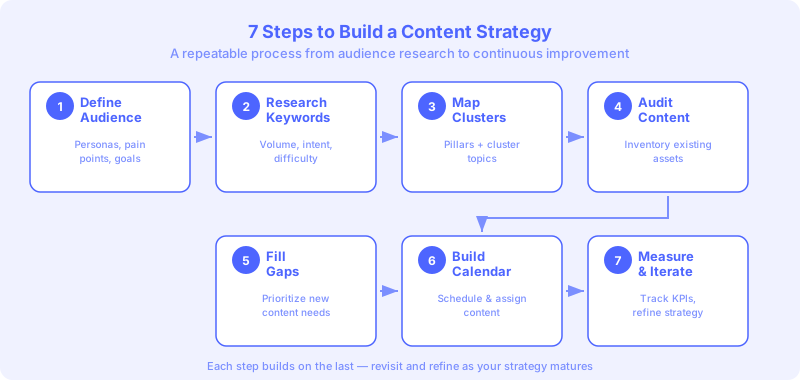
This post is a step-by-step guide to building a real content strategy from scratch. It covers the decisions that need to happen before you write a single brief, and the systems that turn those decisions into a publishing program that builds authority over time.
Step 1: Define Your Audience and the Problems They're Searching For
Every effective content strategy starts with a specific answer to a specific question: who are you writing for, and what are they trying to figure out?
Vague audience definitions produce vague content. For small business content strategy specifically, audience specificity matters even more because you cannot afford to waste cycles on content that misses its target. "Marketing professionals at B2B software companies" is a starting point. "Marketing managers at SaaS companies with 50-200 employees who are trying to build an organic acquisition channel but don't have the budget for a large content team" is a target audience. The specificity matters because it shapes every downstream decision: which keywords you go after, what tone you use, what depth of content you produce, and what outcomes you're optimizing for.
The most reliable way to get specific is to go directly to the questions your audience is already asking. Review your support tickets, sales call notes, community forums, and the "People Also Ask" sections on Google for your target topics. These sources reveal the real questions people have, not the idealized questions a marketing team imagines they have.
Once you understand your audience and their questions, map them to search intent categories. Some questions are informational (I want to understand something), some are commercial investigation (I want to evaluate my options), and some are transactional (I'm ready to act). Knowing which category applies to each question shapes what kind of content you'll write and how you'll measure whether it's working.
Step 2: Research Keywords and Build a Topic Hierarchy
With a clear audience definition, keyword research becomes a focused activity rather than an open-ended list-building exercise. You're looking for the specific terms your audience uses when searching for answers to the questions you identified in step one.
Keyword research for a content strategy is not about finding every relevant keyword. It's about finding the keywords that represent real opportunities for your site given its current authority, and organizing them into a hierarchy that reflects how topics nest inside each other.
Start with your primary topics: the broad subject areas your site wants to be known for. For each primary topic, identify a cluster of related subtopics that answer more specific questions within that space. This hierarchy forms the backbone of your content structure.
For each keyword, note: monthly search volume, keyword difficulty (a proxy for how hard it will be to rank), and search intent. The combination of these three factors tells you how to prioritize. High-relevance keywords with moderate difficulty and clear informational intent are typically where you should start, especially for newer sites that haven't yet built significant domain authority.
The keyword mapping guide covers the mechanics of turning a raw keyword list into an organized hierarchy that maps directly to your content structure. It's worth working through before you move to step three.
Step 3: Map Keywords to a Content Structure
Keywords tell you what to write about. Your content structure tells you how all those pieces relate to each other. The most durable content structure for SEO is the pillar-and-cluster model.
A pillar page is a comprehensive, long-form piece that covers a broad topic in depth. Cluster pages cover specific subtopics within that broad topic in more detail, and they link back to the pillar. The internal link structure between pillar and clusters creates a semantic web that signals topical authority to search engines.
The pillar-and-cluster model works because it mirrors how expertise is organized. A site that has a thorough pillar page on "email marketing" supported by 15 cluster posts on specific subtopics signals to Google that it has genuine depth on the subject. A site with 15 unconnected blog posts on those same subtopics doesn't make the same signal.
Assign each keyword from your research to either a pillar or a cluster post. Broad, high-volume terms with educational intent typically become pillars. Specific, lower-volume terms that address a subset of the broad topic become cluster posts. Some keywords will be cluster posts for one pillar and have their own sub-clusters branching off them. That's fine. Real topic hierarchies are rarely perfectly flat.
For a detailed walkthrough of this structure, content clusters and pillar pages explains how to organize your keywords into a cluster architecture and how to handle edge cases like topics that could belong to multiple clusters.
Step 4: Audit What You Already Have
Building a content strategy from scratch doesn't mean ignoring existing content. If you have any posts, pages, or resources already published, you need to audit them before you start creating new content.
The audit answers three questions. First: does this content cover a keyword in your target hierarchy? If yes, it belongs in your cluster structure and may need updating rather than replacing. Second: is this content cannibalizing a keyword you're also trying to rank for with a different post? If yes, you have a consolidation decision to make. Third: is this content thin, outdated, or off-brand to the point where it's hurting rather than helping your authority signals?
Content that's actively harming your site's authority is worth removing or consolidating, not just leaving in place. Google's evaluation of a site's overall quality affects how well all of its pages perform, not just the pages with quality issues. A handful of very thin or low-quality posts can drag down rankings for your better content.
Once you've audited existing content, you'll have a clearer picture of your real starting point: which cluster positions are already filled (even if imperfectly), which are completely empty, and where your highest-leverage opportunities for quick wins lie. The seo content strategy explainer covers how to integrate audit findings into your overall strategy so you're building on what you have rather than starting from zero.
Step 5: Run a Content Gap Analysis
A content gap analysis identifies the keywords in your target hierarchy that you currently have no content for, as well as topics your competitors are covering that you're missing entirely.
Gap analysis is one of the highest-leverage activities in content strategy planning. It ensures you're building toward coverage of a full topic space rather than deepening coverage in areas where you're already strong while leaving obvious gaps unaddressed.
The basic gap analysis process: for each cluster in your hierarchy, list all the target keywords. Flag each one as covered (you have content targeting it), partially covered (you have content that touches on it but doesn't target it directly), or uncovered (no content at all). The uncovered and partially covered keywords become your content priorities.
Competitive gap analysis adds another layer: look at what your top competitors rank for that you don't. These are topics your target audience is clearly searching for, and someone in your space is already capturing that traffic. Not all competitor topics belong in your strategy, but the ones that align with your audience's questions and your business goals are worth adding to your priority list.
The content gap analysis guide covers the tools and process for running both types of gap analysis efficiently, including how to prioritize the gaps you find rather than trying to fill all of them at once.
Step 6: Build Your Publishing System
Strategy decisions don't produce content. A publishing system does. This is where how to build a content strategy becomes a practical operational question.
Your publishing system includes four components: a content calendar that maps keywords to publish dates, a brief template that gives writers everything they need to produce on-strategy content, a review process that ensures quality and SEO requirements are met before publishing, and a performance tracking system that feeds data back into future planning.
The calendar is where strategy meets execution. It should be organized by cluster and funnel stage, not just by date. When you look at your next four weeks of scheduled content, you should be able to see whether you're filling gaps in specific clusters, whether you have a balanced mix of funnel stages, and whether any posts are updating existing content versus adding new pages.
A content strategy roadmap template helps you map these calendar decisions to quarterly milestones so you can track progress against your strategy. Set a publishing cadence based on your actual production capacity, not an aspirational target. A team that can sustainably produce two high-quality posts per week will outperform a team that sprints to four posts per week for a month and then burns out. Consistency over time is more valuable than short bursts of high volume.
The brief template is the linchpin of a content creation system that produces consistent quality at scale. Every post should start from a brief that specifies the target keyword, search intent, required sections, internal links, target word count, and key questions to answer. Writers who work from complete briefs produce first drafts that need less editorial rework.
Step 7: Track Performance and Iterate
A content strategy that doesn't include a performance feedback loop is a set-and-forget document. Set aside time each month to review how your published content is performing and use that data to update your strategy.
The core metrics to track at the cluster level: organic sessions, keyword ranking positions for target terms, and whether each cluster is gaining, holding, or losing visibility over time. Cluster-level tracking reveals patterns that post-level tracking misses: a cluster that's collectively losing rankings may need a stronger pillar page or better internal linking, not a round of individual post rewrites.
When posts are underperforming, diagnose before you act. Posts that aren't indexed after two weeks may have technical issues. Posts that are indexed but not ranking after 90 days may have keyword difficulty, intent mismatch, or cannibalization problems. Posts that are ranking but not getting clicks may need better title tags and meta descriptions. Each problem has a different fix.
Build updates into your content calendar as scheduled items rather than reactive tasks. A post stuck in positions 8-12 for more than 60 days should automatically get a scheduled refresh. An update to add a new section, incorporate a People Also Ask question, or improve internal linking often moves the post to page one within 30-60 days of being recrawled.
Putting the Strategy Together
Building a content strategy from scratch takes time up front. The audience definition, keyword research, cluster mapping, and gap analysis together might take two to three weeks of focused work before you're ready to start producing content. That investment pays off in a publishing program that produces compounding results rather than random traffic spikes.
The sequence matters. Don't start writing until you've finished the cluster map. Don't build the calendar until you've identified your priority gaps. Don't skip the audit if you have existing content. Each step informs the next, and skipping steps creates gaps in your strategy that you'll end up filling reactively rather than deliberately.
ClusterMagic automates the most time-intensive parts of this process. It maps your existing content to a cluster structure, runs the gap analysis against your keyword targets, and generates briefs for priority gaps. If you're starting from scratch or rebuilding a program that hasn't produced results, book a walkthrough and we'll show you how the process works with your specific topics and goals.
Sources:
Recommended Posts





.svg)