

.svg)
What Is an SEO Content Strategy? (And How to Build One That Works) | ClusterMagic

What Is an SEO Content Strategy? (And How to Build One That Works)
Most marketing teams that publish content regularly still struggle to grow organic traffic. They have a content calendar. They write consistently. They cover topics their audience cares about. And yet, their search rankings stay flat. The issue is almost never effort. It's almost always the absence of a real SEO content strategy.
This post explains what an SEO content strategy actually is, why most content programs fail the SEO test, and how to build one that compounds over time. If you've been treating SEO as something you bolt onto content after it's written, this will reframe how you think about the whole system.
What an SEO Content Strategy Actually Is
An SEO content strategy is a documented plan that connects what you publish to what people search for, organized in a way that builds your site's authority on specific topics over time. It is not a content calendar. It is not a keyword list. It is not "posting consistently."
A content calendar tells you when to publish. A keyword list tells you what terms you want to rank for. An SEO content strategy explains how all your content works together to signal topical authority to search engines, satisfy search intent at each funnel stage, and move people toward a business outcome.
The key structural element is the topic cluster. Instead of publishing individual posts on loosely related subjects, an SEO content strategy organizes content into clusters: a comprehensive pillar page on a broad topic, supported by a set of in-depth posts on specific subtopics. Every post links back to the pillar. The cluster as a whole tells search engines you have deep, credible coverage of a subject, not just one good page.
The difference matters because Google has been explicit in its guidance that it rewards helpful content that demonstrates expertise and depth. Publishing thirty unconnected posts on thirty different topics is the opposite of what that guidance rewards.
Why Most Content Strategies Fail the SEO Test
Content teams fail at SEO for predictable reasons. Understanding them makes it easier to avoid them.
No search intent mapping. Every keyword has an intent behind it: the searcher is trying to learn something, compare options, or complete a transaction. Content that doesn't match that intent won't rank, regardless of how well it's written. A guide written for a keyword where searchers want a comparison page won't satisfy the query, and Google knows it.
Publishing in isolation. Each post is researched and written as a standalone piece. There's no cluster structure, no internal linking plan, and no deliberate effort to connect the dots between posts. From a search engine's perspective, the site looks like a collection of unrelated documents, not a coherent body of expertise.
Chasing volume over intent alignment. Targeting high-volume keywords without considering competition level, intent fit, or topical relevance leads to content that gets no traction. A well-placed piece targeting a lower-volume, high-intent keyword will almost always outperform a poorly-positioned piece targeting a head term.
No topical focus. Covering five industries, three product types, and a dozen unrelated topics signals to search engines that a site has no expertise in any particular area. Depth beats breadth in modern SEO. The teams that pick a tight topical territory and cover it thoroughly almost always outperform those that try to cover everything.
Ahrefs' research on content decay shows that most content loses organic traffic within 18 months without updates or structural support. A strategy that doesn't account for this will require ongoing damage control instead of compounding gains.
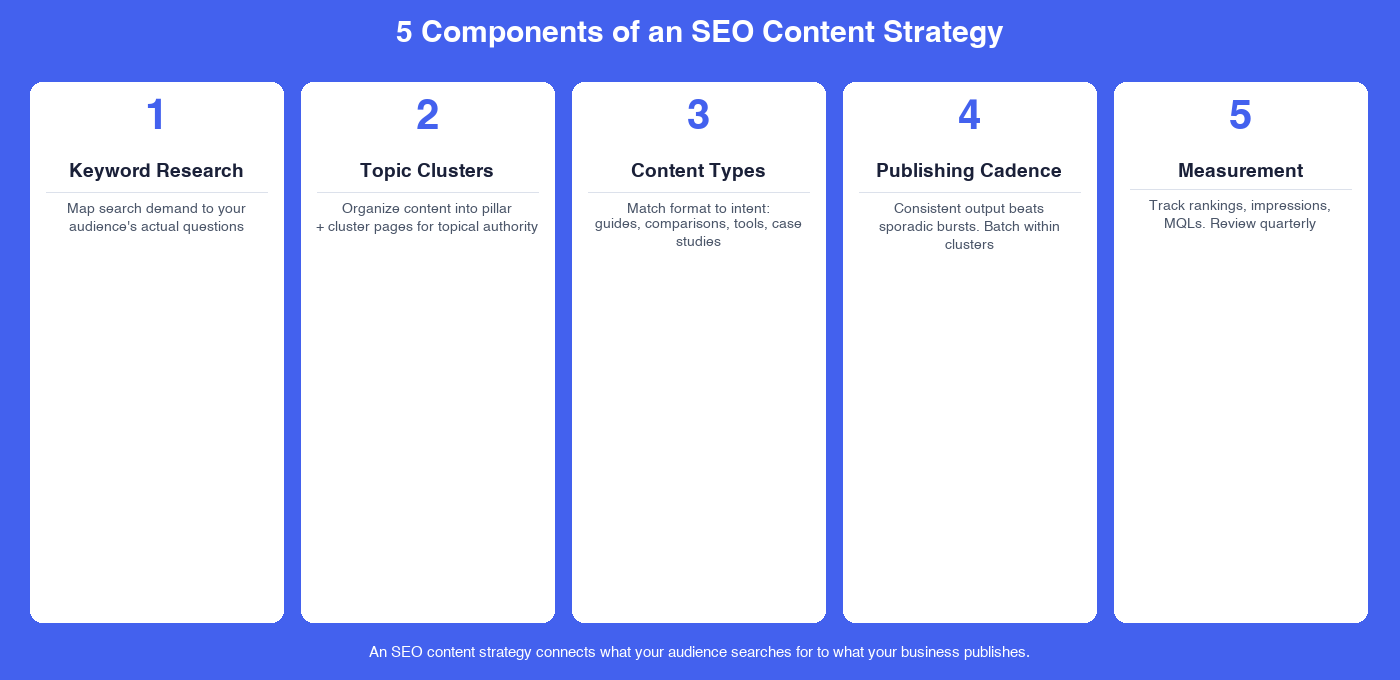
The 5 Components of an SEO Content Strategy
A functional SEO content strategy has five parts. Each one connects to the others.
1. Keyword Research
Keyword research for SEO content strategy isn't about finding the highest-volume terms you can target. It's about mapping the full territory of what your audience searches for and identifying where you can compete. For each topic cluster, you need a primary keyword for the pillar page (broad, higher volume, more competitive) and a set of supporting keywords for cluster posts (more specific, lower competition, clearer intent).
Tools like Semrush and Ahrefs are the standard options. For a broader view of the landscape, the SEO fundamentals for marketers guide covers how keyword research connects to the other foundational SEO disciplines. What matters is that every keyword gets mapped to a specific piece of content before you write anything, so there's no cannibalization (two posts fighting for the same term) and no orphaned content (posts targeting terms that don't fit any cluster).
2. Topic Clusters
Topic clusters are the structural backbone of an SEO content strategy. A cluster consists of one pillar page (a comprehensive guide to a broad topic) and a set of supporting posts (each covering a specific aspect of that topic in depth). Every supporting post links to the pillar. The pillar links to the supporting posts.
This architecture does three things: it tells search engines that your site has authoritative, thorough coverage of a subject; it distributes link equity across the cluster so more pages rank; and it gives users a logical path through your content. The content clusters framework explains the mechanics in more detail if you're building your first cluster.
3. Content Types
Not all content serves the same purpose. An SEO content strategy defines which formats you'll use and when. Blog posts are the most common, but the strategy should also account for comparison pages, glossary entries, FAQ pages, and long-form guides. Each type serves different keyword intents and different funnel stages.
Matching content type to search intent is not optional. If searchers for a term want a quick definition, a 3,000-word deep-dive won't rank. If they want a detailed comparison, a short overview will fall short. The format should follow from the intent, not from what's easiest to produce.
4. Publishing Cadence
Consistency matters for SEO, but the right cadence depends on your resources and cluster priorities. It's better to publish two well-researched, properly briefed posts per month than eight thin pieces. Batch publishing within clusters, publishing all supporting posts for a cluster in a defined window, sends a stronger topical signal than spreading them out over a year.
Moz's research on content velocity shows diminishing returns from raw publishing volume without quality and structure. Set a cadence your team can sustain and build in quarterly reviews to adjust based on what's working.
5. Measurement
An SEO content strategy is only as good as your ability to tell whether it's working. The right measurement framework tracks both leading indicators (signs that the strategy is building momentum) and lagging indicators (evidence that it's producing outcomes).
Leading indicators include organic impressions via Google Search Console, average keyword position trends, and crawl coverage. Lagging indicators include organic traffic growth, keyword rankings in the top 10, and conversions from organic search. Tracking at the cluster level, not just the post level, gives a much clearer picture of whether the structure is working.
How to Align Content with Search Intent at Each Funnel Stage
Search intent maps directly onto the marketing funnel. Most SEO content strategies concentrate on top-of-funnel informational content and neglect the middle and bottom, where purchase decisions actually happen.
Top of funnel content targets informational queries. Searchers are trying to understand something: "what is topical authority," "how does content marketing work," "what is a content cluster." The goal is to attract a broad audience and establish credibility.
Middle of funnel content targets commercial investigation queries. Searchers are comparing options: "best B2B content agencies," "content strategy frameworks," "Ahrefs vs. Semrush." The goal is to be present when buyers are evaluating whether your category of solution applies to their problem.
Bottom of funnel content targets transactional or high-intent queries. Searchers are close to a decision: "[product name] pricing," "[product name] vs. [competitor]," "hire content marketing agency." The goal is to capture buyers who are ready to act.
A complete SEO content strategy has content at all three stages. Teams that only publish top-of-funnel content generate traffic but not pipeline. Teams that only publish bottom-of-funnel content miss the buyers who haven't yet decided they need what you sell.
The Role of Topical Authority
Topical authority is what happens when a site has deep, comprehensive coverage of a specific subject area. It's the cumulative signal that search engines use to determine whether a site's content deserves to rank broadly on a topic, not just for one well-optimized page.
Topical authority is built through clusters, not individual posts. One excellent article on content strategy doesn't make your site an authority on content strategy. A pillar page plus eight to twelve cluster posts, all well-researched and properly interlinked, starts to make that case. Add original research, external links, and time, and it compounds.
For deeper execution on this, the blog content strategy guide covers how to sequence cluster builds and manage publishing cadence to accelerate authority development.
How to Know If Your SEO Content Strategy Is Working
One of the most common frustrations with content SEO is that it takes time. Most well-executed strategies start showing meaningful movement between three and six months in, with more pronounced compounding after 12 months. Knowing what to look for in the early stages prevents teams from abandoning strategies that are actually working.
Leading indicators to watch in months one through three:
- Google is crawling and indexing new content quickly (check via Google Search Console's URL inspection)
- Impressions are growing for target keywords, even if clicks are still low
- Posts are appearing in position 20 to 50 for their target terms, showing they're indexed and relevant
Lagging indicators to watch after month six:
- Organic traffic growing month-over-month at the cluster level
- Two to three posts per cluster moving into the top 10 for their target keywords
- Organic-sourced leads or conversions trending upward
If impressions are growing but clicks aren't, the issue is usually title and meta description optimization. If posts aren't appearing at all for their target keywords, the issue is usually topical authority (the cluster isn't built out enough to signal relevance) or technical SEO (crawlability or indexation problems).
An SEO content strategy is a long game, but it's one of the few marketing channels that builds genuine compounding value. Every post that ranks generates traffic without ongoing ad spend. Every cluster that earns topical authority makes it easier for subsequent content to rank faster. The teams that build the system correctly and then run it consistently are the ones that eventually dominate organic search in their category.
If you want to learn more about having that system built and run for you, ClusterMagic handles the research, cluster architecture, content production, and publishing.
Recommended Posts





.svg)