

.svg)
SEO Fundamentals: A Plain-English Guide for Marketers (2026) | ClusterMagic

If you work in marketing and SEO still feels like a black box controlled by developers and consultants, you're not alone. The industry has a habit of wrapping straightforward concepts in jargon, making the whole discipline seem more complicated than it needs to be.
The truth is that SEO best practices haven't fundamentally changed in their core logic since search engines existed: make your website easy for search engines to find, understand, and trust. The specific tactics evolve, but the principles are stable. This guide translates those principles into language that doesn't require a computer science background.
We're skipping the origin story of Google and the history of algorithm updates. If you want the conceptual foundation of how search engines work, the what is a search engine guide covers that. This guide focuses on what you, as a marketer, need to understand and do in 2026 to make SEO work for your business.
The Three Pillars of SEO
Every SEO activity falls into one of three categories. Understanding these categories helps you prioritize and communicate with specialists, even if you never touch a line of code.
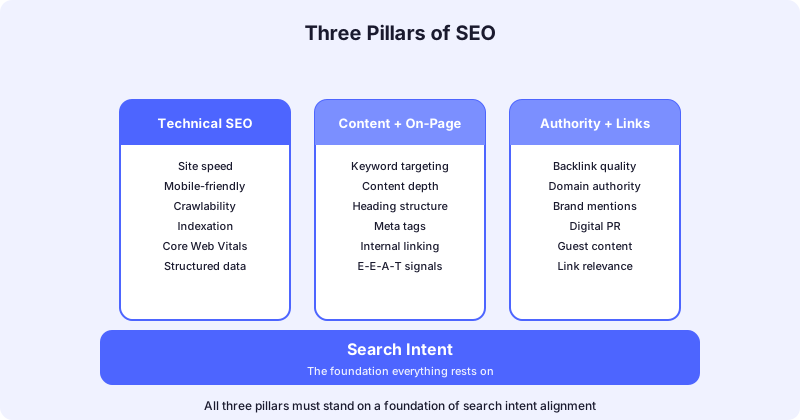
Pillar 1: Technical SEO
Technical SEO ensures search engines can access, crawl, and index your website properly. Think of it as the infrastructure that makes everything else possible. If Google can't crawl your site, nothing else matters.
What marketers need to know about technical SEO:
Site speed directly affects rankings and user experience. Google's Core Web Vitals set specific thresholds: pages should load their largest visible element within 2.5 seconds, respond to user interaction within 200 milliseconds, and remain visually stable during loading. According to First Page Sage's 2026 SEO analysis, only about half of websites currently meet all Core Web Vitals thresholds. Those that improve from "poor" to "good" report significant conversion rate increases.
Mobile-first indexing means Google primarily uses the mobile version of your site for ranking decisions. If your content looks different on mobile (hidden sections, collapsed menus, different layouts), that mobile version is what Google evaluates. Your mobile experience is your SEO experience.
Crawlability means search engines can find and follow links to every page you want indexed. Common issues include pages blocked by robots.txt, orphan pages with no internal links, and JavaScript-rendered content that Googlebot can't process. Google's Search Console URL inspection tool lets you check whether specific pages are indexed and identify any issues.
Structured data (also called schema markup) helps search engines understand what your content is about and display rich results (star ratings, FAQ dropdowns, how-to steps). It doesn't directly boost rankings, but it improves click-through rates by making your search listing more informative and visually prominent.
As a marketer, you don't need to implement technical SEO yourself. You need to understand what it is, why it matters, and how to check whether your site has problems. Free tools like Google PageSpeed Insights and Google Search Console give you that visibility without requiring developer skills.
Pillar 2: Content and On-Page SEO
Content is where marketers spend most of their SEO effort, and for good reason. Content is the vehicle that carries your expertise to the people searching for it.
Search intent is the most important concept in content SEO. Every query has an intent: the searcher either wants to learn something, compare options, buy something, or find a specific page. Your content must match that intent. A blog post can't rank for a transactional keyword, and a product page can't rank for an educational one.
Keyword research identifies the specific phrases your audience types into search engines. This isn't about finding the highest-volume keyword. It's about finding keywords where the searcher's need aligns with what your business offers. The keyword mapping guide walks through the process of assigning keywords to pages so each page has a clear purpose.
On-page optimization refers to the elements you control on each individual page:
- Title tag: The clickable headline in search results. Keep it under 60 characters with your primary keyword near the beginning. This is the single most important on-page element.
- Meta description: The text below the title in search results. It doesn't affect rankings directly but influences whether someone clicks. Write 150-160 characters that sell the click.
- Headers (H2, H3): Structure your content with descriptive headings that help readers scan and help search engines understand your page structure. Include your primary keyword in at least one H2.
- Body content: Write for your reader, not for an algorithm. Cover the topic thoroughly. Use your target keyword naturally. Google's language models understand context and synonyms, so keyword stuffing does more harm than good.
- Internal links: Link to other relevant pages on your site. This helps search engines discover your content and understand how topics relate to each other. The internal linking guide covers implementation in detail.
For a complete page-level checklist covering every on-page element before you hit publish, the SEO best practices checklist provides a structured reference you can apply to every new page.
The E-E-A-T framework (Experience, Expertise, Authoritativeness, Trustworthiness) reflects how Google evaluates content quality. Google's quality rater guidelines make clear that content demonstrating first-hand experience and genuine expertise earns more trust from ranking systems. In practical terms: include author bios, cite specific sources, share insights from direct experience, and keep content accurate and current.
Pillar 3: Authority and Links
Authority is how search engines measure whether your site deserves to rank for competitive queries. The primary signal for authority is backlinks: links from other websites pointing to yours.
Not all links are created equal. One link from a respected industry publication is worth more than a hundred links from random blog comments. Quality, relevance, and the linking site's own authority all factor into how much value a link passes.
How marketers build authority without a link building team:
Create content worth citing. Original research, unique data, and comprehensive guides naturally attract links because other writers reference them. If your content says the same thing as every other article on the topic, there's no reason for anyone to link to you specifically.
Contribute expert commentary. Industry publications, podcasts, and roundup articles often feature quotes from practitioners. These contributions typically include a link back to your site and establish your name in the space.
Build relationships, not link schemes. Exchanging links with unrelated sites, buying links, or participating in link networks violates Google's guidelines and risks penalties. Modern link building is about creating genuine value and genuine professional relationships. The focus has shifted from chasing volume to earning mentions from credible sources.
Internal linking is the authority lever you control completely. When you link from one page on your site to another, you pass relevance signals and help search engines understand your site's topic structure. A well-linked site doesn't just help individual pages rank. It builds domain-wide topical authority.
SEO Best Practices: What to Do First
If you're starting from scratch or cleaning up a neglected site, here's the order that delivers the most impact per hour invested.
Step 1: Fix the Technical Foundation (Week 1-2)
Run your site through Google PageSpeed Insights and fix anything flagged as critical. Set up Google Search Console if you haven't already. Check the Coverage report for indexing errors. These are often quick fixes (broken links, misconfigured redirects, missing pages) that remove obstacles to ranking.
Step 2: Research and Map Your Keywords (Week 2-3)
Identify 20-30 keywords that represent the searches your ideal customers are making. Group them by topic and intent. Assign each keyword to a specific page on your site, creating new pages where gaps exist. This keyword map becomes the foundation of your content plan.
Step 3: Optimize Your Most Important Pages (Week 3-4)
Start with the pages closest to revenue: your service pages, product pages, and comparison content. For each page, confirm the title tag, meta description, heading structure, and content match the target keyword's intent. Add internal links to and from these pages.
Step 4: Build Your Content Clusters (Month 2+)
Expand from your optimized core pages into supporting content. Each cluster should have a comprehensive pillar page and 6-12 focused cluster pages that cover subtopics in depth. Publish consistently and link everything together. For the full strategy behind content clusters and topical authority, the dedicated guides cover the methodology.
Step 5: Earn and Monitor Backlinks (Ongoing)
Create content that naturally earns links: original data, tools, comprehensive guides, and expert analysis. Monitor your backlink profile quarterly using a tool like Ahrefs or Semrush. Disavow any spammy links that appear.
Common SEO Mistakes Marketers Make
Optimizing for Keywords Nobody Searches
Just because a phrase describes your product doesn't mean anyone searches for it. Internal jargon and brand-specific terminology often have zero search volume. Always validate keywords with actual search data before building content around them.
Targeting Keywords That Are Too Competitive
A small B2B company trying to rank for "CRM software" is competing against Salesforce, HubSpot, and a dozen venture-backed review sites. Target keywords where you can realistically reach page one within 6-12 months. Keyword difficulty scores in SEO tools give a rough estimate, but the most reliable check is examining who currently ranks and whether your site can credibly compete.
Publishing Without a Structure
Individual blog posts published without an overarching topic strategy create a scattered site that search engines struggle to interpret. Every post should belong to a topic cluster, link to its pillar page, and serve a defined purpose in your keyword map.
Ignoring Technical Issues
A beautiful blog post can't rank if the page takes 8 seconds to load, isn't mobile-responsive, or is accidentally blocked from indexing. Technical issues are silent killers. Check Search Console monthly for crawl errors, mobile usability issues, and Core Web Vitals problems.
Treating SEO as a One-Time Project
SEO is a system, not a project. Rankings are not permanent. Competitors publish new content. Search algorithms update (Google rolled out 12 confirmed algorithm updates between 2024 and 2025). Content ages. Links decay. Teams that treat SEO as an ongoing investment consistently outperform those that treat it as a one-time setup.
How SEO Connects to Your Broader Marketing Strategy
SEO doesn't exist in isolation. It amplifies other marketing channels and benefits from them.
Content marketing and SEO are the same effort. The content you create for SEO purposes (guides, tutorials, comparisons) is also the content that fuels your email marketing, social media, and sales enablement. A strong content program doesn't need separate "SEO content" and "marketing content." It needs content that serves both.
Paid search data informs SEO priorities. If you're running Google Ads, you already have data on which keywords convert. Use that data to prioritize your organic keyword targets. Keywords with proven conversion rates deserve organic investment.
Brand awareness accelerates SEO results. Branded searches, direct traffic, and social mentions all send positive signals to search engines. A well-known brand earns more clicks in search results, which reinforces rankings. SEO and brand marketing compound each other.
What Changes in SEO (and What Doesn't)
Google's algorithm changes constantly. Specific ranking signals rise and fall. New SERP features appear. AI Overviews now show up on most searches, drawing from organically ranked pages.
What doesn't change: Search engines reward content that genuinely helps the searcher. Pages that load fast, answer questions directly, and demonstrate real expertise have always ranked well and will continue to. The specifics of how Google measures those qualities evolve, but the underlying principle remains constant.
What has changed in 2026: AI search visibility now layers on top of traditional rankings. The good news, based on Sitebulb's expert analysis, is that pages ranking in the top 20 organically are overwhelmingly the ones cited in AI Overviews. Traditional SEO is the prerequisite for AI search visibility, not a separate discipline.
If you focus on the fundamentals covered in this guide (technical health, intent-aligned content, topical authority, and earned links) the algorithm updates will be adjustments to your approach, not existential threats.
If you want help building an SEO strategy grounded in these fundamentals, book a strategy call with ClusterMagic to see how a cluster-based content program turns SEO best practices into compounding organic growth.
Recommended Posts





.svg)