

.svg)
How to Build a Content Strategy Roadmap (With Free Template) (2026) | ClusterMagic

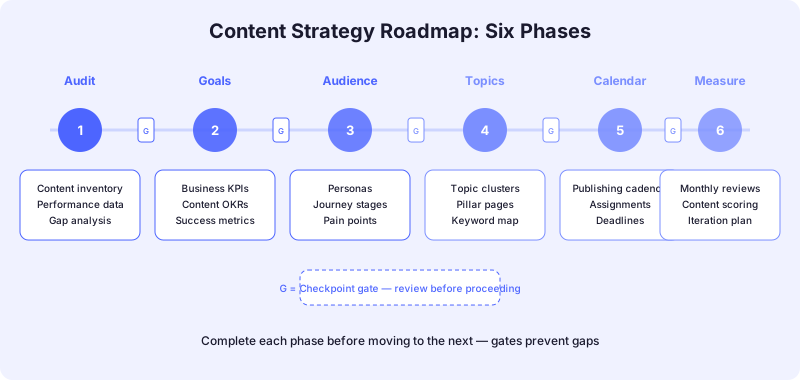
A content strategy roadmap turns vague publishing intentions into a structured plan that connects business goals to specific content actions. Without one, content teams default to reactive publishing: writing whatever seems urgent this week, chasing trending topics without a system, and wondering six months later why traffic has not moved.
The roadmap is the document that answers every strategic question before writing begins. Which topics will you cover? In what order? How do they connect to each other? What does success look like at 30, 60, and 90 days? According to Content Marketing Institute's 2025 B2B research, only 22% of marketers rate their content marketing as very successful, and the primary gap cited is the lack of clear goals. A content planning roadmap eliminates that gap.
This tutorial walks through six phases for building a content strategy roadmap from scratch. Each phase includes what to do, why it matters, and how to document it. If you want us to build this for your team, schedule a roadmap session and we will have a working plan within two weeks.
Phase 1: Audit Your Existing Content
You cannot plan forward without knowing where you stand. The content audit is the foundation of every effective content strategy roadmap, and skipping it is the most common reason roadmaps fail.
Start by cataloging everything you have published. Pull every blog post, landing page, and resource into a spreadsheet. For each piece, record the URL, target keyword, current ranking position, monthly organic traffic, and publish date. Tools like Semrush's content audit feature and Google Search Console make this data accessible without manual checking.
Next, categorize each piece by performance tier:
- Performing well. Ranking on page one, generating consistent traffic. These posts need monitoring, not rewriting.
- Within striking distance. Ranking on positions 4-20. These are your highest-ROI opportunities because a targeted update can push them onto page one.
- Underperforming. Low traffic, low rankings, or targeting keywords you have moved away from. Decide whether to update, consolidate, or remove.
- Missing. Topics your audience searches for that you have not covered. These become priority items in your roadmap.
The content gap analysis guide walks through this categorization process in detail. The audit typically reveals that 30-40% of a site's content needs updating rather than replacement, which reshapes the roadmap's balance between new content and content refreshes.
Phase 2: Set Measurable Goals Tied to Business Outcomes
Content goals that sound like "increase brand awareness" or "establish thought leadership" are impossible to measure and impossible to plan against. Your content strategy roadmap needs goals with numbers, timelines, and clear ownership.
Effective content roadmap goals follow this structure: metric, target, timeframe. For example:
- Increase organic blog traffic from 8,000 to 15,000 monthly sessions within 6 months
- Generate 50 marketing-qualified leads per month from content by Q3
- Achieve page-one rankings for 12 priority keywords within 9 months
- Reduce average cost per published post from $400 to $250 through workflow improvements
Each goal should connect to a business outcome, not a vanity metric. Traffic without conversion context is meaningless. Rankings without revenue attribution are incomplete. The content marketing ROI measurement guide covers how to tie content metrics directly to revenue.
Limit yourself to three to five primary goals. More than five creates competing priorities that diffuse the team's focus across too many initiatives.
Phase 3: Define Your Audience With Search Behavior Data
Audience personas built from demographics alone miss the information that actually shapes a content roadmap. You need to understand what your audience searches for, what format they prefer, and what stage of the buying journey each query represents.
Start with your keyword data. Group your target keywords by search intent:
- Informational. The searcher wants to learn something. "What is topical authority" or "how to build a content strategy." These are top-of-funnel awareness topics.
- Commercial investigation. The searcher is evaluating options. "Best content marketing tools" or "SEO agency vs in-house." These are mid-funnel comparison topics.
- Transactional. The searcher is ready to act. "Content marketing services pricing" or "hire SEO content writer." These are bottom-of-funnel conversion topics.
Your roadmap needs content at every stage. The ratio depends on your current funnel. If you have strong bottom-of-funnel content but no top-of-funnel visibility, your roadmap should weight informational content heavily in the first quarter. The SEO content strategy framework provides a detailed model for mapping content to funnel stages.
Ahrefs' keyword research guide is a useful resource for identifying the specific queries your audience uses at each stage.
Phase 4: Build Your Topic Architecture
This is where the roadmap gets structural. Topic architecture determines which pillar topics you will own, which supporting posts build authority around each pillar, and how everything connects through internal links.
Map your pillars first. A pillar topic is a broad subject area where you want to be the definitive resource. For a content marketing SaaS, pillars might include "content strategy," "SEO fundamentals," "content production," and "content analytics." Each pillar will have a comprehensive pillar page supported by 8-15 cluster posts.
For each pillar, identify the cluster posts needed:
- Posts that answer specific questions within the pillar topic
- Posts that compare approaches or tools relevant to the pillar
- Posts that provide templates, frameworks, or step-by-step tutorials
- Posts that cover industry-specific applications of the pillar topic
The content clusters and pillar pages guide covers the structural mechanics of this architecture. Every post in your roadmap should belong to a cluster. Orphan posts that do not connect to a pillar dilute your topical authority instead of building it.
Document the architecture in a visual map showing pillar pages at the center with cluster posts radiating outward. This becomes the strategic layer of your roadmap, determining which posts to prioritize and in what order to publish them.
Phase 5: Create the Publishing Calendar
The publishing calendar translates your topic architecture into a week-by-week schedule. This is where strategy meets execution.
Start by setting your publishing cadence. Be realistic about your team's capacity. Two high-quality posts per week consistently beats five mediocre posts followed by two weeks of silence. According to Brafton's content roadmap research, a sustainable cadence for small teams is one flagship piece per month, one to two supporting posts per week, and one conversion asset per quarter.
Sequence your calendar around clusters, not random topics. When building authority in a cluster, publish the pillar page first, then release supporting posts over the following weeks. Each new cluster post should link back to the pillar and to previously published cluster posts. This sequencing creates a compounding authority signal that random publishing cannot match.
Your calendar should include for each entry:
- Publish date
- Post title and slug
- Target keyword and cluster assignment
- Content format (guide, listicle, tutorial, comparison)
- Funnel stage
- Brief deadline and assigned writer
- Internal linking targets
The SEO content calendar guide has a working template that integrates these fields. Build the calendar in 90-day blocks so you can adjust quarterly based on performance data without overhauling the entire roadmap.
Phase 6: Define Measurement Checkpoints
A roadmap without measurement checkpoints is just a publishing schedule. Build in monthly and quarterly reviews that evaluate whether the roadmap is producing the results defined in Phase 2.
Monthly review (30 minutes):
- Are posts being published on schedule?
- What is the indexation rate for new posts?
- Are "striking distance" posts improving after updates?
- Are any clusters showing early ranking movement?
Quarterly review (2 hours):
- Compare current organic traffic to roadmap goals
- Evaluate which clusters are building authority fastest
- Identify topics that underperformed expectations and diagnose why
- Adjust the next quarter's calendar based on findings
The quarterly review is where you restructure. If a cluster is gaining traction faster than expected, accelerate it by adding more supporting posts. If a topic area is not moving despite strong content, investigate whether the problem is technical, competitive, or intent-related.
CoSchedule's content roadmap framework offers additional measurement templates if you need a starting structure.
The Template: Putting It All Together
Here is the content strategy roadmap template structure that integrates all six phases into a single working document:
Section 1: Current State Summary
- Content audit findings (performing, striking distance, underperforming, missing)
- Traffic and ranking baselines
- Competitive landscape overview
Section 2: Goals and Success Metrics
- Three to five measurable goals with timelines
- KPIs for each goal
- Reporting cadence
Section 3: Audience and Intent Map
- Target audience segments with search behavior data
- Keyword groups by intent stage
- Content format preferences per segment
Section 4: Topic Architecture
- Pillar topics with cluster maps
- Internal linking structure
- Priority ranking by business impact and keyword difficulty
Section 5: 90-Day Publishing Calendar
- Week-by-week schedule with all fields populated
- Brief deadlines and assignments
- Cluster sequencing plan
Section 6: Measurement Framework
- Monthly review checklist
- Quarterly review agenda
- Decision criteria for roadmap adjustments
This template works for teams of any size. A solo content marketer uses the same structure as a ten-person team. The difference is cadence and volume, not the strategic framework.
The content strategy template guide provides a downloadable version of this framework if you want to start filling it in immediately.
Build the Roadmap Before You Build the Content
The content strategy roadmap is not an overhead exercise. It is the single document that prevents your team from wasting time on content that does not connect to business outcomes, does not build topical authority, and does not compound over time.
Every hour spent on the roadmap saves multiple hours of unfocused production later. Teams that plan in 90-day blocks, publish in clusters, and measure monthly outperform teams that publish reactively by a significant margin.
If building the roadmap feels like more planning than your team can take on right now, book a session and we will build it with you. The roadmap is the starting point. The content that follows is where the growth happens.
Recommended Posts





.svg)