

.svg)
Content Strategy Template: A Free Framework That Actually Works | ClusterMagic
A content strategy template is not a spreadsheet of blog post ideas. It is a structured framework that connects your business goals to your content decisions, your audience to your topics, and your publishing calendar to measurable outcomes. Most teams skip the strategy layer and go straight to producing content, which is why so many content programs generate traffic that never converts and posts that rank for keywords nobody on the buying team actually searches.
This guide gives you a free content strategy template you can use immediately, with an explanation of what belongs in each section and why it matters. Whether you are starting from scratch or formalizing a process that has been running on instinct, this framework gives you the structure to make content decisions that compound over time.
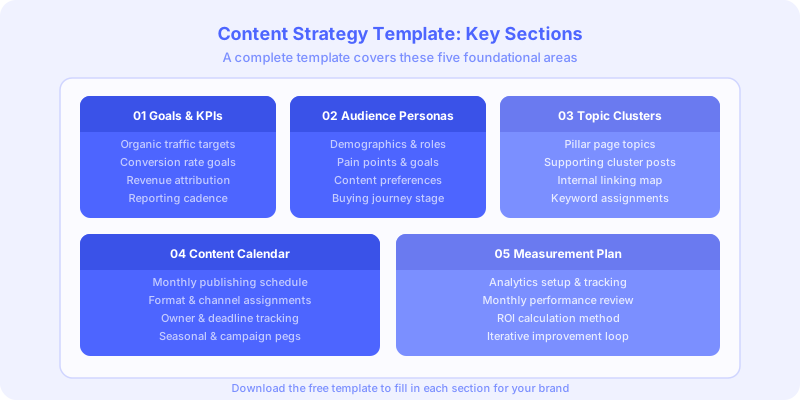
What a Content Strategy Template Should Include
Before filling in any template, understand what it is actually for. A content strategy template documents the thinking behind your content program so that everyone who touches it, from writers to executives, operates with the same priorities. It answers: who are we creating for, what problems do we help them solve, which topics do we own, and how do we know if it is working?
A complete content strategy template covers six sections: business goals and content's role in achieving them, audience definition and intent mapping, content pillars and keyword clusters, channel and format decisions, editorial calendar structure, and KPIs with measurement cadence. For a more detailed breakdown of the strategy layer that feeds this template, the content strategy framework guide covers each component in depth. Skip any of these sections and your strategy has a gap that will show up later as wasted effort or misaligned content.
The template below is designed to be filled in over a focused two-hour working session, not a week-long project. The goal is a working document you can act on immediately, not a polished presentation that sits in a folder.
Section 1: Business Goals and Content's Role
Start by writing down the two or three business outcomes your content program is supposed to support. Common examples: generate qualified inbound leads, shorten the sales cycle by educating prospects before they reach a sales call, reduce support ticket volume by answering common questions in public content, or build brand recognition in a new market segment.
For each goal, write one sentence that describes specifically how content contributes. "We publish SEO-optimized comparison content so that buyers researching our category find us before they find competitors" is specific enough to make content decisions against. "We want to build brand awareness" is not.
This section becomes your decision filter. When someone requests a content piece that does not connect to any of these goals, the template gives you a principled reason to decline or deprioritize it. Without documented goals, every content request looks equally valid.
Section 2: Audience Definition and Intent Mapping
Define your audience in terms of the problems they are actively trying to solve, not just their job title and company size. Job titles tell you who they are. Problems tell you what they need from your content. A content marketing manager at a 50-person SaaS company is not an audience; "a marketing manager trying to scale content output without hiring more writers" is.
For each audience segment, map their intent across the stages of awareness: unaware of the problem, aware of the problem but not the solution category, evaluating solution options, and comparing specific vendors. Your content program needs to serve all of these stages, with different content types and keyword targets for each.
Pair this with keyword research that reflects how each segment actually searches. Connect this audience map to your blog content strategy so your editorial decisions trace back to documented audience needs rather than gut feel.
Section 3: Content Pillars and Keyword Clusters
Content pillars are the three to five topic areas where your brand has genuine expertise and where your target audience has documented search demand. Each pillar becomes a hub for a cluster of related posts, all of which link back to a central pillar page and to each other.
For each pillar, document: the central topic and its primary keyword, the pillar page URL, and a list of supporting cluster topics with their target keywords. This is where content clusters architecture meets your content strategy template. The cluster map turns your pillars from abstract topic areas into a concrete production roadmap.
Limit your active pillars to three to five. Trying to build authority in eight topic areas simultaneously produces shallow coverage everywhere rather than deep authority anywhere. Choose the pillars where the intersection of search demand, audience relevance, and your team's expertise is strongest.
Section 4: Channel and Format Decisions
Document which channels you publish to, which content formats you use on each channel, and the primary purpose each channel serves. A blog post serves organic search. A LinkedIn newsletter serves direct audience engagement. A YouTube tutorial serves discovery and product education. Each channel has different format requirements and different audience expectations.
Also document what you are not doing. Explicitly deciding not to publish short-form video this quarter because your team lacks the production capacity is a better decision than simply not doing it by default. Documented channel decisions prevent scope creep and give you a clear answer when someone asks why you are not on a new platform.
Align your channel decisions with your seo content strategy to make sure the channels you invest in contribute to your organic search goals, not just social vanity metrics.
Section 5: The Editorial Calendar Structure
Your editorial calendar translates strategy into scheduled work. It should include at minimum: the post topic and primary keyword, the content pillar it belongs to, the target publication date, the assigned writer, and the status in your workflow (briefed, in progress, in review, scheduled, published).
Build your calendar around your content clusters, not around a random mix of topics. If you are publishing three posts per week, one common approach is to publish one new pillar-level post, one supporting cluster post, and one post refreshing existing content. This balance advances your topical authority, fills cluster gaps, and keeps your existing rankings from decaying.
A realistic editorial calendar accounts for your team's actual capacity. Use your content brief template to standardize the inputs so writers can produce more efficiently. A calendar built around over-optimistic output estimates produces missed deadlines and demoralized teams. Start with what you can consistently deliver and increase velocity once the system is running smoothly.
Section 6: KPIs and Measurement Cadence
Define in advance which metrics indicate whether your content strategy is working. Match your KPIs to your goals: if your goal is inbound lead generation, your primary content KPI is content-attributed leads or demo requests, not page views. Page views are a leading indicator, but they do not confirm that content is actually supporting the business goal.
A practical KPI set for most content programs: organic sessions (monthly), keyword ranking positions for target cluster keywords (monthly), content-attributed leads or pipeline (monthly), keyword footprint growth in Google Search Console (quarterly), and content piece performance by cohort (quarterly, measuring traffic trajectory for posts published in a given quarter). The content strategy roadmap template provides a timeline view that ties these KPIs to specific milestones. For connecting strategy KPIs to financial outcomes, the content strategy ROI measurement guide covers the full attribution path.
Review your KPIs on a defined cadence and tie them back to your goals section. A quarterly review asks whether your content program advanced the business goals you documented in Section 1. A monthly review monitors the leading indicators that predict whether you are on track. Both reviews should result in documented decisions: what to continue, what to change, and what to stop.
Putting the Template to Work
A content strategy template is only as useful as the discipline with which you maintain it. The most common failure mode is building a thorough strategy document in January and never updating it. Treat your template as a living document: update the editorial calendar weekly, review KPIs monthly, and revisit pillars and goals quarterly.
The strategy layer is what separates content teams that produce results from teams that produce volume. When every content decision traces back to a documented goal, audience need, and cluster position, you produce less wasted content and more of the posts that compound into durable organic traffic.
ClusterMagic handles the keyword clustering and gap identification that makes Sections 3 and 6 of this template much faster to complete. Instead of manually grouping hundreds of keywords and tracking cluster coverage in a spreadsheet, you can see your entire topic architecture mapped and updated as you publish. Book a walkthrough to see how the cluster mapping layer fits into your strategy process.
Further reading:
Recommended Posts





.svg)