

.svg)
Content Strategy Framework: How to Structure Content for Maximum SEO Impact | ClusterMagic

Publishing content without a framework is like building a house without blueprints. You might end up with something functional, but it will be full of structural problems you can't easily fix later. A content strategy framework gives your content program the architecture it needs to rank, scale, and compound over time instead of plateauing after the first few months.
This tutorial walks through how to build a content planning framework from the ground up, with specific emphasis on SEO structure. The goal isn't another abstract model. It's a prescriptive system you can implement this quarter.
What Is a Content Strategy Framework?
A content strategy framework is a structured system for planning, producing, and organizing content so it achieves specific business outcomes. For SEO-focused teams, the framework connects keyword research, topic clustering, content briefs, publishing cadence, and performance measurement into a repeatable process.
The difference between a strategy and a framework is execution architecture. A strategy says "we need to rank for these topics." A framework says "here's exactly how we'll research keywords, organize them into clusters, assign them to content briefs, publish on a cadence, and measure results." The framework is the operating system that makes the strategy real.
Most content programs fail not because the strategy is wrong, but because there's no framework to translate strategy into consistent execution. According to the Content Marketing Institute's 2026 B2B research, the biggest content challenge for 40% of B2B marketers is creating content that prompts a desired action. A solid SEO content framework directly addresses that challenge by ensuring every piece of content has a defined intent and a clear role in the larger system.
The Four Layers of an SEO Content Framework
Think of your content planning framework as four stacked layers. Each layer builds on the one below it. Skip a layer, and the structure above it becomes unstable.
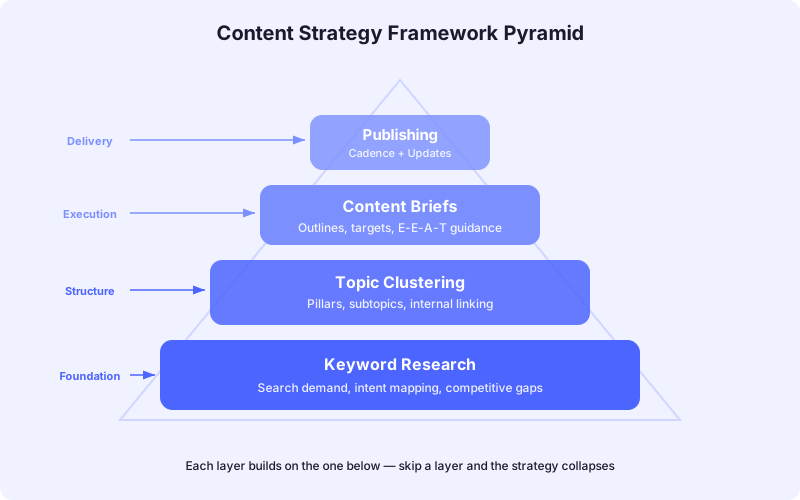
Layer 1: Keyword Research Foundation
Every content framework starts with keyword research, but the way you organize that research determines whether your framework scales. Raw keyword lists don't help. Structured keyword maps do.
Start by pulling keyword data for your core subject areas using tools like Ahrefs' Content Gap feature or Semrush's keyword research suite. Then organize keywords into three dimensions:
By topic: Group keywords into thematic clusters that map to specific subject areas your brand needs to own. A keyword like "content strategy framework" belongs in a different cluster than "content creation tools," even though both relate to content marketing.
By intent: Classify each keyword by search intent: informational, navigational, commercial, or transactional. Informational keywords drive awareness-stage content. Commercial and transactional keywords drive consideration and decision-stage content.
By difficulty: Layer in keyword difficulty scores to identify where you can win quickly versus where you'll need to build authority over time. Start with lower-difficulty keywords in each cluster to establish initial rankings, then build toward more competitive terms.
The output of this layer is a keyword map that assigns every target keyword to a topic cluster, intent category, and difficulty tier. This map becomes the foundation for everything that follows. If you haven't built one yet, the keyword mapping guide walks through the process in detail.
Layer 2: Topic Cluster Architecture
With your keyword map in place, the next layer organizes those keywords into topic clusters with clear pillar and supporting content relationships.
Each topic cluster follows a hub-and-spoke structure. The pillar page covers the broad topic at strategic depth, targeting your highest-value keyword in that cluster. Supporting pages each target a specific subtopic keyword, going deep on one narrow aspect of the broader subject.
The critical design decision at this layer is scope. A pillar topic that's too broad generates clusters so large they become unmanageable. A pillar topic that's too narrow doesn't support enough cluster content to build meaningful authority.
The sweet spot for most B2B content programs is a pillar that can support 8-15 supporting articles. The content clusters and pillar pages guide covers how to identify the right scope for each pillar topic. Each cluster page should have a clearly differentiated angle, target keyword, and search intent. If two planned cluster pages would answer the same question, they need to be merged or differentiated.
Your cluster architecture should also define the internal linking relationships upfront. Every cluster page links back to the pillar. The pillar links out to every cluster page. Cluster pages link to each other when genuinely relevant. These linking rules aren't suggestions. They're structural requirements that make the cluster function as an authority signal rather than a loose collection of related posts.
Layer 3: Content Brief System
Topic clusters define what you'll cover. Content briefs define how each piece will be executed. This layer translates your strategic plan into actionable production documents.
A content brief within an SEO content framework should include the target keyword and secondary keywords, search intent classification, pillar or cluster page designation, recommended word count based on SERP analysis, required H2 and H3 headings (with keywords naturally embedded), internal links to assign (pillar and related cluster pages), external reference sources, and the specific angle that differentiates the piece from what already ranks.
The most important element is the differentiation angle. Backlinko's SEO strategy guide reinforces that content competing for the same keyword with the same angle as existing top-10 results rarely breaks through. Your brief should explicitly state what unique perspective, data, or structural advantage your piece brings.
Build a brief template that your team uses for every piece. Consistency in briefs produces consistency in output. When briefs vary wildly between writers, the resulting content doesn't feel like it comes from a single, authoritative source.
For teams that want a head start on brief design, the content brief template guide provides a ready-to-use framework.
Layer 4: Publishing Cadence and Workflow
The final layer defines when and how content gets published. Cadence matters more than most teams realize. Publishing in bursts followed by long gaps sends inconsistent signals to search engines and makes it harder to build audience habits.
For cluster-based SEO content, the ideal publishing pattern is focused builds. Rather than publishing one post across five different topic clusters each week, publish five posts within the same cluster over a concentrated period. This approach fills out topic clusters faster, sends a stronger topical authority signal in a shorter window, and simplifies internal linking because related content exists simultaneously. To put this cadence into a structured 90-day plan, the SEO content calendar template gives you the scheduling framework for executing a cluster-based publishing strategy.
A practical cadence for a mid-size content team might look like this: dedicate the first two weeks of each month to a single topic cluster, publishing 4-6 pieces. Use the third week for performance review and content optimization. Reserve the fourth week for planning and briefing the next cluster.
Workflow design should specify roles at each stage: research, briefing, drafting, editing, SEO optimization, publishing, and distribution. The Slickplan SEO content strategy framework recommends a 90-day cycle where weeks 1-6 focus on publishing, weeks 7-10 on refreshing and expanding, and weeks 11-12 on internal link passes and content updates.
Building Your Framework: The Implementation Sequence
Phase 1: Foundation (Weeks 1-2)
Complete your keyword research and build your keyword map. Audit existing content against the keyword map to identify what you already have, what needs updating, and where the gaps are. Define your pillar topics and rough cluster scopes.
This phase is research-heavy and produces no published content. That's intentional. Rushing past the foundation phase guarantees structural problems later that are expensive to fix once dozens of posts exist.
Phase 2: Architecture (Weeks 3-4)
Finalize your topic cluster architecture. For each cluster, define the pillar page scope, all supporting pages, target keywords, internal linking plan, and publication sequence. Build content briefs for the first cluster you'll produce.
At this stage, you should also set up your measurement framework. Define the leading, engagement, and outcome metrics you'll track. Connect Google Search Console performance reports with your analytics platform so you can monitor keyword performance as content publishes.
Phase 3: First Cluster Build (Weeks 5-8)
Produce and publish your first complete topic cluster. Start with the pillar page, then publish supporting content in rapid succession. Implement all internal links as each piece goes live. Monitor indexing and initial ranking performance.
The first cluster is your proof of concept. It validates whether your keyword research identified real opportunities, whether your brief template produces content that meets quality standards, and whether your publishing cadence is sustainable for your team.
Phase 4: Optimization and Scale (Weeks 9-12)
Review performance data from your first cluster. Identify what's ranking, what needs updating, and what the data tells you about keyword opportunity accuracy. Refine your framework based on real-world results. Begin briefing and producing the second cluster.
This iterative cycle, build a cluster, review performance, refine the framework, build the next cluster, becomes your ongoing operating rhythm. Each cycle should get faster and more efficient as the framework matures.
Content Planning Framework vs. Content Marketing Strategy Frameworks
These terms get used interchangeably, but they describe different things. A content planning framework is the operational system for researching, producing, and publishing content. It's tactical and execution-focused. A content marketing strategy framework is broader and includes distribution channels, audience segmentation, brand messaging, and business alignment.
This guide focuses on the planning framework because that's where most teams need the most structure. You can have a brilliant content marketing strategy, but without a production framework to execute it, the strategy stays theoretical.
The planning framework feeds into the marketing strategy framework but doesn't replace it. Your marketing strategy defines who you're targeting and why. Your planning framework defines what you'll publish, how it's structured, and when it goes live.
Framework Pitfalls to Avoid
Building for scale before proving the concept. Don't create a framework for 10 topic clusters and 150 articles before you've successfully built and ranked one cluster. Prove the model first, then scale.
Treating the framework as fixed. Your framework should evolve based on performance data. The keyword opportunities you identified in month one will shift by month six. Quarterly framework reviews keep the system aligned with reality.
Ignoring content quality in favor of structure. A perfectly structured framework that produces mediocre content will underperform a messier system that produces excellent content. Structure amplifies quality. It doesn't replace it.
Skipping the internal linking layer. Topic clusters without intentional internal linking are just categories. The linking architecture is what transforms a group of related posts into a system that compounds authority. Follow internal linking best practices from the start.
Putting the Framework to Work
A content strategy framework isn't a document you create once and file away. It's a living system that evolves with your content program. The four layers, keyword research, topic clustering, content briefs, and publishing cadence, give you the structural foundation to produce content that ranks and compounds rather than content that stalls after publication.
Start with one cluster. Build it completely. Measure the results. Then use what you learned to refine the framework before scaling to the next cluster.
If you want a team to build and execute this framework for you, book a strategy call with ClusterMagic. The entire service is built around the cluster-first content framework described here.
Recommended Posts





.svg)