

.svg)
SEO Content Strategy Framework: Build One That Actually Works | ClusterMagic

Why Most Content Programs Plateau (And How a Framework Fixes It)
Most content teams publish consistently and still watch their organic traffic sit flat for months. The content exists. The effort is real. But the rankings never come.
The problem is almost never the writing. It's the absence of a coherent seo content strategy that connects every piece of content to a larger structure. Without a framework, you're creating pages in isolation. Search engines reward sites that demonstrate deep, organized expertise on a topic. Random publishing, no matter how frequent, doesn't do that.
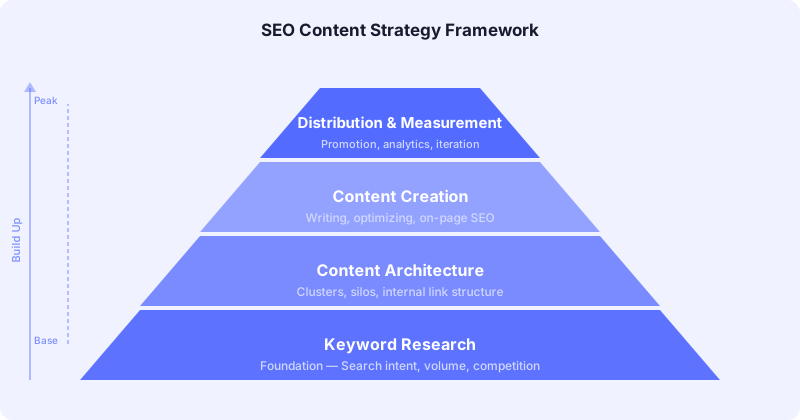
A proper seo content strategy framework gives your content program a skeleton. It defines how your topics relate to each other, which pieces support which, and how new content fills in gaps rather than duplicating what you already have. This post walks through what that framework looks like in practice.
Layer 1: Audience and Intent Foundation
Every effective content strategy for seo starts with the same question: who is searching, and what do they actually want when they type that query?
Search intent is the foundation of your entire framework. Google has spent years getting better at matching content to what a searcher means, not just what they typed. If your content doesn't align with intent, it won't rank, regardless of how well-written it is.
Map your target audience to four intent categories. Informational intent covers people researching a topic (how-to guides, explainers, comparisons). Navigational intent covers people looking for a specific brand or tool. Commercial investigation covers people evaluating options before buying. Transactional intent covers people ready to act.
Your content mix should reflect where most of your audience is in that journey. For most B2B SaaS companies, the bulk of content lives in informational and commercial investigation territory. Understanding this shapes every keyword and content decision that follows.
Layer 2: Keyword Architecture
Once you understand intent, you need to map keywords into a hierarchy that reflects how topics nest inside each other. This is the skeleton of your seo content strategy framework.
Start with your primary topics, the broad subject areas your site wants to own. Under each primary topic, identify a cluster of related subtopics that answer more specific questions within that space. This parent-child relationship is what search engines use to evaluate whether a site has genuine expertise on a subject.
Keyword difficulty and search volume both matter, but neither one alone tells the full story. A keyword with 500 monthly searches and low competition can drive more qualified traffic than a 10,000-volume term where you have no realistic shot at page one. Prioritize based on your site's current authority and the relevance to your business outcomes.
For a deeper look at the mechanics of this process, the seo content strategy explainer covers the distinction between keyword lists and actual strategy. And for the specific topic clustering approach, content clusters and pillar pages walks through how to structure your keyword architecture into pages that support each other.
Layer 3: Content Structure (Pillar and Cluster Model)
Keyword architecture informs your content structure. The most durable framework for SEO in 2026 is the pillar-and-cluster model: one comprehensive pillar page covers a broad topic at depth, and a set of cluster pages cover related subtopics in detail, each linking back to the pillar.
This structure works because it mirrors how search engines understand expertise. A site that has a thorough pillar page on "content marketing" supported by 12 cluster posts on specific subtopics (editorial calendars, content briefs, distribution channels) signals far more authority than a site with 12 unconnected posts on those same subtopics.
The pillar page anchors your topical authority. The cluster posts expand it. Internal links between cluster posts and the pillar create a navigational and semantic web that makes it easier for search engines to index all the pages and understand how they relate.
A few rules that make this structure work in practice. The pillar page should be the most comprehensive resource you have on the broad topic. Each cluster post should address a specific question that the pillar doesn't answer in full. Every cluster post links back to the pillar. Related cluster posts cross-link to each other where the connection is genuine, not forced.
Layer 4: Content Briefs and Quality Standards
Structure and keyword architecture get you to the right topics. Content briefs ensure that each piece of content actually earns the ranking it's going after.
A brief is a pre-writing document that specifies the target keyword, search intent, required headers and subheadings, word count range, internal links to include, and any specific questions or data the post must address. It's not a creative straitjacket. It's a map that keeps writers focused on what the reader and the search engine both need from that specific piece.
Quality in SEO is increasingly measured by how completely a piece of content satisfies the searcher's underlying question. Using a content quality score helps your team evaluate completeness objectively rather than relying on subjective judgment. Google's documentation on helpful content makes this explicit. The site that answers the question most thoroughly and accurately tends to win. Briefs help you systematize that standard across every piece you produce.
The blog content strategy guide covers how to translate your framework into a blog-specific publishing plan, including how to set quality benchmarks that your team can actually apply consistently.
Layer 5: Publishing Cadence and Capacity Planning
A framework with no publishing engine is just a plan. You need a realistic cadence based on your team's actual production capacity, not an aspirational number that sets you up to fall behind.
Most content teams overestimate how much they can publish and underestimate how long it takes to produce genuinely useful content. A sustainable cadence for a small team (two to three writers) is typically two to four well-researched posts per week. A solo content marketer can realistically sustain one to two posts per week at the quality level that earns rankings.
Consistency matters more than volume. A site that publishes two strong posts every week for six months outperforms a site that sprints to publish 20 posts in a month and then goes quiet. Search engines interpret consistent publishing as a signal of an active, maintained resource.
Build your calendar to match your capacity. Leave buffer for content refreshes, which you'll need once older posts start to slip in rankings. Technical SEO for content teams covers the site-health factors that affect how quickly refreshed content gets recrawled and re-ranked. A good rule of thumb: dedicate at least 20% of your publishing capacity to updating and improving existing content rather than only creating new pages.
Layer 6: Performance Tracking and Iteration
A framework that doesn't include a feedback loop calcifies. You need to track performance and use that data to inform what you write next.
The core metrics for an seo content strategy framework are: organic sessions by page, keyword rankings for target terms, click-through rate from search results, and pages per session for content that's meant to drive internal navigation. The SEO fundamentals for marketers guide covers how these metrics connect to the broader SEO disciplines that support your content program. Engagement signals like time on page and scroll depth give you a proxy for content quality.
Track these metrics at the cluster level, not just the individual page level. If your entire "content planning" cluster is underperforming, that tells you something different than if one specific post has low click-through rate. Cluster-level analysis reveals gaps in your topic coverage and opportunities to strengthen your pillar's internal link structure.
Set a monthly review cadence. Look at which posts gained rankings, which slipped, and which are on the cusp of page one for their target keywords. Posts within striking distance of page one often need targeted updates rather than full rewrites. Adding a new section, improving the header structure, or updating data can push a post from position 8 to position 3. For a full walkthrough of the mapping process, the keyword mapping guide explains how to organize your keyword data so that tracking and iteration become systematic rather than reactive.
Putting the Framework Together
The six layers described above form a complete seo content strategy framework. Here's the sequence:
- Define your audience and map their intent categories.
- Build a keyword hierarchy organized around primary topics and subtopics.
- Assign keywords to a pillar-and-cluster content structure.
- Create briefs that specify what each piece of content must accomplish.
- Set a publishing cadence that matches your real production capacity.
- Track performance at the cluster level and iterate based on what the data shows.
Each layer informs the next. Skip one and the framework loses coherence. The teams that build organic traffic at scale aren't the ones producing the most content. They're the ones whose content is organized into a structure that earns authority over time.
ClusterMagic automates the most time-consuming part of this framework: analyzing your existing content, identifying cluster gaps, and generating briefs that reflect search intent and your site's current authority. If you want to see how it works with your specific topic areas, book a walkthrough and we'll map it out together.
Sources:
Recommended Posts





.svg)