

.svg)
Content Quality Score: How to Measure and Improve SEO Content Quality | ClusterMagic

Google does not assign a visible content quality score to your pages. There is no metric in Search Console labeled "quality" and no number in your analytics dashboard that tells you whether Google considers your content trustworthy. But Google absolutely evaluates content quality through a system of signals tied to E-E-A-T: Experience, Expertise, Authoritativeness, and Trustworthiness. The absence of a visible score does not mean quality is unmeasured. It means you need to build your own scoring framework.
A content quality score gives your team a repeatable way to evaluate and improve content before and after publication. It turns subjective editorial judgment into a structured assessment that maps to the signals Google actually uses. According to a ranking factors study analyzing 10 million search results, content quality accounts for 25% of Google's ranking weight and carries the highest individual impact score of any factor at 9.5 out of 10. Quality is not a nice-to-have. It is the single most impactful lever you control.
This guide walks through how to build a content quality score, what to measure, and how to improve content quality systematically across your site. If you want a team that builds quality into every piece from the research stage, talk to ClusterMagic.
What Content Quality Means in SEO
Content quality in SEO is not the same as literary quality. A beautifully written essay that does not answer the searcher's question is low-quality in Google's framework. A plainly written tutorial that solves the reader's exact problem is high-quality. Quality in SEO means relevance, accuracy, depth, and trustworthiness relative to the search intent.
Google's Search Quality Rater Guidelines provide the clearest picture of how quality is evaluated. Human raters assess pages on a scale from Lowest to Highest quality, considering factors like the purpose of the page, the expertise of the creator, the accuracy of the information, and the reputation of the site.
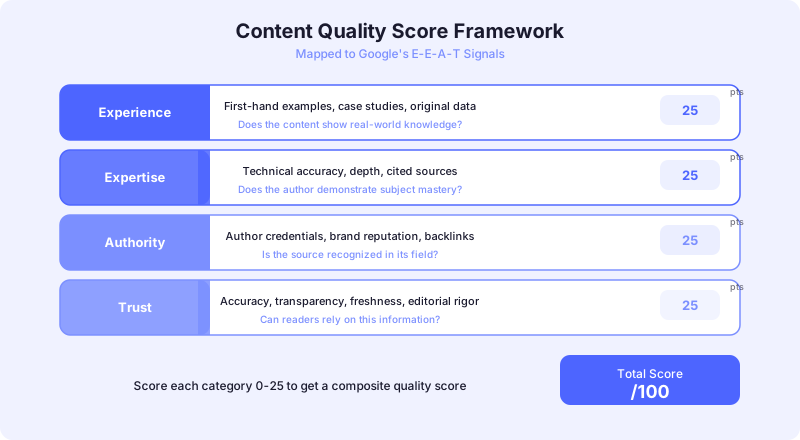
The E-E-A-T framework sits at the center of this evaluation:
- Experience asks whether the creator has firsthand experience with the topic
- Expertise asks whether the creator has the knowledge or skill to discuss it authoritatively
- Authoritativeness asks whether the site and creator are recognized sources on the topic
- Trustworthiness asks whether the content is accurate, transparent, and honest
Trust is the most important component. A page can demonstrate experience and expertise but still fail on trust if it contains inaccuracies, hides its sources, or lacks transparency about who created it and why.
Building a Content Quality Score Framework
A practical content quality score assigns numerical values to the components that correlate with search performance. Here is a framework that maps directly to E-E-A-T and can be applied to any content type.
The Scoring Categories
Intent Match (0-20 points): Does the content match the search intent for its target keyword? Check the top five ranking results and compare format, depth, and angle. A perfect score means your content delivers exactly what a searcher expects to find for that query.
Depth and Completeness (0-20 points): Does the content cover the topic thoroughly? Compare your subtopic coverage against the top-ranking competitors. Are there questions a reader would naturally have that your content leaves unanswered? A complete piece addresses the core topic and the logical follow-up questions.
Expertise Signals (0-20 points): Does the content demonstrate that the creator knows the subject? Look for specific examples, original analysis, practical frameworks, and accurate technical detail. Generic advice that could apply to any topic scores low. Specific, experience-based guidance scores high.
Source Quality (0-20 points): Are claims backed by credible sources with links to specific pages? Are external references authoritative and current? Content that makes assertions without evidence or links to generic homepages scores low.
Readability and Structure (0-20 points): Is the content scannable with clear headings, short paragraphs, and logical flow? Can a reader find the answer to their specific question without reading the entire piece? Strong structure improves both user experience and Google's ability to extract relevant information.
Applying the Score
Score each piece on this 100-point scale. Group your content into tiers:
- 80-100: High quality. Monitor for freshness but no urgent action needed.
- 60-79: Moderate quality. Schedule updates to close gaps in depth or sourcing.
- 40-59: Low quality. Rewrite or merge with stronger related content.
- Below 40: Very low quality. Consider removing from your site or noindexing.
This scoring system gives your editorial team a shared language for quality that goes beyond "I think this is good." It makes quality discussions objective and actionable.
How to Audit Your Existing Content Quality
A content quality audit applies your scoring framework across your entire library to identify what needs improvement, what should stay, and what should go.
Step 1: Inventory Your Content
Export a list of all indexed pages from Google Search Console or crawl your site with Screaming Frog. For each page, pull the URL, title, primary keyword, monthly organic sessions, and current average ranking position. This gives you the baseline data to prioritize your audit.
Step 2: Score a Sample Set
Do not try to score every page at once. Start with your top 30 pages by organic traffic and your bottom 30 pages. This gives you a picture of what your best and worst content looks like under the scoring framework. Patterns will emerge quickly.
Step 3: Identify Quality Patterns
Common patterns you will find during an audit:
Thin content scores low on Depth and Completeness. These are pages that cover a topic at surface level without providing the detail a searcher needs. They often rank on page two or three, close enough to show Google sees relevance but not deep enough to earn a top position.
Unsourced claims drag down the Source Quality score. Statements like "studies show" without linking to the actual study, or "experts agree" without naming the expert, erode trust. Fix these by adding specific citations with links to the source material.
Outdated information affects both Expertise Signals and Trustworthiness. A post referencing 2022 data or a discontinued tool feature tells readers and Google that the content is not maintained. Regular freshness updates are essential for pages targeting competitive keywords.
Poor structure shows up as low Readability scores. Long paragraphs, vague headings, and buried key information make content harder for readers to use and harder for Google to parse. These are often the easiest fixes with the most immediate impact.
The content gap analysis guide complements this audit by showing you where competitors cover subtopics that your content misses entirely.
Improving Content Quality Score: Practical Techniques
Add Firsthand Experience
Google's 2022 addition of "Experience" to E-A-T signaled that firsthand knowledge is a distinct quality signal. Content that includes real examples from actual practice scores higher than content that only synthesizes information from other sources.
If your team has run A/B tests, managed campaigns, built systems, or solved specific problems, put that experience into the content. A sentence like "when we tested this approach across 15 client sites" carries more weight than "this approach is widely recommended." You do not need to share proprietary data. You need to show that the advice comes from someone who has done the work.
Strengthen Source Citations
Replace every vague reference with a specific, linked citation. If you reference a Google guideline, link to the exact documentation page. If you cite a statistic, link to the original research, not a blog post that also cited it secondhand.
Recency matters too. A 2021 study on search behavior may be outdated in 2026. When refreshing content, check whether newer data exists and update your citations accordingly. This practice directly improves your content's Trustworthiness signal.
Improve Topical Depth
The difference between a 60-point and an 85-point piece is usually depth. Take your existing content and ask: what would a reader want to know next? What follow-up question would they have after reading each section?
If your post explains how to do something, add a section on common mistakes. If it covers a concept, add practical examples. If it recommends a strategy, address when that strategy does not work. Depth means anticipating and answering the questions your reader did not know they had.
Building topical authority across a subject area compounds the quality signal. Individual pages score higher when they exist within a cluster of related, interlinked content that demonstrates comprehensive coverage of a topic.
Author Transparency
Identify who created the content and why they are qualified to discuss it. Author bylines with bios that include relevant credentials or experience strengthen the Expertise and Authoritativeness signals. An anonymous blog post about medical topics scores very differently than one attributed to a named practitioner with listed credentials.
For company blogs, the author bio should explain the team's relevant experience. "ClusterMagic Team" works when the company's About page clearly establishes the team's SEO and content expertise. The key is that readers can verify who is behind the content.
Tracking Content Quality Over Time
Content quality is not static. A page that scored 90 when published can drop to 60 after two years without updates. Build a review cadence:
Quarterly reviews for top-performing content (top 20% by traffic). Check for accuracy, freshness, and competitive changes. Update data points, add new sections if the topic has evolved, and refresh external links to current sources.
Biannual reviews for middle-tier content. Decide whether to update, merge, or leave as-is based on current traffic trends and competitive landscape.
Annual pruning for low-performing content. Pages scoring below 40 that also attract minimal traffic are candidates for removal, consolidation, or complete rewrites. Removing low-quality content can improve overall site quality signals and concentrate crawl budget on your best pages.
Track your average content quality score across your library over time. A rising average means your editorial standards are working. A declining average means you are publishing faster than you are maintaining.
Content Quality and Google Algorithm Updates
Google's core algorithm updates increasingly reward quality and penalize thin or generic content. The December 2025 core update showed sites demonstrating experience and expertise gaining 23% in visibility while generic content farms saw significant drops.
Proactive quality management is algorithm-update insurance. Sites that maintain high content quality scores across their libraries experience less volatility during core updates because they are already aligned with what updates are designed to reward.
The pattern across recent updates is consistent: Google is raising the bar on what counts as quality content. Thin pages that once ranked adequately on domain authority alone are losing ground to pages that demonstrate genuine depth, expertise, and trustworthiness. Building a content quality score into your editorial process ensures you stay ahead of that trajectory rather than reacting to it.
Connecting Content Quality to Business Outcomes
High content quality scores correlate directly with the metrics that matter to business stakeholders. Pages scoring above 80 in this framework typically show:
- Higher average ranking positions for their target keywords
- Lower bounce rates because content matches intent and delivers value
- More backlinks earned organically because quality content gets cited
- Higher conversion rates because trust signals reduce friction
For teams measuring content marketing ROI, quality scoring adds a leading indicator. If your quality scores are improving, your traffic and conversion metrics will follow. If quality scores are dropping, declining performance is predictable.
A structured quality framework also makes content investment decisions easier. Instead of debating whether to publish more content or improve existing content, the data tells you: if your average quality score is below 70, improving existing content will deliver faster returns than publishing new pieces.
ClusterMagic builds quality into the content pipeline from the keyword research stage through to final review, ensuring every piece published meets the standard that drives rankings and reader trust.
Recommended Posts





.svg)