

.svg)
Content Marketing ROI: How to Measure What Works | ClusterMagic

Only 21% of marketers can accurately measure content ROI, according to recent industry data. The other 79% report on activity (posts published, traffic, social shares) without connecting that activity to revenue. That gap is not a content quality problem. It is a measurement infrastructure problem.
Content marketing ROI calculation follows a straightforward formula: (Value Generated minus Cost of Content) divided by Cost of Content, multiplied by 100. The SEO ROI calculation guide walks through this formula with worked examples. What makes it difficult in practice is that both sides of the equation require deliberate setup to measure correctly. Revenue attribution is hard. Content costs are frequently undercounted. And the timeline for organic content to produce returns is often months longer than stakeholders expect.
This guide covers how to set up the measurement infrastructure, which metrics to track, and how to present ROI in a way that earns continued investment.
Why Most Content ROI Measurement Falls Short
The most common measurement mistake is using proxy metrics as stand-ins for business outcomes. Pageviews, social shares, and even email subscribers are useful signals, but none of them answer the question a CFO or VP of Marketing is actually asking: did this content investment produce revenue or reduce customer acquisition costs?
The measurement gap is structural. Most content teams have access to analytics tools but lack the event configuration, attribution modeling, and cost tracking infrastructure needed to connect content consumption to pipeline contribution. Without that infrastructure, even good content produces inconclusive data.
The second problem is timeline mismatch. Blog content published today may not generate significant organic traffic for three to six months. Teams that evaluate content ROI on a 30-day cycle will consistently undervalue organic content and over-index on paid channels with faster attribution cycles. Building the right time horizons into your reporting framework is as important as tracking the right metrics.
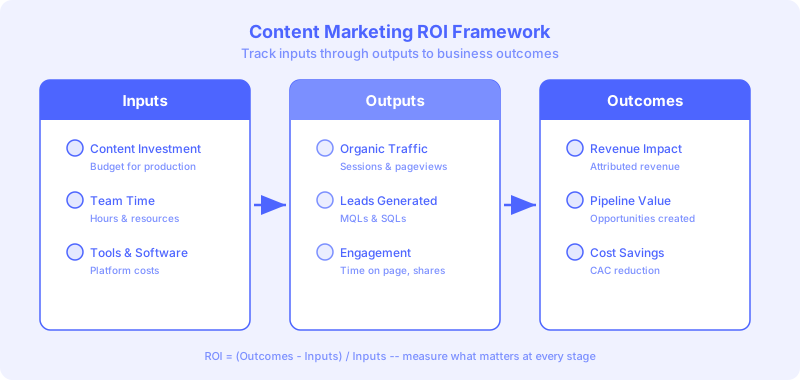
The Full Picture of Content Value
Content marketing ROI is not just direct revenue. A complete value calculation includes five components:
Direct revenue attribution. Conversions where content was the last or primary touchpoint before a purchase or sign-up. This is the easiest component to measure and the one most teams track exclusively.
Pipeline influence. Deals where buyers consumed content at some point during the purchase process, even if content was not the final touchpoint. Multi-touch attribution models in GA4 capture this. A buyer who read three blog posts before requesting a demo should have those posts credited in the pipeline value calculation.
Organic traffic value. The estimated cost equivalent of your organic traffic in paid search terms. If your content generates 10,000 monthly organic visitors for keywords with a $4 average CPC, the traffic value is approximately $40,000 per month. This is not cash in hand, but it represents real cost avoidance compared to buying the same traffic through paid channels.
AI citation value. As AI-powered search results and tools like Perplexity and ChatGPT increasingly surface content in response to queries, being cited in those results has measurable brand value. Tracking branded impressions and AI referral traffic is an emerging but increasingly important ROI component.
Brand lift. Increases in branded search volume and direct traffic over time reflect growing brand awareness. This is the hardest component to attribute to specific content but becomes visible at the aggregate level over 6 to 12-month windows.
Setting Up Attribution Infrastructure
GA4 Event Configuration
The foundation of content ROI measurement is proper GA4 event setup. Every meaningful action on your site should be tracked as a conversion event: email subscriptions, resource downloads, contact form submissions, demo requests, and any high-intent page visit (pricing pages, case study pages).
Without these events configured, GA4 reports traffic and engagement but cannot tell you which content paths lead to revenue. The setup investment is typically a few hours for a developer or analyst, and it is the single highest-leverage action for improving content measurement.
Multi-Touch Attribution Models
GA4's default attribution model gives full credit to the last touchpoint before conversion. For content marketing, this consistently undervalues organic content because readers often discover a brand through blog posts, return directly or through branded search later, and then convert. The direct or paid session gets the credit while the content that created the awareness gets none.
Data-driven attribution, available in GA4 for accounts with sufficient conversion volume, distributes credit across the touchpoints that most frequently appear in converting paths. For accounts below the threshold, a linear or time-decay model is more accurate than last-click for content evaluation.
Connect your SEO content analytics setup directly to this attribution model so that ranking and traffic data maps to the same conversion events you are using for ROI reporting.
Cost Tracking
Most ROI calculations undercount content costs because they include only direct production expenses and miss the distributed costs. A complete cost calculation for a single blog post includes: writer or editor time (at fully-loaded hourly rate), strategist or SEO analyst time for keyword research and briefing, designer time for custom images or graphics, tool costs allocated per published piece, and distribution or promotion costs if applicable.
For a content team producing 20 posts per month, the true cost per post often runs 30-50% higher than the invoice cost alone. Accurate cost tracking prevents you from declaring a positive ROI based on understated inputs.
The Metrics That Connect Content to Revenue
Organic Conversion Rate by Content Type
The most direct content ROI signal is the conversion rate of organic visitors by content category. Do product comparison posts convert at a higher rate than educational guides? Do posts targeting bottom-of-funnel keywords produce more demo requests than top-of-funnel posts? This segmentation turns aggregate conversion data into editorial guidance.
Use GA4's content grouping feature to segment by category, then compare organic conversion rates across groups. The content performance analysis guide covers how to build these segments into a repeatable audit process. The categories that convert above average should inform your content calendar priorities. Those that convert below average should be audited for CTA clarity and audience-intent alignment.
Time to Conversion
Content that generates conversions within 24 hours of a first visit is typically bottom-of-funnel content targeting high-intent keywords. Content that generates conversions after multiple sessions over several weeks is likely top-of-funnel content building awareness over a longer cycle.
Tracking time to conversion by content category helps you set realistic ROI timelines. A guide targeting a broad informational keyword may take six months to produce its first conversion. That does not make it a poor investment. It makes it a slow-return investment that should be evaluated on a different timeline than a comparison page targeting buyers actively evaluating solutions.
Organic Traffic Value Trend
Track monthly organic traffic value (organic sessions multiplied by average CPC for the keywords driving that traffic) as a cumulative line over time. Well-structured content programs compound: month 12 should show significantly higher traffic value than month 1 with similar or lower marginal production costs.
This trend line is one of the most persuasive elements in a stakeholder ROI presentation because it shows the compounding return characteristic that distinguishes organic content from paid advertising, where value disappears when spend stops.
Building a Content ROI Report
The 30-Day View
Monthly reports should cover direct conversions attributed to organic content, new pages indexed and ranking, and any significant position changes for high-priority keywords. Keep this report tactical: it is for the content team to assess recent work and adjust the editorial calendar.
Avoid drawing strong ROI conclusions from 30-day data alone. New content rarely matures in this window.
The 90-Day View
At the quarter level, content ROI reporting becomes meaningful. By 90 days, most published content has been indexed, crawled multiple times, and either gained or failed to gain traction. Pull conversion data with multi-touch attribution for all content published in the cohort, calculate the organic traffic value generated, compare against total production costs for the period, and calculate ROI using the formula above.
This is also the window to connect content performance to your content marketing ROI guide benchmarks. A healthy content program typically shows positive ROI by quarter 2 and growing returns in subsequent quarters as early content assets continue to compound.
The Annual View
Annual content ROI reporting should include all five value components described earlier: direct revenue, pipeline influence, organic traffic value, AI citation value, and brand lift. This is the report that justifies continued investment to leadership.
Industry data suggests companies can see a 367% ROI in year one of a structured content program, climbing to 633% in year two and 656% in year three as content assets mature. Present your program against these benchmarks with your actual numbers, not just activity metrics.
Common ROI Reporting Mistakes to Avoid
Reporting on activity instead of outcomes. "We published 24 posts this quarter" is an output. "Organic traffic grew 34% and generated 180 qualified leads" is an outcome. Knowing which content performance metrics qualify as outcomes versus activity signals makes this distinction easier to enforce. Stakeholders who fund content programs want outcomes.
Ignoring the compounding effect. Content from 18 months ago is likely still generating traffic and conversions today. A ROI calculation that only looks at recently published content undervalues the total program return.
Using vanity metrics as ROI proxies. Social shares, follower counts, and raw pageviews are engagement signals, not business outcomes. They can appear in a supporting data section but should never be the primary ROI evidence.
For teams working on organic traffic growth, connecting that traffic data to the ROI framework described here is the step that transforms a traffic report into a business case.
Presenting ROI to Leadership
The most effective content ROI presentations lead with a dollar figure, not a traffic chart. Calculate the total value generated across all five components, subtract total costs, and present the net return alongside the percentage ROI. Then support that top-line number with the trend data that explains how you got there and where the program is heading.
Anticipate the comparison question. Leadership will compare content ROI against paid channel ROI. Organic content typically loses on speed (paid produces results faster) but wins on long-term cost efficiency and compounding returns. Make that case explicitly with data from your own program, not industry benchmarks alone.
If you want to see how ClusterMagic surfaces content performance data in a format that maps directly to this ROI framework, book a walkthrough and we will show you the reporting layer in action.
Recommended Posts





.svg)