

.svg)
SEO ROI Calculator: How to Calculate Your SEO Return on Investment | ClusterMagic

Proving that SEO generates revenue is one of the hardest conversations in marketing. The traffic numbers look healthy, rankings are climbing, but when the CFO asks for a dollar figure, most teams stall. An SEO ROI calculator solves that problem by turning organic performance data into a financial metric that stakeholders actually understand. The average return on SEO investment across industries sits at 748% according to First Page Sage's 2026 ROI report, but that number means nothing if you cannot calculate your own.
This tutorial walks through the core formulas for how to calculate SEO ROI, gives you a ready-to-use Google Sheet template, and covers four easy wins that improve your return without increasing spend. If you want help building the content engine that drives those returns, book a strategy call with ClusterMagic.
The Core SEO ROI Formula
The base calculation is straightforward:
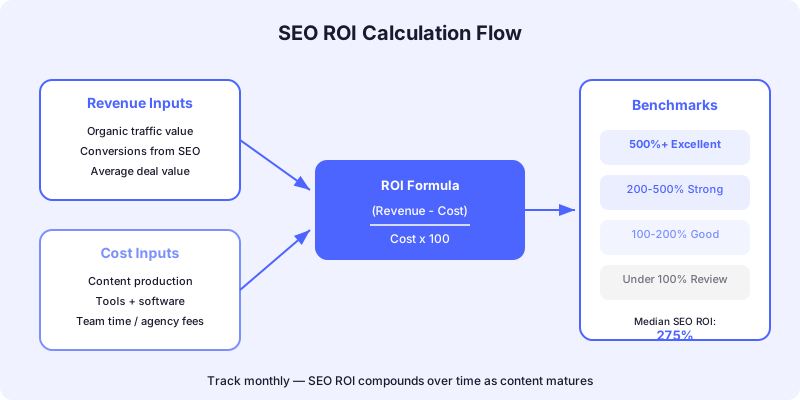
SEO ROI = (Revenue from SEO - Cost of SEO) / Cost of SEO x 100
If your organic channel generated $80,000 in attributed revenue last quarter and your total SEO investment was $20,000, your ROI is 300%. That means every dollar spent returned three dollars in revenue. A healthy benchmark is a 5:1 ratio (500% ROI) for mature programs, though results vary significantly by industry.
The challenge is not the math. It is accurately defining the two variables: what counts as revenue from SEO, and what counts as cost.
Defining SEO Revenue
Revenue attribution for SEO falls into three categories, each progressively harder to track but increasingly valuable to measure.
Direct organic conversions are the simplest. A visitor arrives through organic search, completes a purchase or fills out a lead form in the same session, and the conversion is attributed to organic. Track this in Google Analytics 4 using the Traffic Acquisition report filtered to organic search.
Assisted organic conversions capture the visitors who found you through search but converted in a later session through a different channel. GA4's Model Comparison report shows how organic participates in multi-touch conversion paths. Most teams undercount SEO value by 30-50% when they only track last-click attribution.
Organic traffic value estimates what you would have paid in Google Ads for the same clicks. Multiply your monthly organic clicks by your average CPC for those keywords. Tools like Ahrefs' Site Explorer and Semrush's Organic Research report calculate this automatically. This metric is especially useful for early-stage SEO programs that haven't yet built enough conversion volume to show direct revenue.
Defining SEO Costs
Complete cost accounting prevents the artificially inflated ROI numbers that erode credibility with finance teams. Include every line item:
- Agency or freelancer fees for SEO strategy and execution
- Content production costs (writers, editors, designers)
- SEO tool subscriptions (Ahrefs, Semrush, Screaming Frog, etc.)
- Technical SEO implementation hours
- Internal team time allocated to SEO tasks
- Link building or digital PR investment
If your fully loaded monthly SEO spend is $12,000, that is the denominator. Leaving out internal labor or tool costs makes your ROI look better on paper but falls apart under scrutiny.
Building Your SEO ROI Calculator in Google Sheets
A spreadsheet-based SEO ROI calculator lets you update numbers monthly and track trends over time. Here is the structure for a template you can build in fifteen minutes.
Tab 1: Monthly Organic Revenue
Create columns for month, organic sessions, conversion rate, conversions, and average deal value. The formula for monthly organic revenue is: Organic Sessions x Conversion Rate x Average Deal Value. Pull session data from GA4 and conversion data from your CRM or ecommerce platform.
Tab 2: Organic Traffic Value
List your top 50 ranking keywords, their monthly search volumes, your click-through rates by position (use Advanced Web Ranking's CTR study for benchmarks), and the average CPC for each keyword. The traffic value formula is: Monthly Clicks x Average CPC = Keyword Value. Sum across all keywords for total monthly traffic value.
Tab 3: Total SEO Costs
Track every cost category monthly. Use separate rows for agency fees, content production, tools, and internal labor. Total these for your monthly cost figure.
Tab 4: ROI Dashboard
Pull the revenue and cost totals from the other tabs and apply the ROI formula. Add a trailing 12-month view so you can see how ROI compounds as content matures. Most SEO programs do not break even until month six to twelve, then accelerate as older content accumulates rankings and backlinks.
For teams already tracking content marketing ROI, this calculator plugs directly into your existing measurement framework by isolating the organic search component.
How to Calculate SEO ROI by Channel Segment
Not all organic traffic has the same value. Breaking your SEO ROI calculation into segments reveals where your investment is working hardest.
Blog Content ROI
Isolate blog traffic using URL path filters in GA4. Track conversions that begin with a blog page view, then measure against your content production costs. Blog content typically has a longer payback period (6-12 months) but compounds over time as posts rank for increasing numbers of keywords.
Product and Service Page ROI
These pages convert at higher rates because the traffic carries commercial intent. Measure organic sessions landing on product or service pages, track direct conversions, and compare against the cost of creating and optimizing those pages. This segment usually shows the fastest ROI.
Brand vs. Non-Brand Segmentation
Brand organic traffic (people searching your company name) converts well but is not truly generated by SEO effort. Filter brand terms out of your ROI calculation to get an honest picture of what your SEO investment produces. Use Google Search Console's Performance report to separate brand and non-brand query traffic.
Understanding these segments helps you make better allocation decisions. If blog content shows a 200% ROI but product page optimization shows 800%, you know where to shift resources. The SEO content analytics guide covers the tracking infrastructure you need to measure at this level of detail.
4 Easy Wins to Improve Your SEO ROI
These four optimizations improve your return without requiring additional budget.
1. Fix Conversion Rate Leaks on High-Traffic Pages
Pull your top 20 organic landing pages by traffic volume. Identify the pages with above-average traffic but below-average conversion rates. Adding a clear CTA, improving page speed, or tightening the content-to-intent match on these pages can lift conversion rates by 15-30% without creating any new content.
2. Optimize Existing Content for Page-Two Keywords
Open Google Search Console, filter for queries where your average position is between 8 and 20, and sort by impressions. These are keywords where you already have relevance but have not cracked the top results. Updating the content to better match intent, adding depth, and improving internal linking often pushes these rankings onto page one. Moving from position 11 to position 5 can increase click-through rate by 5x based on Backlinko's CTR analysis.
3. Consolidate Thin and Duplicate Content
Multiple pages targeting the same keyword split your authority and compete against each other. Audit your content for cannibalization using Semrush's Cannibalization report or a manual Search Console query. Merge the weaker pages into the strongest one with 301 redirects. This concentrates authority and typically lifts the surviving page's rankings within weeks.
4. Improve Internal Linking on Money Pages
Your highest-value pages (those that drive conversions) need the most internal link equity flowing to them. Audit your internal link structure to ensure that blog posts and supporting content link to your core conversion pages. The internal linking guide covers a systematic method for building this structure without making your content feel forced.
SEO ROI Benchmarks by Industry
Benchmarks help you contextualize your own numbers against realistic expectations. According to First Page Sage's 2026 data, the spread across industries is significant:
High-ROI industries include real estate (1,389%), financial services (1,031%), and medical devices (1,183%). These sectors benefit from high customer lifetime values and strong commercial search intent.
Mid-range performers include B2B SaaS (702%), manufacturing (813%), and professional services (600-800%). The returns are strong but take longer to materialize because sales cycles are longer and attribution is more complex.
Lower but still positive returns appear in ecommerce (317%) and local services (400-500%). Higher competition and lower margins compress the ratio, but SEO still outperforms most paid channels on a cost-per-acquisition basis.
If your numbers fall below your industry benchmark, the problem is usually in one of three places: attribution gaps (you are generating value you cannot see), content quality (you are publishing but not ranking), or conversion optimization (you are ranking but not converting). Diagnosing which one applies is the first step. The content marketing ROI measurement framework can help you identify the bottleneck.
Common Mistakes in SEO ROI Calculation
Measuring Too Early
SEO compounds over time. Evaluating ROI at month three of a new program almost always shows a negative return because content has not had time to index, rank, and attract traffic. Set a minimum evaluation window of six months, with meaningful trend analysis starting at twelve months.
Ignoring Assisted Conversions
Last-click attribution dramatically undercounts SEO's contribution. A prospect might discover your brand through an organic blog visit, return two weeks later through a branded search, and then convert through an email link. Last-click credits the email. Assisted conversion reporting in GA4 shows the full picture.
Inflating Revenue Attribution
Counting all revenue from customers who ever visited your site organically inflates the number beyond credibility. Use time-decay or position-based attribution models to give SEO appropriate credit without claiming everything.
Excluding Opportunity Cost
If you stopped investing in SEO, your organic traffic would not disappear overnight, but it would decline steadily as competitors publish, algorithm updates roll out, and your content ages. The cost of not doing SEO is a real factor that belongs in any ROI conversation, even if it does not fit neatly into the formula.
Tracking SEO Return on Investment Over Time
The most useful SEO ROI calculator is not a one-time snapshot. It is a monthly tracking system that shows trend lines. Build a quarterly report that includes:
- Trailing 12-month ROI trend
- Revenue per organic session (total organic revenue / total organic sessions)
- Cost per organic acquisition (total SEO costs / total organic conversions)
- Organic traffic value growth rate
- Comparison to paid search cost per acquisition
This reporting cadence gives leadership a clear financial narrative: SEO costs X, returns Y, and the trend is improving at Z% per quarter. That story, told consistently with real numbers, is what protects SEO budgets during cost-cutting cycles.
For teams building or refining the content strategy that powers these numbers, ClusterMagic's content intelligence platform maps keyword opportunities to content clusters so every piece you publish contributes to measurable organic growth.
Key Takeaways
Calculating SEO ROI does not require complex tools. It requires honest cost accounting, proper revenue attribution, and a commitment to measuring over a realistic time horizon. Start with the base formula, build your Google Sheet tracker, implement the four easy wins, and benchmark against your industry. The math will speak for itself.
Recommended Posts





.svg)