

.svg)
Competitive Content Analysis: Reverse-Engineer Your Rivals

Most competitive content analysis guides hand you a tool list and call it a day. The real work happens after the export: deciding which gaps are worth chasing and why. This guide walks through a practical process for running a competitor content audit that produces an actual content plan, not just a spreadsheet full of URLs.
What competitive content analysis actually tells you
A competitive content analysis is the process of mapping what your competitors publish, how it ranks, and where they leave territory uncovered. Done well, it answers three questions:
- Which topics do they dominate that you should match or beat?
- Which topics do they ignore that your audience still needs?
- Which topics are contested enough that you need to outperform them on depth and quality?
The third category is the one most teams underestimate. It is not enough to publish on the same topic. If a competitor has a 2,500-word guide on keyword research that ranks #2, you need a meaningfully better page to displace it, not a 1,500-word recap. The bar is set by what already ranks, and you have to clear it.
This is the insight that separates content gap analysis from a keyword research exercise. You are not just finding topics, you are finding topics where the existing coverage leaves a real opening. That distinction shapes everything about how you prioritize and execute.
Step 1: Pick the right competitors to analyze
Not every competitor in your market belongs in a content audit. You want competitors whose content actually ranks, which is a separate list from competitors who sell what you sell.
Start by searching your three or four most important head terms in an incognito browser. Note which domains come up repeatedly in the top ten results. These are your content competitors.
A business competitor with no organic presence is not worth including in this exercise. A niche publication that ranks for everything you care about absolutely is.
Aim for three to five domains. More than that and the analysis sprawls; fewer and you miss patterns. If you are in a highly competitive vertical, it is worth including one or two large domain generalists (think HubSpot or Moz in the marketing space) alongside more direct competitors. They set the quality ceiling you are working against.
Once you have your list, run a quick check in Ahrefs or SEMrush to confirm each domain has meaningful organic traffic. If a competitor drives fewer than 5,000 monthly organic visits, their content is not proving much and you can safely deprioritize them.
Step 2: Pull their ranking keyword universe
For each competitor domain, pull their full keyword footprint. Export all keywords where they rank in positions 1 through 20. Filter out branded terms and navigational queries, both of which skew the data without informing your strategy.
Now do the same for your own domain.
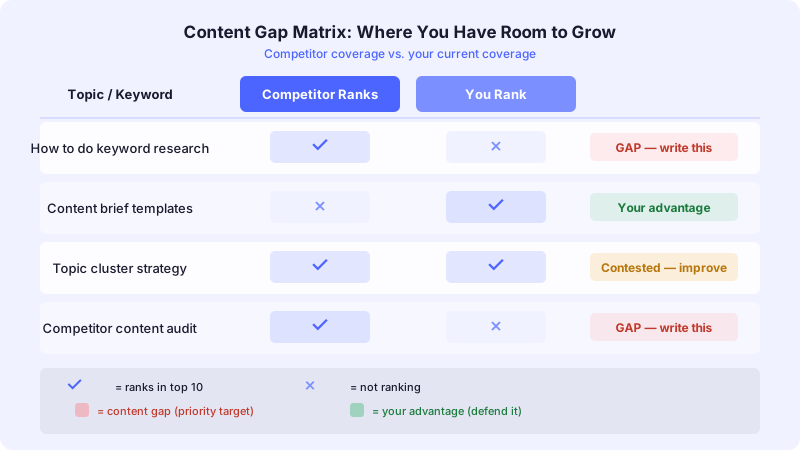
The gap you care about is: keywords they rank for that you do not appear for at all. Not position 15 versus position 8, but complete absence from the results. These are your true content gaps, the topics where you have zero presence and they have established authority.
Ahrefs calls this their Content Gap tool, which lets you paste in competitor URLs and surface keywords driving their traffic that you are not ranking for. SEMrush has a similar feature in their Keyword Gap report. Both are worth running even if you use them only once per quarter.
For a more detailed process on identifying these gaps at the keyword level, the content gap analysis guide covers the mechanics in depth.
Step 3: Map keywords to content clusters, not individual pages
Here is where most competitor content audits go wrong. Teams look at a list of 400 gap keywords and try to address them one post at a time. The better move is to group those keywords by topic cluster, then evaluate whether the cluster is worth owning as a whole.
A cluster might be five to fifteen keywords that all orbit the same concept. If a competitor has five posts on content briefs (what they are, how to write them, templates, examples, for agencies) and you have none, that is not a list of five missing posts. It is a missing cluster that represents a topic you have zero authority in. The cluster-level view changes your prioritization entirely.
Building topical authority matters here. Search engines reward sites that cover a topic comprehensively, not sites that have one good page surrounded by nothing related. According to Google's own documentation on how helpful content is evaluated, depth and coverage of a subject area are explicit signals of expertise.
A single post rarely establishes that. A cluster does.
The topical authority explainer goes into how Google interprets cluster depth and why publishing isolated posts rarely builds the kind of authority that compounds.
Step 4: Audit what they actually published
Ranking data tells you which topics they win. Reading their content tells you why, and where the ceiling is.
For each priority gap cluster, read the top two or three competitor posts. Note:
- Depth: Do they cover the topic end-to-end or skim the surface?
- Format: Is it a listicle, a step-by-step guide, a comparison, or something else?
- Freshness: When was it last updated? An 18-month-old post with no 2025 or 2026 context is beatable on recency alone.
- Perspective: Do they take a real stance, or hedge everything into uselessness?
The competitor content audit is not about copying their structure. It is about understanding what the floor is so you can build something that clears it by enough to win the click and hold the position.
One pattern worth flagging: if every top-ranking post on a topic is a generic overview, the gap is not the topic itself, it is depth. Write the definitive guide, something that actually explains the nuance, and you have a real differentiation argument. Shallow competitors are often the easiest to outrank because readers signal quality to Google through engagement, and a genuinely useful post wins that signal.
It is also worth checking how often competitors update their top posts. Google applies what it calls Query Deserves Freshness to certain query types, which means "how-to" and date-sensitive queries consistently reward more recently updated content. If a competitor last touched a post in 2023 and it is still ranking, a fresher version is a credible threat.
Step 5: Score and prioritize your gaps
Not every gap is worth closing. A simple scoring approach: evaluate each gap cluster on three dimensions.
Search volume potential: Add up the estimated monthly search volume across the keywords in the cluster. This is directional, not exact, but it surfaces which clusters actually drive traffic versus which ones look interesting on paper but barely get searched.
Competitive difficulty: Check the domain authority or domain rating of the sites holding the top three positions. If they are all domain authorities above 80, your new post will need serious promotion or link building to break through. That does not mean skip it, but it does mean factor in the lift required.
Strategic fit: Does this cluster serve the audience you are trying to reach? A B2B SaaS company finding a content gap in celebrity gossip keywords should skip it. The traffic is real but the audience is wrong, and wrong-audience traffic does not convert or build authority in your space.
Tools like ClusterMagic help accelerate this step by grouping keywords into clusters automatically and surfacing volume and difficulty signals in one view, so you are not manually stitching together spreadsheets from three different exports.
Prioritize clusters where volume is real, difficulty is manageable for your current domain strength, and the topic fits your positioning. These are your high-confidence bets. Tackle them before going after the harder clusters, because early wins build the domain authority that makes the harder ones more achievable later.
Step 6: Turn gaps into a publishing plan
A competitive content analysis is only useful if it outputs something actionable. Here is a clean way to structure the handoff to your editorial calendar.
For each priority cluster, define:
- The pillar post that anchors the cluster (typically the broadest, highest-volume term)
- Two to four supporting posts that go deeper on specific subtopics
- The target format for each (guide, comparison, checklist, tutorial)
- A realistic publish cadence that gets the pillar out first
The SEO content strategy framework covers how to structure pillar-and-cluster architecture if you want to go deeper on execution.
Once you have the cluster map, sequence the posts so the pillar comes first. Publishing supporting content before the pillar exists means you have nowhere to link to, and the supporting posts will be weaker for it. Internal links from a strong pillar are part of what gives the cluster its ranking signal.
HubSpot's research on topic clusters and pillar pages showed that organizing content around interconnected cluster structures led to measurable improvements in organic traffic for sites that adopted the model. The mechanism is consistent: interconnected posts reinforce each other's authority in ways that standalone posts simply do not.
What to do when competitors cover everything
If you are in a competitive space where large publishers have covered every obvious topic, the gap strategy shifts. You are no longer looking for uncovered topics. You are looking for covered topics where the existing content is shallow, outdated, or written for a different audience than yours.
A SaaS company competing with broad content marketing blogs does not need to write another "what is content marketing" definition post. It needs to write "content marketing for teams of three, with no agency budget, who need to rank in 90 days." The narrower, more specific framing serves a searcher the broad content ignores, and narrowly framed content often faces significantly weaker competition.
This is also where your product or service can differentiate the content. If you have access to data, case studies, or outcomes your competitors cannot claim, build the post around that evidence. Generic insight is the one thing large publishers will always outproduce you on. Specific evidence, a real customer result, a proprietary data point, a workflow you have actually run, is the one thing they cannot replicate.
Running the audit on a recurring basis
A competitor content audit done once is a snapshot. Running it on a 90-day cycle turns it into an early-warning system. New competitor posts gaining traction, new keywords emerging in your gap list, old competitor content going stale: all of these show up in a recurring audit before they show up in your traffic numbers.
Set a lightweight quarterly process: pull keyword gaps, review for new clusters, check whether posts from the last cycle have moved the needle. It should take two to three hours with the right tools.
Treating the audit as a living process changes how your team thinks about publishing. Instead of chasing arbitrary content calendars, you are responding to competitive intelligence. That discipline keeps your roadmap grounded in what the market is actually doing.
For a complementary perspective on measuring whether your own content is performing once published, the content performance analysis guide is a useful companion to the competitive research process.
The competitive edge hiding in plain sight
The best gap your competitive content analysis will find is rarely a missing keyword. It is usually a missing angle: the post no one has written yet because everyone assumed it was already covered. That gap is almost always visible in the data if you look for clusters where search volume is real but the top-ranking pages are thin, off-topic, or three years old.
Build the cluster around that angle, make it the most thorough treatment the topic has seen, and you have a defensible position. Topical authority compounds: the first team to own a cluster keeps the advantage as long as they maintain it.
Recommended Posts





.svg)