

.svg)
How to Optimize Your Content Creation Process (Without Burning Out) | ClusterMagic

Most content teams don't have a process problem. They have a documentation problem. The steps exist somewhere in people's heads, the Slack DMs, and the "final_FINAL_v3" drafts in Google Drive. When that institutional knowledge walks out the door, the whole system breaks.
A documented, repeatable content creation process is what separates teams that scale from teams that sprint and crash. This guide walks you through the five stages of a healthy workflow, where AI fits in, and how to know if your process is actually working. If you want to see a fully built version of this process in action, learn more about how ClusterMagic runs it for you.
Why Most Content Processes Break Down
The symptoms are familiar: missed deadlines, content that goes through six rounds of edits, writers waiting on briefs that never arrive, and editors who can't approve anything without a manager signing off. These problems look like people problems. Usually, they're process problems.
The three most common failure points:
- No clear ownership at each stage. Everyone thinks someone else is moving the piece forward.
- Briefs that arrive late, incomplete, or after the writer has already started.
- Review cycles with no defined feedback scope, so every round introduces new opinions.
The fix isn't a new project management tool. It's deciding what happens at each stage, who is responsible, and what "done" looks like before moving to the next step.
The 5 Stages of a Repeatable Content Process
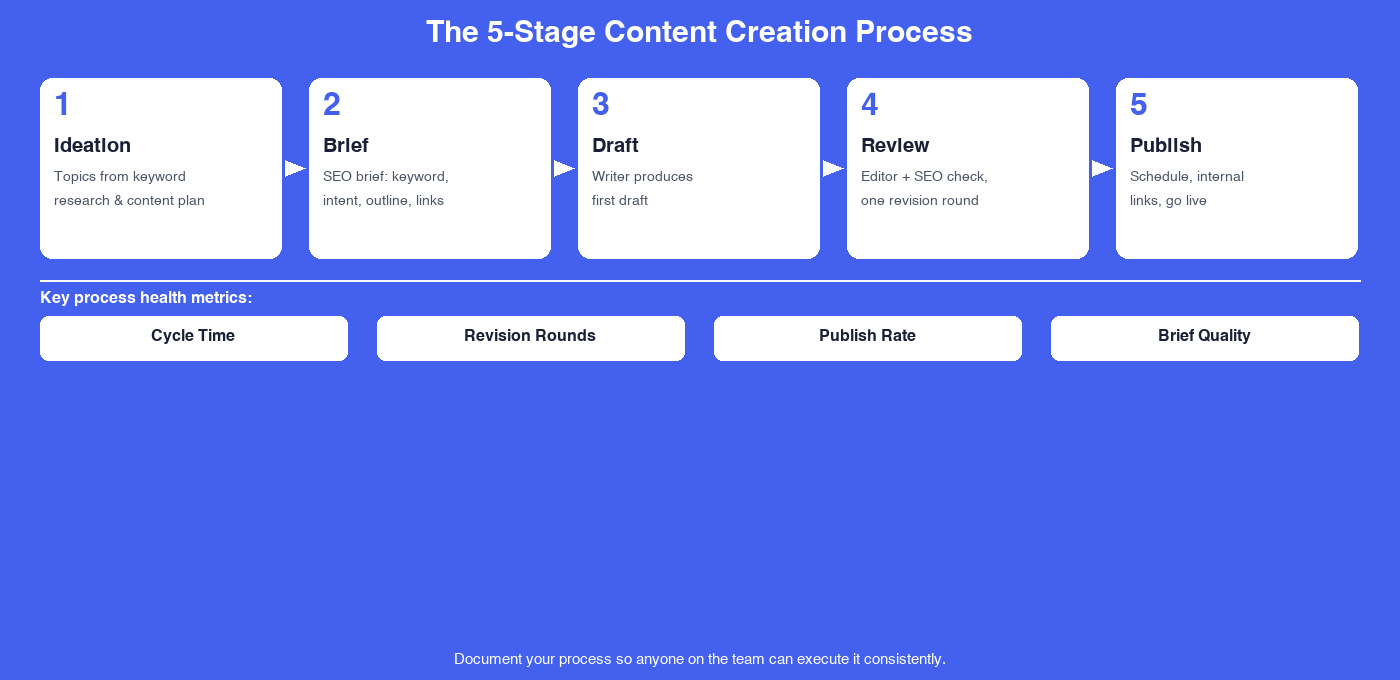
A reliable content creation process has five stages. Each stage has a single owner, a clear input, and a defined output.
Stage 1: Ideation
Ideation isn't a brainstorm free-for-all. Good ideation is driven by keyword data, customer questions, sales team feedback, and competitive gaps. The output of ideation is a prioritized list of topics tied to business goals, not a dumping ground of random ideas.
Tools like Airtable or Notion work well for maintaining an idea backlog with fields for target keyword, funnel stage, content type, and priority score. The goal is to make idea selection a quick, low-friction decision rather than a weekly debate.
Stage 2: Brief
The brief is where most content processes lose time. A weak brief forces writers to make decisions they shouldn't be making. A strong brief gives the writer everything they need to produce a first draft that hits the target.
Your brief should include: target keyword and secondary keywords, audience and intent, outline structure, internal and external links to include, word count range, and tone notes. For a full breakdown of what belongs in a content brief, see our guide to the content brief template.
Brief quality directly determines draft quality. A 30-minute investment in a thorough brief saves two rounds of revision.
Stage 3: Draft
The draft stage is where the writer works. The only job of the process here is to protect focused writing time and remove blockers quickly. Writers should not be chasing down approvals, waiting on assets, or unclear about the brief.
This is also where AI-assisted drafting fits naturally. AI tools can accelerate first drafts, help with outline structure, or generate alternative phrasings. What AI cannot replace: original research, subject matter expertise, and brand voice consistency. Treat AI output as a starting point, not a finished draft.
Stage 4: Review
Review is the stage most likely to spiral without clear constraints. A well-defined content approval workflow prevents the back-and-forth that stalls pipelines. Define who reviews, in what order, and what each reviewer is responsible for. An editor checks structure and clarity. A subject matter expert checks accuracy. A brand or legal reviewer checks compliance. These are separate passes with separate scopes.
CoSchedule's content calendar methodology recommends setting hard deadlines for feedback turnaround, typically 24 to 48 hours per reviewer. Without time constraints, reviews drift and publish dates slip. Limit revision rounds to two before escalating.
Stage 5: Publish
Publishing is not just clicking a button. The publish stage includes final SEO checks (title tag, meta description, internal links, alt text), scheduling at the right time, and setting up distribution. A published piece without a distribution plan reaches almost no one. Build distribution steps directly into the publish checklist.
HubSpot's content production templates include publish checklists that cover on-page SEO, social scheduling, and email. Adapt a version for your own team.
How to Document Your Process So Anyone Can Execute It
Documentation does not need to be a 40-page wiki. It needs to answer three questions for each stage: who is responsible, what do they need to start, and what do they hand off when done.
A simple process doc includes:
- A one-page flowchart showing stage sequence and handoffs
- A brief template (linked, not embedded) so it's always current
- A publish checklist
- A list of tools and where each stage lives (Notion, Google Docs, Airtable, etc.)
Run a new team member through the process doc before their first assignment. If they finish confused, the doc needs work, not the person.
Where AI Fits in the Workflow
AI is a drafting and research accelerant. It is not a replacement for human editorial judgment. The teams seeing the best results use AI at specific, bounded stages: generating outline options during briefing, drafting section bodies from a structured brief, and suggesting meta descriptions or title tag variations.
The mistake is using AI as a shortcut for the brief stage. Putting a vague topic into an AI tool and publishing the output produces thin content that doesn't serve the reader and doesn't rank. The brief still has to be written by a human who understands the audience and the keyword intent.
AI-assisted drafting works best when the input is highly specific. The more constraints you give the tool, the more useful the output. For a deeper look at how to integrate AI into a structured workflow, the AI SEO content workflow guide covers the full production loop from brief to publish.
How to Measure Process Health
Most content teams measure output (posts published per month). Healthy teams also measure process quality. Three metrics worth tracking:
- Cycle time: the number of days from brief assignment to publish. Track this per content type. If articles are taking 30 days and you want 14, find where time is accumulating.
- Revision rounds: how many back-and-forth cycles each piece goes through before approval. More than two rounds signals a brief quality or reviewer scope problem.
- Publish rate: what percentage of pieces that enter the pipeline actually get published. A low publish rate means you're investing in content that gets killed. Find out why.
These three numbers will tell you more about process health than any productivity dashboard.
The Connection Between Process and SEO Outcomes
A faster, more consistent content creation process has a direct SEO impact. Teams that publish on a regular cadence build topical authority faster. Pieces that go through a proper brief and review cycle are more likely to fully answer search intent, which is what search engines reward. Teams exploring automated content creation for SEO should build this process foundation first so automation amplifies quality rather than bypassing it.
When you scale content production without a documented process, quality variance increases. Some pieces rank well. Others don't. You can't diagnose why because the inputs were inconsistent. A repeatable process makes your content output more predictable and your SEO results more attributable.
Semrush's content audit research consistently shows that sites with a defined content production workflow outperform those without on both publishing frequency and organic traffic growth over 12-month periods. If your team wants the process handled end-to-end, ClusterMagic runs the full content workflow for you — from keyword research and briefs through to published articles.
What a Healthy Content Process Looks Like in Practice
It helps to see the five stages as a concrete checklist rather than an abstract framework. The following example walks through what a well-run process looks like for a single 1,500-word B2B blog post from idea to publish. This is what "good" looks like at a team producing eight to twelve posts per month.
Worked Example: Publishing a Comparison Post
The topic: "Content brief template vs. creative brief: what's the difference?"
Stage 1 check (Ideation):
- [ ] Topic sourced from keyword data, not random suggestion
- [ ] Target keyword confirmed with search volume and intent checked
- [ ] Post fits a gap in the existing content cluster, not duplicating a live post
- [ ] Added to the content backlog with funnel stage and priority score noted
Stage 2 check (Brief):
- [ ] Primary keyword, secondary keywords, and cluster context documented
- [ ] Searcher intent confirmed: informational, not transactional
- [ ] H2 outline provided so writer knows the structure before starting
- [ ] Internal linking targets listed (at least two)
- [ ] Word count range set (1,200 to 1,600 words)
- [ ] Tone example included (link to a comparable live post)
- [ ] Brief reviewed by content lead before writer is assigned
Stage 3 check (Draft):
- [ ] Writer has brief before starting, no open questions
- [ ] First draft submitted within agreed turnaround window
- [ ] Introduction addresses search intent in the first 100 words
- [ ] No placeholder sections or unresolved notes left in the draft
Stage 4 check (Review):
- [ ] Editor reviews for structure and clarity only in round one
- [ ] Subject matter check completed separately if needed
- [ ] Feedback returned within 48 hours
- [ ] Revision rounds capped at two before escalation
Stage 5 check (Publish):
- [ ] Title tag under 60 characters, includes primary keyword
- [ ] Meta description written (130 to 155 characters)
- [ ] Internal links in place and pointing to correct URLs
- [ ] Featured image has descriptive alt text
- [ ] Distribution plan confirmed before clicking publish (email, social, syndication)
This checklist is not exhaustive. Your team's version will be shaped by your tools, your approval structure, and the content types you produce. The point is that each stage has a defined "done" condition before the piece moves forward. When every person on the team knows what done looks like, handoffs are faster and quality holds even as volume increases.
A related place to invest is your SEO content strategy, which shapes what topics enter the ideation stage in the first place. A weak strategy sends good process skills chasing low-value topics. The strongest content operations build the process and the strategy together so each one reinforces the other.
Where to Start
Pick the one stage in your current process that causes the most friction. For most teams, that's the brief. Start there. Build a brief template, document who owns it, and use it on your next five pieces. Measure whether draft quality improves.
You don't need to rebuild everything at once. A process that works is one that gets followed. Start small, document as you go, and tighten each stage over time.
Recommended Posts





.svg)