

.svg)
Content Subscription Services: The SEO Buyer's Guide | ClusterMagic

Most content subscription services promise consistent publishing. Few promise consistent rankings. That gap is where marketing teams burn budget, hit a wall at three months, and conclude that "content just doesn't work for us."
It usually isn't the content itself. It's the strategy underneath it. A content subscription service that doesn't connect publishing cadence to keyword clusters, internal linking, and topical authority is just scheduling noise. This guide is for teams who want to understand what makes an SEO-oriented subscription different, how to compare providers honestly, and what tradeoffs to expect. If you want to see how a strategy-led subscription handles this in practice, get started with a walkthrough.
What a Content Subscription Service Actually Covers
The term gets used loosely. At minimum, a content subscription gives you a recurring volume of written deliverables (typically blog posts) for a flat monthly fee. At the higher end, it functions like an embedded content team: keyword research, briefs, writing, optimization, and reporting.
The range is enormous. A $499/month subscription might deliver four generic 1,000-word posts with minimal SEO input. A $3,000/month subscription might include a dedicated strategist, cluster-mapped editorial calendars, and topic authority tracking.
Most services fall into one of three operational models:
- Marketplace model: You post requirements, freelancers bid or claim the work. Quality varies by writer. Best for buyers who want flexibility and already have their own editorial process.
- Managed service model: The provider assigns writers, editors, and sometimes a strategist. More consistent output, less flexibility on scope changes.
- Strategy-led subscription model: The provider owns both the content plan and the execution. You get deliverables shaped by research, not just a brief you wrote yourself.
Understanding which model you're buying matters more than comparing word counts or price per post. For a deeper look at how these models fit into a broader SEO program, see what managed SEO services actually include.
The SEO Problem Most Subscriptions Ignore
Here is the honest version: most content subscriptions are optimized for throughput, not for rankings.
They hire generalist writers, use surface-level briefs, and deliver posts that check the on-page boxes (keyword in the title, a few headers, a meta description) without addressing what actually drives organic growth: topical coverage and internal linking structure.
Google doesn't reward individual good articles in isolation. It rewards sites that demonstrate depth and authority on a topic over time. A cluster of 10 well-linked posts on a single subject will outperform 10 unconnected posts at twice the quality. This is the core principle behind topical authority, and it's what separates a content strategy from a content calendar.
This is why a content gap analysis should precede any subscription engagement. If you don't know which keyword clusters you're targeting, no volume of publishing will move the needle reliably. The subscription fills a calendar; the strategy fills the gaps competitors haven't covered.
How to Compare Content Subscription Services for SEO
Does the Service Build Toward Topical Authority?
Ask providers directly: do they map deliverables to keyword clusters, or do they take topics from you one post at a time? Cluster-first planning is the single biggest differentiator between subscriptions that compound over time and ones that plateau.
A provider with cluster logic will be able to show you a planned topic map, not just a content calendar. The calendar shows what publishes when. The map shows how posts connect and which competitive gaps they close.
How Are Briefs Structured?
Brief quality is the clearest signal of SEO sophistication. A strong brief includes the target keyword, secondary keywords, search intent classification, competitor URLs to beat, required internal links, and a structural outline. A weak brief is a topic and a word count.
If you want a benchmark, the content brief template guide covers what a brief that writers actually use looks like in practice. Compare what a prospective provider sends you against that standard.
What Does Quality Control Actually Mean?
Every service claims quality. Ask what the review process is. Who edits the work: a dedicated editor, the writer themselves, or an automated grammar pass? Is there SEO-specific review, or just prose review? How many revision rounds are included?
Most managed services include one round of revisions. If your brand voice or technical accuracy requirements are demanding, one round is rarely enough. Some providers charge for additional rounds; factor that into true cost comparisons.
Is AI Use Disclosed and Managed?
In 2026, most services use AI at some point in the production process, whether for drafts, outlines, or first-pass research. That isn't inherently a problem. Undisclosed AI output that ships without meaningful human editing is.
Ask providers directly about their AI policy. Look for answers that distinguish between AI as a drafting aid (acceptable) and AI as a final output (a risk to content quality and, increasingly, to search performance as Google's helpful content guidance continues to evolve).
What Different Price Points Actually Buy You
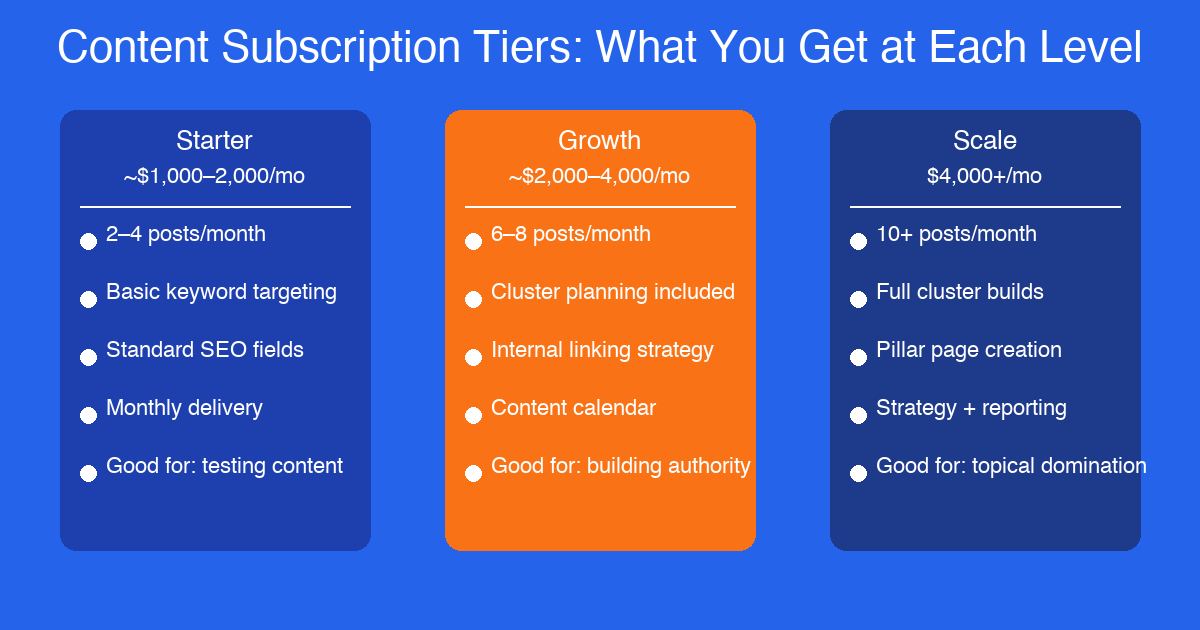
Pricing in this category runs from roughly $500/month to $10,000+/month for full-service engagements. Here is a realistic breakdown of what the tiers deliver. These are operational expectations, not what providers advertise.
$500–$1,500/month: You get volume. Usually four to eight posts per month from a writer pool. Minimal strategy involvement, basic on-page optimization, light or no internal linking work. Good fit for maintaining publishing cadence when you have your own SEO strategy and just need execution bandwidth. Ahrefs' content marketing research consistently shows that most published content earns zero organic traffic, which is the risk when publishing at this tier without a keyword-driven plan.
$1,500–$4,000/month: This is where managed quality starts. Dedicated writers, editorial oversight, and some keyword-level input. Some providers at this tier include cluster mapping; most still expect you to supply strategic direction.
$4,000–$10,000+/month: Full-service territory. You should expect keyword research, cluster architecture, brief creation, writing, editing, SEO QA, internal link mapping, and performance reporting. If a provider at this price doesn't include all of these, you're overpaying for managed execution. ClusterMagic is an example of a strategy-led subscription built around this model, focused specifically on topic cluster strategy and content execution.
For SaaS companies specifically, the calculus shifts slightly. The content types, buying cycle, and audience sophistication all change what "good" looks like. The SaaS content marketing guide covers that context in more detail.
Tradeoffs Worth Being Honest About
No subscription model is frictionless. Here are the tradeoffs that matter.
Speed vs. quality. Higher volume always creates pressure on quality. If a provider promises ten posts per month at a price that implies four hours per post, someone is cutting corners on research, editing, or SEO alignment.
Generalist vs. specialist writers. Marketplace models give you access to specialists in narrow industries, but you have to find and vet them. Managed models give you consistency but often route to generalist writers who research your topic rather than knowing it.
Flexibility vs. predictability. Project-based pricing lets you scale up or down with no commitment. Subscription pricing gives you predictability and, usually, a lower effective cost per piece. If your content needs fluctuate significantly month to month, a hybrid model with a small subscription baseline plus on-demand capacity often makes the most sense.
Ownership of strategy. In a subscription that includes strategy, you become dependent on the provider's judgment. That's fine when the provider's judgment is good. It's a liability when priorities shift or when you need to transition providers. Document the cluster maps, briefs, and editorial rationale you receive. Own the strategy artifacts, not just the published posts.
The Compounding Value Argument
The real business case for a content subscription service isn't monthly traffic. It's what that traffic looks like at month eighteen.
Organic search compounds in a way that most paid channels don't. A well-structured cluster of posts targeting a keyword group doesn't just maintain traffic; it grows as new posts add topical signal, internal links strengthen existing posts, and the domain earns authority in the subject area. The organic traffic growth guide walks through exactly how that compounding works at each phase. Scaling content production without losing that strategic coherence is the operational challenge most teams underestimate.
The providers worth paying for understand this compounding logic. They track topical coverage, not just traffic. They know which posts are supporting others and which clusters are incomplete. They can show you the gap between where the site is and where it needs to be to compete for high-value keywords. Search Engine Journal's research on content clusters documents why interconnected content consistently outperforms standalone posts for organic growth.
That's a meaningfully different engagement than a service that delivers posts and sends an invoice.
Questions to Ask Before You Sign
Before committing to any monthly content writing service, get clear answers to these:
- How do you decide what topics to cover each month? (You want: cluster-based research. Red flag: "We'll use whatever topics you send us.")
- Can you show me a sample brief? (Compare against your own quality standards.)
- What does your SEO review process cover? (You want: keyword targeting, internal linking, search intent alignment. Red flag: "We use Yoast/Surfer before publishing.")
- How do you measure success? (You want: ranking movement and organic traffic growth. Red flag: "We track words delivered.")
- What happens if quality isn't there? (You want a clear revision and escalation policy in writing.)
The right provider will answer these questions without hesitation and give you specifics, not assurances.
A content subscription service is a long-term investment in organic growth. The ones that deliver that growth are structured around SEO from the start, not bolted on afterward. The ones that don't are structured around volume, and volume without strategy is just a more expensive way to not rank.
Recommended Posts





.svg)