

.svg)
What Are Managed SEO Services? (And Do You Actually Need Them) | ClusterMagic

Most marketing teams know they need SEO. Far fewer have the bandwidth to actually do it well. Managed SEO services exist in that gap, handling the strategy, execution, and reporting that most in-house teams don't have time for.
But "managed SEO" means different things depending on who you ask. Some providers send a monthly report and call it strategy. Others run the entire content pipeline, technical audits, link building, and analytics. Knowing what you're buying before you sign matters more than most buyers realize.
This guide breaks down what managed SEO services actually include, what different models cost, and how to know whether hiring out is the right move for your situation. If you'd rather skip the research and get started with ClusterMagic, you can see exactly what a strategy-led managed program looks like before committing.
What Managed SEO Services Actually Include
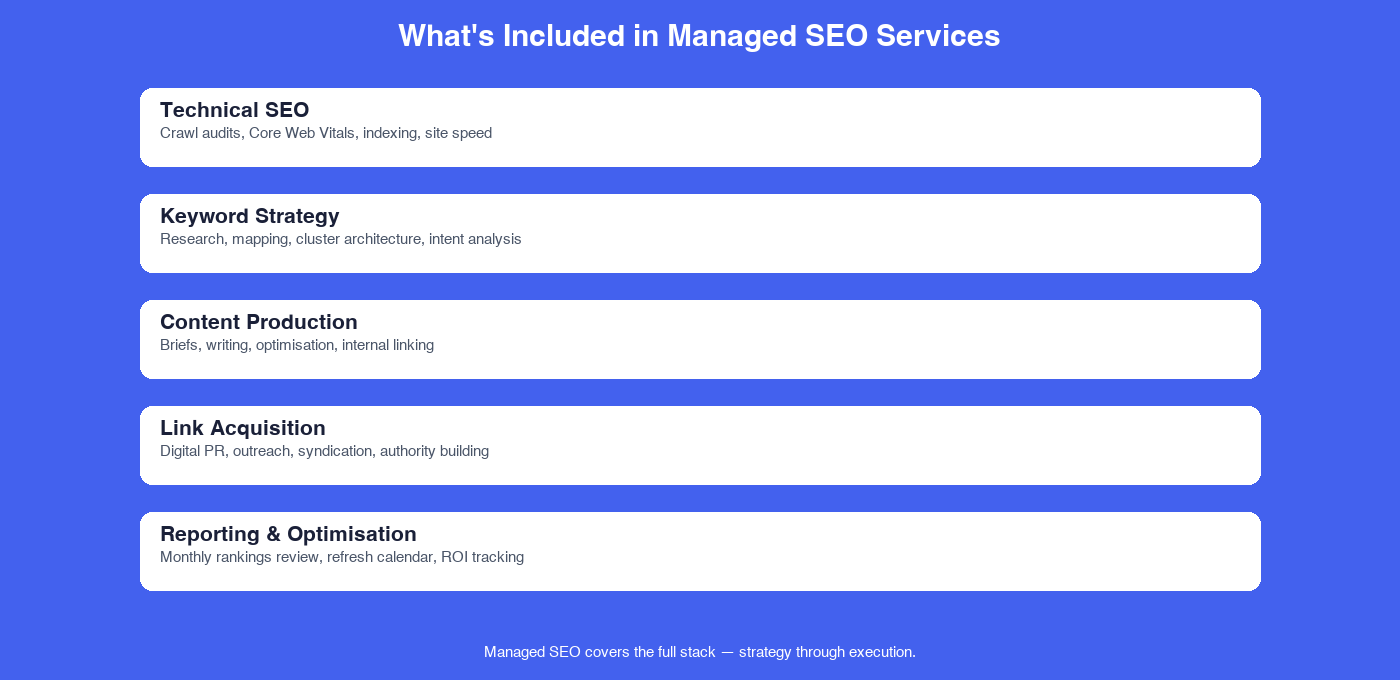
The word "managed" implies someone else is running the operation. In practice, managed SEO services cover three core areas: strategy, execution, and measurement. What varies is how deep each provider goes in each area.
A well-run managed SEO engagement typically includes:
- Keyword research and prioritization, identifying which terms your audience searches, which ones have realistic ranking potential, and how to sequence them
- On-page optimization, improving existing pages with better titles, meta descriptions, heading structure, and internal linking
- Content creation, writing new blog posts, landing pages, or supporting content mapped to target keywords
- Technical SEO, site speed, crawlability, indexation, Core Web Vitals, structured data (the technical SEO for content teams guide covers what content-focused teams most often miss)
- Link building, earning or placing backlinks from relevant external sites
- Reporting and analysis, tracking rankings, organic traffic, and conversions over time
Not every provider handles all of these. Some specialize in content-led SEO and don't touch technical issues. Others focus on link acquisition and treat content as someone else's problem. Before you evaluate any provider, decide which of these areas are genuinely gaps for your team.
The Different Models: Local, National, and Content-Led SEO
Managed SEO services aren't one-size-fits-all. The right model depends on your business type, target geography, and primary growth lever.
Local SEO services focus on visibility in geographically bounded searches: "dentist near me," "plumber in Austin," and similar queries. They typically include Google Business Profile optimization, local citation building, review management, and localized content. Moz's Local Search Ranking Factors breaks down exactly what drives local visibility and is worth reading before you evaluate any local SEO provider. For a detailed breakdown of what local SEO services packages include and what separates strong providers from generic ones, the dedicated guide covers what to ask before you sign.
National and enterprise SEO deals with broader keyword targets, usually for brands without a geographic constraint. The strategy involves deeper technical work, large-scale content programs, and competitive link building. Ahrefs' guide to enterprise SEO covers what separates enterprise-level execution from standard approaches.
Content-led SEO is the model most relevant to B2B and SaaS companies. The core thesis is that publishing a structured body of topical content, organized into content clusters around a pillar page, builds ranking authority over time. ClusterMagic is an example of this model — a managed service that handles keyword research, topic cluster strategy, content production, and publishing. Check out our content subscription services guide for a detailed look at how recurring content programs support this model.
Each model has different cost structures, timeframes, and skill requirements. Knowing which one fits your goals before talking to providers saves you from comparing apples to oranges.
What Managed SEO Actually Costs
Pricing for managed SEO services ranges widely. Here is a realistic breakdown by tier:
- Entry-level ($500-$1,500/month): Typically freelancers or small agencies. Expect limited scope: a few pieces of content per month, light reporting, and minimal technical work. Works for small local businesses.
- Mid-market ($1,500-$5,000/month): Small-to-mid agencies or specialized content programs. More structured deliverables, clearer strategy, and better reporting. Suitable for growing SMBs and early-stage startups.
- Full-service ($5,000-$20,000+/month): Comprehensive managed programs at larger agencies. Includes technical SEO, content at scale, link building campaigns, and dedicated account management. Common for established companies with competitive niches.
The number matters less than what you're getting for it. A $3,000/month retainer that produces four well-researched, optimized articles per month often delivers better long-term value than a $1,000 retainer that produces eight thin posts. Search Engine Journal's overview of SEO pricing provides useful benchmarks for what different service levels typically cost.
What you're really paying for is execution consistency. Organic search compounds when you publish steadily, fix technical issues before they compound, and build links over time. A managed service removes the gaps in execution that kill most in-house SEO programs.
Hire vs. Build In-House: How to Decide
Managed SEO makes sense in certain situations and doesn't in others. Be honest about your team's actual capacity, not ideal capacity.
Hiring a managed service usually makes sense when:
- Your team has no dedicated SEO or content resource
- You need results in a defined timeframe and can't afford a 6-month hiring process
- Your niche is competitive and requires specialized expertise
- You've tried in-house SEO and execution keeps slipping
Building in-house is the better path when:
- You have the budget to hire a skilled SEO lead and content team
- Your content topics require deep proprietary knowledge an outside team can't replicate
- You need SEO tightly integrated with product and sales feedback loops
A hybrid approach works well for many companies: an in-house content strategist or editor who maintains brand voice and product knowledge, paired with a managed service handling keyword research, writing at scale, and technical audits. See our organic traffic growth guide for more on what a full SEO program looks like in practice.
Red Flags When Evaluating Providers
The SEO services market has a credibility problem. Because results take months to materialize, it's easier to sell vague promises than concrete deliverables. If you're also considering working with a dedicated agency rather than a subscription service, what SEO content agencies actually do is worth reading before you compare proposals. Watch for these warning signs:
- Guaranteed rankings. No reputable SEO firm guarantees position one. Google's own guidance explicitly warns against providers making this claim.
- Proprietary "secret" methods. Legitimate SEO is based on well-documented principles. A provider that won't explain their approach is a provider who doesn't want you to evaluate their approach.
- Link schemes. Buying links from private blog networks or link farms is a violation of Google's guidelines and creates long-term risk. Ask any provider directly how they build links.
- No reporting or vague reporting. If a provider can't show you exactly what rankings changed and why, you have no way to evaluate the work.
- Low prices combined with high-volume promises. Producing 20 SEO blog posts per month for $800 means either the posts are thin, AI-generated without editorial review, or both.
The best providers are transparent about their process, realistic about timelines, and willing to show you examples of past results with context about the competitive environment.
How to Measure Whether It's Working
SEO takes time. Three months is too early to draw conclusions about a managed engagement. But you should see leading indicators that the program is moving in the right direction.
Track these metrics monthly:
- Keyword rankings for target terms (directional movement matters, not just position one)
- Organic impressions and clicks in Google Search Console (are more pages surfacing?)
- Indexed content (are new pages getting discovered and indexed promptly?)
- Referring domain growth (is the backlink profile growing from legitimate sources?)
Track these quarterly:
- Organic traffic growth to target pages
- Conversion contribution from organic (not just traffic, but what that traffic does)
- Share of voice on your most important keyword clusters
A good managed SEO partner surfaces these numbers without being asked. They send a monthly report that explains what happened, why, and what comes next. Ahrefs' rank tracker and Google Search Console together cover most of what you need to evaluate progress without paying for additional tooling.
The most important signal is trajectory, not any single month's numbers. If rankings are trending upward, more pages are getting indexed, and qualified organic traffic is increasing over a 6 to 12 month window, the program is working. For teams that want to understand the fundamentals behind these metrics, the SEO fundamentals for marketers guide covers the core concepts without jargon.
What to Expect in the First 90 Days
Understanding the measurement framework matters, but so does knowing what the early weeks of a managed SEO engagement actually look like. Most buyers have an unrealistic picture of the ramp. Setting accurate expectations at the start prevents the friction that ends otherwise good programs too early.
Month one is almost entirely setup. A credible provider will spend the first four weeks doing things that produce no visible output: auditing your existing site, building a keyword inventory, mapping competitive gaps, and identifying the topic clusters with the best near-term opportunity. If a provider skips this phase and jumps straight to publishing content, that's a signal they're optimizing for activity, not outcomes.
During this period, expect to be asked for access to Google Search Console, Google Analytics, and whatever rank tracking the provider uses. You'll also likely go through a brand and audience intake process. The quality of what comes next depends heavily on what the provider learns in this phase. Be thorough.
Month two is when execution starts. The first batch of content enters production, on-page optimizations go live on existing pages, and technical issues identified in the audit begin getting fixed. You'll see the first round of reporting, which at this stage is mostly baseline data rather than evidence of progress.
One thing most buyers don't anticipate: the lag between content publishing and ranking movement. A post published in week six of an engagement may not show meaningful ranking movement until week fourteen or sixteen. This is normal. Topical authority builds across a body of content, not from a single post. A structured approach to improving organic search performance helps identify which leading indicators to watch during that ramp period. The patience required here is real, and good providers prepare you for it rather than letting you discover it on your own.
Month three is when you can start drawing early conclusions. Not about traffic, but about process. Are briefs arriving with the level of detail you expected? Is the content hitting the quality bar? Are optimizations actually going live on schedule, or are they sitting in a queue? Is reporting arriving on time and answering the questions that matter?
These process signals at 90 days predict whether the program will compound the way it's supposed to. If briefs are thin, content is generic, or reporting is hard to interpret, those problems don't resolve themselves at month six. Address them now, or evaluate whether you have the right provider.
The teams that get the most out of managed SEO engagements are the ones who treat month one as an active collaboration, not a handoff. The provider brings the SEO infrastructure. You bring the product knowledge, audience understanding, and organizational access that makes the content specific enough to matter.
Managed SEO services are a real option for teams that need organic growth without the overhead of building that capability entirely in-house. The key is knowing exactly what you're buying, what a realistic outcome looks like, and how you'll evaluate whether it's working. Get clear on those three things before you sign anything.
Recommended Posts





.svg)