

.svg)
What Do SEO Content Agencies Actually Do? (Services Explained) | ClusterMagic

Hiring an SEO content agency is one of the more common moves for marketing teams that need to grow organic traffic but don't have the headcount to do it alone. It's also one of the decisions that goes wrong most often, usually because the buyer didn't have a clear picture of what an agency actually does before signing.
This isn't a simple answer. SEO content agencies vary enormously in scope, specialization, and quality. Some are essentially content mills with a keyword tool. Others run sophisticated content programs with real editorial oversight, technical SEO expertise, and a data-driven approach to topic prioritization. Knowing the difference upfront saves months of frustration.
Here's what good SEO content agencies do, how they differ from general marketing agencies, and what to look for when evaluating one. If you want to learn more about how a subscription-based content program compares to a traditional agency retainer, that's a good place to start.
The Core Services an SEO Content Agency Provides
The best way to understand what an SEO content agency does is to map out the content pipeline they're responsible for owning. Most credible agencies cover these five areas.
Keyword research and content strategy. This is where the work starts. An agency researches which keywords your target audience is searching, groups them by intent, and builds a content plan that prioritizes topics by opportunity size and ranking difficulty. Ahrefs' keyword research guide is a useful benchmark for understanding what rigorous keyword research looks like. For a deeper look at how that strategy translates into an editorial system, the blog content strategy guide is worth reading alongside it.
Content briefs and writing. Once a keyword is approved, the agency produces a content brief that outlines structure, target length, competing pages, and what a strong piece needs to cover. A well-defined content approval workflow ensures each deliverable passes through quality gates before publication. Writers (staff or vetted freelancers) produce the draft. Good agencies have editorial layers; the first draft from a writer is not the final product.
On-page optimization. Every piece of content needs proper title tags, meta descriptions, header structure, and internal links before it goes live. An agency handles these as part of the publishing process, not as an afterthought. Moz's on-page SEO guide covers the fundamentals if you want a reference point.
Link building. Backlinks remain one of the strongest ranking signals. Agencies that include link building typically use outreach (pitching content to relevant publishers), digital PR (creating assets worth linking to), or content placement. Ask any agency to describe their link acquisition process specifically; vague answers here are a warning sign.
Performance reporting. A content program without measurement is guesswork. Agencies track keyword rankings, organic traffic, and conversions, and report on them in a way that connects output to outcome. Google Search Console and a rank tracker are the minimum tools; serious agencies layer in additional analytics.
These five areas form the core. Some agencies also handle technical SEO audits or content distribution, but those are add-ons rather than standard scope.
How SEO Content Agencies Differ from General Marketing Agencies
General marketing agencies are generalists by design. They can build a brand, run paid campaigns, design a website, and manage social media. That breadth is useful for certain clients. But organic search requires sustained focus on a specific set of skills that generalist agencies often treat as secondary.
The difference shows up in a few concrete ways:
- SEO content agencies think in clusters. They build content around topic authority, not just individual keywords. A general agency often produces content without a structural relationship between pieces. For a detailed breakdown of how cluster architecture works, see the guide to content clusters and pillar pages.
- SEO content agencies operate on search data. Every topic decision is grounded in keyword volume, difficulty, and intent. General agencies often produce content based on what seems interesting or what the client requested, without validating whether anyone is searching for it.
- SEO content agencies track ranking outcomes. Their KPIs are search positions and organic traffic, not just content volume or social engagement.
- They have editorial processes built for scale. Writing 8 to 20 optimized blog posts per month requires workflow infrastructure that general agencies rarely have.
If your primary goal is organic traffic growth and you need content that ranks, a specialist SEO content agency is nearly always the better choice over a generalist shop. For a broader look at different service models, see our guide on managed SEO services.
What Agencies Won't (and Shouldn't) Do
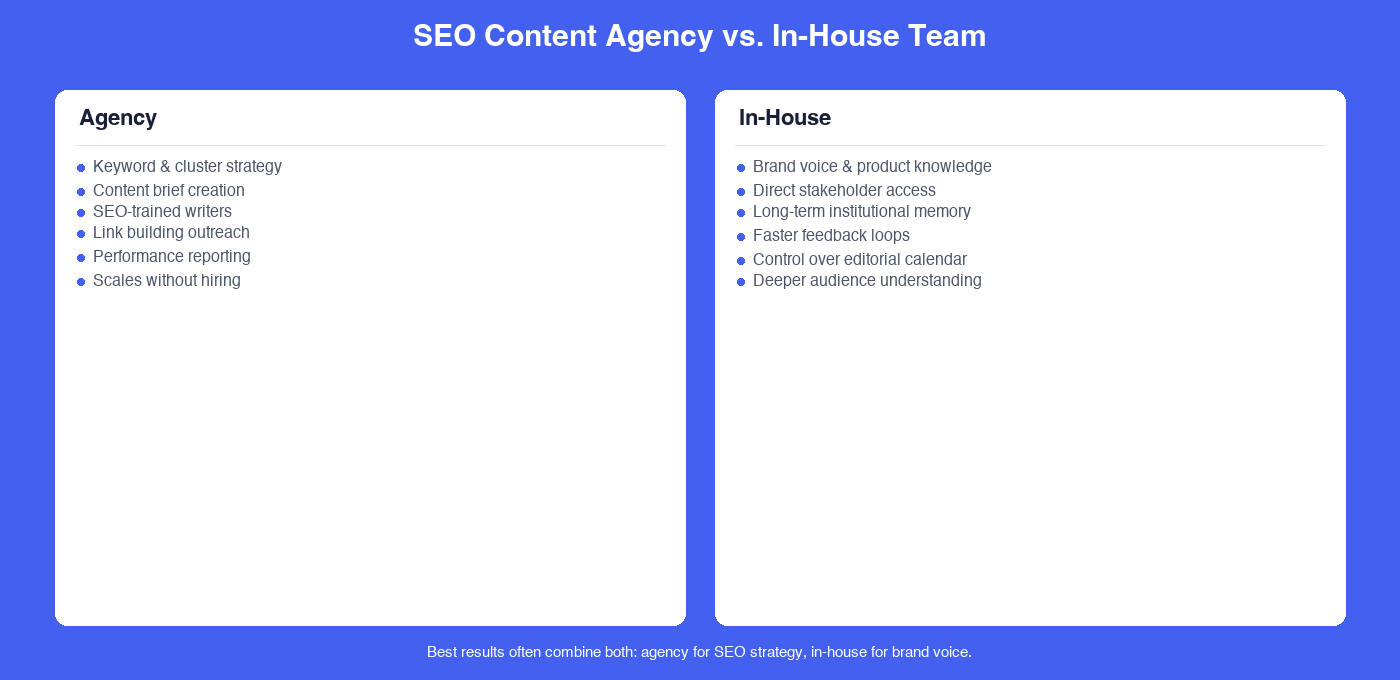
There's a boundary that good agencies respect and bad ones ignore. No outside agency can replace what you know about your own product, customers, and market. When that boundary blurs, content quality suffers.
Specifically, agencies should not be the source of truth for:
- Your product's differentiators, positioning, and use cases
- Customer pain points and the specific language your audience uses
- Industry context that requires hands-on experience in your field
- Internal data, case studies, or proprietary insights
The best agency relationships work because the client provides product and audience expertise, while the agency provides SEO strategy and execution. Agencies that promise to handle everything without client input are usually producing generic content that could apply to any competitor in your space.
A good agency will ask you pointed questions about your customers and product during onboarding. If they don't, that's a signal they're planning to write content that feels SEO-friendly but misses what actually resonates with your audience.
Engagement Models: Retainer, Project, and Subscription
SEO content agencies structure their work in a few different ways. Each model has tradeoffs.
Retainer. The most common model for ongoing content programs. You pay a fixed monthly fee for a defined scope: a set number of articles, optimization work, reporting, and strategy calls. Retainers work well when you need consistent output over time. The risk is paying for capacity you don't fully use some months.
Project-based. A fixed scope with a defined deliverable: a content audit, a cluster of 10 articles for a product launch, or a one-time keyword strategy. Projects are useful for filling a specific gap without committing to a long-term relationship. They're less suited for ongoing traffic growth.
Subscription. A newer model where you subscribe to a recurring content package, often with a clear monthly deliverable count and predictable pricing. For businesses that need consistent content without agency overhead, this model is appealing. ClusterMagic is built on this model — a topic-cluster-focused subscription covering keyword research, briefs, writing, and publishing. Our guide to content subscription services covers this model in more detail.
Most growth-stage companies start with a retainer once they've validated that SEO is a priority channel. Projects are useful for testing an agency before committing. For a broader look at how all of these pieces fit into a long-term program, the organic traffic growth guide covers the full system from keyword foundation through compounding returns.
What Good Reporting Looks Like
Reporting is where agency relationships often break down. Clients receive a dense PDF or dashboard login, spend 20 minutes clicking around, and still don't know whether the program is working.
Good reporting tells a story. It shows what changed, why it changed, and what comes next. Specifically, look for:
- Rankings movement for the keywords you're actively targeting (not just "we ranked for 400 keywords this month")
- Organic traffic trends by page, not just site-wide
- Content performance: which pieces are driving impressions and clicks, which aren't
- Link acquisition: how many new referring domains, from what types of sites
- Clear next steps tied to what the data shows
A monthly report that runs two to three pages with commentary is more useful than a 20-page automated export. If your agency sends you a report you have to interpret yourself, ask for a walkthrough. If the walkthrough still doesn't clarify what you're getting for your money, that's worth addressing directly. HubSpot's guide to SEO reporting offers a useful framework for what a client-ready report should include.
Questions to Ask Before Signing
Due diligence on an SEO content agency comes down to a handful of direct questions. Take notes on whether you get specific answers or hedged ones.
- Can you show me an example content brief you've produced for a similar client?
- What does your content review process look like between first draft and final delivery?
- How do you build links, specifically? What types of sites are you targeting?
- What tools do you use for keyword research and rank tracking?
- What does your onboarding process look like, and what do you need from us to get started?
- What does a monthly report look like? Can you show me a sanitized example?
- What happens if a piece of content doesn't perform? How do you revisit it?
The quality of the answers matters as much as the answers themselves. An agency that speaks in vague generalities during the sales process will likely deliver vague work. Having a content strategy framework of your own helps you evaluate whether an agency's approach is genuinely strategic or just organized. Agencies that are specific, direct, and willing to show their process are usually the ones worth hiring.
Search Engine Journal's agency selection guide covers additional questions worth adding to your evaluation process, particularly around contract terms and communication expectations.
An SEO content agency at its best is an extension of your marketing team, bringing the research, writing infrastructure, and measurement rigor that most in-house teams can't sustain alone. At its worst, it's a vendor churning out forgettable content that never earns a ranking. The difference usually comes down to how clearly the agency explains what they do, and how willing you are to stay involved in guiding the work.
Recommended Posts





.svg)