

.svg)
SEO Content Strategy for Ecommerce: Drive Traffic That Converts
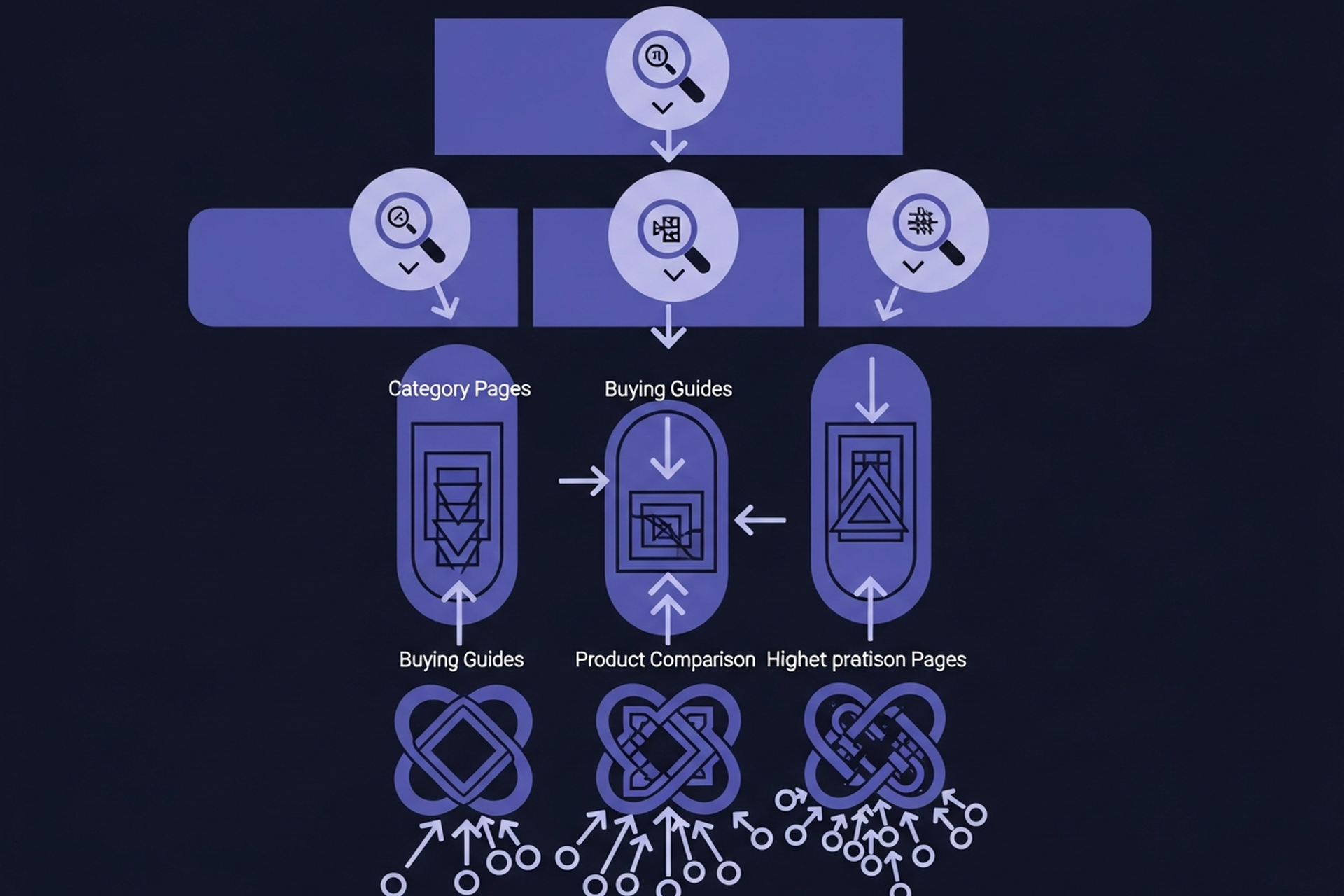
Most ecommerce SEO advice starts and ends with product page optimization. Title tags, meta descriptions, image alt text, schema markup. That work matters. But it's only half of an SEO content strategy for ecommerce.
The other half is the content that attracts buyers before they know exactly what they want to buy, builds trust with shoppers who are comparing options, and guides undecided visitors toward a decision. Organic search drives 43% of all ecommerce traffic. A significant portion of those buyers found their way through content that wasn't a product page.
Here's how to build the content side of ecommerce SEO around sales outcomes, not just traffic numbers.

Start With the Buyer Journey, Not the Keyword List
Ecommerce content planning often starts with a keyword tool and ends with a list of topics that look reasonable on paper but don't connect to how buyers actually make purchase decisions.
A more effective starting point is the buyer journey for your specific category:
Awareness stage: Buyers don't know what they need yet, or they know the problem but not the solution. Content here answers questions like "what's the best way to X" or "how do I choose a Y." These queries often have high volume and low purchase intent. They're valuable for brand building and early-stage trust, but they don't convert directly.
Consideration stage: Buyers are comparing options. They're searching for "X vs Y," "best X for [specific use case]," or "X reviews 2026." This is where detailed comparison content, use-case guides, and category page SEO do the most direct commercial work.
Decision stage: Buyers are ready to purchase but may have final questions about a specific product, a brand's policies, or shipping and returns. Content here is often product-level, but FAQ content and trust signals matter significantly.
Map your content plan against these three stages. If everything you've created targets awareness but nothing supports the consideration stage, you're generating traffic that doesn't convert. If you've only focused on decision-stage product pages, you're invisible to buyers earlier in the process.
Optimize Category Pages as Content, Not Just Navigation
Category pages are the most underutilized real estate in ecommerce SEO. Most stores treat them as navigation: a grid of products with a few filter options. High-performing ecommerce sites treat category pages as content that earns search rankings.
What a well-optimized category page includes:
- A concise introductory text block (150-300 words) that naturally incorporates the primary and secondary keywords for that category, explains what the category covers, and addresses the key considerations buyers care about
- Structured product listings with enough descriptive context that the page communicates value on its own, not just through product titles
- Internal links to related categories and relevant buying guides
- Schema markup for product lists, reviews, and breadcrumbs
Research from Ringly on ecommerce SEO consistently shows that category pages drive the majority of ecommerce revenue through organic search. A product page can only rank for that specific product's queries. A category page can rank for the broader category plus dozens of related commercial queries.
The investment in category page content pays compounding dividends because every product added to that category benefits from the page's existing authority.
Build a Blog That Targets Buying-Intent Queries
Blog content in ecommerce often falls into one of two failure modes: either it's purely informational with no connection to products, or it's thinly disguised product promotion that adds no value for the reader.
The sweet spot is content that genuinely answers a buyer question while naturally connecting to relevant products where appropriate.
Content types that consistently drive traffic and sales for ecommerce:
Buying guides and comparisons
"Best hiking boots for wide feet," "kitchen knives under $100 compared," "which type of yoga mat is right for your practice." These posts directly match consideration-stage intent. They rank for high-commercial-intent queries and readers who find them are explicitly shopping.
A well-written buying guide:
- Explains the key factors to evaluate (not just product features, but how those features map to buyer needs)
- Covers genuine tradeoffs
- Links to relevant products or categories
- Earns links from other sites because it's a genuine resource
How-to and use-case content
Content that shows buyers how to use a product, what to do with an ingredient, or how to accomplish something they want to accomplish. This content attracts buyers who are still forming their sense of what they need and positions your brand as a trusted guide in the category.
A kitchen supply store's guide to "how to season and maintain a cast iron skillet" reaches buyers at the right moment and naturally connects to cast iron cookware products.
Seasonal and occasion content
Seasonal content captures demand that spikes predictably every year. The key is publishing 30-60 days before the relevant period so search engines have time to index and rank the content before traffic peaks. A gift guide published a week before a holiday is too late. The same guide published six weeks before can capture the full wave.
SEO Content Strategy for Ecommerce: Keyword Research Across the Funnel
Most ecommerce keyword research focuses on high-volume terms. There's a better way to structure the keyword work for an SEO content strategy.
Top-of-funnel: Target informational queries with moderate volume and low difficulty. These build domain authority and brand familiarity. Don't expect direct conversion.
Middle-funnel: Target commercial-intent queries with lower volume but meaningful purchase intent. "Best X for Y" queries, comparison queries, and category-specific queries sit here. These convert.
Bottom-funnel: Target decision-stage queries: product-specific terms, brand-specific terms, and "X reviews" or "X alternatives" searches. These are closest to conversion.
Tools like Semrush and Ahrefs both provide intent filtering to help segment keywords by likely buyer stage. Organizing your content roadmap around this funnel structure ensures you're not generating traffic that can't convert.
Connect Content to Product Through Internal Linking
Content that drives organic traffic but never connects to products is a missed opportunity. Internal linking from blog content to relevant product and category pages closes the loop between informational traffic and commercial outcomes.
The mechanics are straightforward:
- When a buying guide recommends a product type, link to the relevant category page
- When a how-to guide references a specific product, link to the product page
- When a category page exists for a topic covered in a post, link from the post to the category
This serves two purposes. First, it gives readers a natural path to purchase without hard-selling. Second, it passes link authority from content pages to product and category pages, improving their rankings.
The goal isn't to turn every blog post into a product catalog. It's to make the connection between content and commerce feel natural and genuinely helpful for the reader.
Measure Content Against Sales Outcomes, Not Just Traffic
Ecommerce content is often evaluated purely on traffic. A post that drives 10,000 monthly sessions looks like a success. But if those sessions generate no purchases, no email signups, and no returns from organic channels, the traffic isn't doing what it needs to do.
Better metrics for ecommerce content performance:
- Assisted conversions: Posts that appear in the conversion path even if they're not the last click before purchase
- Category page traffic and revenue: How much of the traffic to category pages is coming from organic channels
- Average session depth from content: Do blog readers visit product pages? Do they add to cart?
- Return visitor rate: Do first-time visitors from content posts come back and purchase later?
Both Google Analytics and your ecommerce platform's attribution reports can surface assisted conversion data. Evaluating content by its role in the full path, not just the last click, gives a more accurate picture of what's working.
The Bottom Line
An SEO content strategy for ecommerce that only covers product pages is leaving a significant portion of organic opportunity on the table. Buyers do research. They compare options. They look for guidance before they know exactly what they want to buy.
The content you create around that research process is what earns their trust and ultimately drives them to purchase.
Start with category page optimization, build a content roadmap structured around the buyer funnel, and connect every piece of content to relevant products through internal linking. Measure outcomes, not just traffic. The goal is organic search traffic that actually contributes to revenue, not just impressions. Our ecommerce SEO complete guide covers the technical side of this in depth, and the B2B content strategy for lead generation guide shows how the same content funnel principles apply in B2B contexts.
Recommended Posts




.svg)