

.svg)
AI Blog Writing Tools: A Feature Comparison for Teams

Picking the right AI blog writing tools has gotten harder, not easier. A year ago, the choice was basically "Jasper or ChatGPT." Now a content lead is staring at twenty tabs across ten platforms, each one promising to triple output and halve costs. This comparison cuts through the noise and looks at what actually matters when a team has to ship 40 posts a month without torching quality.
The honest answer: no single tool covers the whole blog production workflow. The best-performing content teams in 2026 run a stack of two or three tools, each doing the job it is good at. Below is a side-by-side look at the major players and where the sharp edges are.
How we evaluated these AI blog writing tools
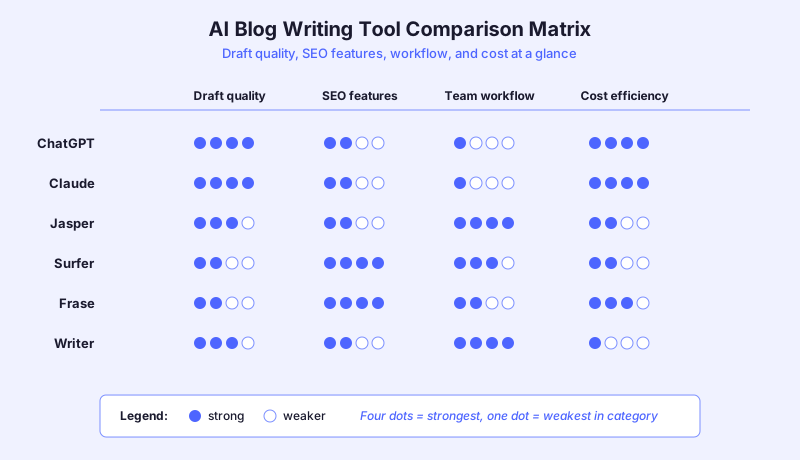
There are dozens of listicles ranking AI writers by star count. Most of them read like an affiliate marketing exercise. This comparison is organized around four questions a real content team cares about:
- Draft quality: does the raw output need heavy editing, or is it close to publishable?
- Workflow fit: does it slot into a team process, or is it a solo-writer toy?
- SEO integration: does it help you rank, or is it just a text generator?
- Total cost at scale: what does it actually cost to produce 40 posts a month?
Tools that only nail one of these can still earn a place in your stack. The trick is knowing what each one is good at so you do not pay for overlap.
The six tools in the comparison
Three of these are general-purpose AI writers. Three are SEO-focused content platforms that include AI drafting as part of a larger workflow. Lumping them into one ranking is where most comparison posts go wrong. These are different categories solving related but distinct problems.
1. ChatGPT (OpenAI)
ChatGPT remains the default starting point for most writers. The free tier handles short-form drafting competently, and ChatGPT Plus at $20 a month unlocks GPT-5, longer context windows, and file uploads for style guides. It is cheap, fast, and genuinely flexible.
Where it wins: research synthesis, outline generation, and rewriting existing drafts. If you feed it a solid brief and a few example articles, it produces a usable first draft in under a minute.
Where it falls short: no native SEO features, no brand voice training (without custom GPTs), no team workflow. ChatGPT is a brilliant individual contributor, not a content operations platform.
Best for: solo writers, freelancers, and teams using it as a drafting layer underneath a dedicated content ops tool.
2. Claude (Anthropic)
Claude is the other general-purpose model that shows up on every serious content team's stack. The 200K token context window lets you paste an entire brief, style guide, five competitor articles, and your last ten posts into one conversation, then ask for a draft that sounds like your brand. That kind of context depth is why Claude consistently outscores GPT on long-form editorial tasks in blind evaluations.
Where it wins: long-form articles, nuanced voice matching, handling large context loads, and following detailed instructions without drifting. Drafts tend to need less restructuring than ChatGPT output.
Where it falls short: same gaps as ChatGPT. No SEO scoring, no keyword density feedback, no team dashboard. You are paying for raw writing capability, not workflow.
Best for: teams that already have a strong brief process and want the cleanest draft possible before editing.
3. Jasper
Jasper is the marketing-team-first AI writing platform. It launched as a GPT wrapper with marketing templates, then built out the thing most general tools are missing: Brand Voice, a memory layer, team collaboration, and approval workflows. Pricing starts around $39/month per seat for the Creator plan and scales into the hundreds for Teams and Business.
Where it wins: brand consistency across writers, a large library of marketing-specific templates, and a campaign-style view that ties blog posts to broader content pushes. The Brand Voice feature genuinely does reduce editing time when you have multiple contributors.
Where it falls short: draft quality under the hood is the same models everyone else uses. You are paying for the workflow layer, not a smarter model. Cost can balloon fast on larger teams.
Best for: marketing teams with 3+ writers who need brand consistency and do not want to build their own prompt library.
4. Surfer SEO
Surfer is not really a writing tool. It is an SEO optimization tool that added AI drafting. The Content Editor analyzes the top-ranking pages for your target keyword and tells you, in real time, what topics to cover, how long the post should be, and which terms to include. The AI Content Generator then drafts the article to hit that brief.
Where it wins: rank-focused writing. If the goal is publishing content that competes with specific SERP results, Surfer's data-driven briefs are hard to beat.
Where it falls short: the drafts it generates tend to feel formulaic, like a page that was optimized at you rather than written for you. Editors still spend real time rewriting.
Best for: teams whose editorial KPI is ranking for specific keywords, not building a brand voice.
5. Frase
Frase sits in the same SEO-brief-plus-writer category as Surfer, with a stronger research side. The Frase platform pulls SERP data, extracts common headings, surfaces the questions people actually ask, and assembles briefs that feed directly into the AI writer. Pricing is friendlier than Surfer, starting at around $15/month for the Solo plan.
Where it wins: fast, deep research briefs. The question mining is especially good for building posts that match search intent without guessing.
Where it falls short: the native AI writer is average. Most Frase users actually use it for briefs and then draft elsewhere (Claude, ChatGPT, or a human).
Best for: content strategists who care most about the research-to-brief step, and are happy to draft in a separate tool.
6. Writer
Writer is the enterprise option. It runs on proprietary models (Palmyra), offers strong compliance and governance features, and gives brand and legal teams serious control over terminology, tone, and claims that can or cannot be made. Pricing is quote-based and starts in the thousands.
Where it wins: regulated industries, large orgs with brand and legal risk, and teams that need audit trails. Nothing else in this list has the governance depth.
Where it falls short: overkill for most content teams. If you are not in healthcare, finance, or legal, you are paying for features you will never use.
Best for: enterprise content teams with compliance requirements, or brands where off-message copy is a real legal risk.
Feature comparison at a glance
| Tool | Category | Starting price | Brand voice | SEO features | Team workflow |
|---|---|---|---|---|---|
| ChatGPT | General AI | $20/mo | Custom GPTs | None native | Weak |
| Claude | General AI | $20/mo | Via prompts | None native | Weak |
| Jasper | Marketing AI | $39/seat/mo | Strong | Light | Strong |
| Surfer | SEO-first | $89/mo | None | Strong | Medium |
| Frase | SEO-first | $15/mo | None | Strong (briefs) | Medium |
| Writer | Enterprise | Quote | Strongest | Light | Strongest |
A few things jump out of that table. General AI tools (ChatGPT, Claude) are the cheapest but leave you to build your own workflow around them. SEO-first tools (Surfer, Frase) cost more and push you toward a specific way of working. Marketing and enterprise tools charge for the collaboration layer on top of roughly the same underlying AI models.
What the comparison leaves out (and why it matters)
Most AI blog writing tools do not handle the step that determines whether a post actually ranks: the upstream keyword research and cluster planning that decides what to write in the first place. You can draft the most beautiful article in the world, but if it targets a keyword with no search volume or competes with fifteen domain authority 90 sites, it will not earn traffic.
This is where a topical authority approach matters more than the drafting tool. AI writers handle execution. Tools like ClusterMagic handle the keyword research and content brief generation that feed those writers, so you know what to build before you build it. The split roughly looks like this: ClusterMagic (or a similar research and briefs layer) tells you what to write and how to cover it, then Claude or Jasper drafts against that brief. Skipping the first half is why so many AI-generated blogs fail to rank even when the prose reads cleanly.
We cover the broader picture in our guide to the AI content writing workflow that actually ranks, which walks through how briefs, drafts, edits, and internal links fit together.
Picking the right tool for your team
After all the feature matrices, the decision usually comes down to three questions:
How many writers are on the team? Solo and freelance writers get more value from ChatGPT or Claude than from Jasper. The brand voice and workflow features are wasted on a team of one.
What does success look like? If success means "ranking for 30 target keywords," Surfer or Frase earn their cost. If success means "publishing on-brand thought leadership," Jasper or Claude are better fits. If success means "shipping 200 pages a month without brand or legal slipping," Writer is the only real option.
How mature is your editorial process? Tools do not fix a broken process. Teams without a brief template or an editorial calendar get frustrated with every tool on this list because they expect software to do the thinking for them. Fix the process first, then pick the tool that fits it. Our guide to optimizing the content creation process walks through the baseline workflow most teams need before adding AI into the mix.
Stacking tools instead of picking one
The teams producing the best AI-assisted content in 2026 are not choosing a single tool. They are stacking two or three in a specific order:
- Research and briefs: a keyword clustering and brief-generation layer (Frase, or a dedicated clustering platform)
- Drafting: a strong general AI (Claude or ChatGPT) or a workflow-focused tool (Jasper)
- Editing and optimization: a human editor with an SEO scoring tool in the background (Surfer for rank-focused posts)
This is how the math works on 40 posts a month without quality collapse. One tool drafts, another optimizes, and the human editor catches the things neither tool sees. Most teams that complain AI content does not work are trying to use one tool to cover all three jobs and being disappointed when it handles none of them well.
What to do next
Before signing up for anything, audit what is actually slow in your current process. Is it research? Drafting? Editing? Internal linking? The right AI blog writing tool is the one that shortens your slowest step, not the one with the most features on its homepage.
If research and briefs are the bottleneck, start there. A better brief makes every drafting tool downstream work dramatically better, whether the drafter is a human writer, Claude, or Jasper. For more on the baseline work, see our guide to building a content strategy that drives results.
The AI blog writing tools market will keep shifting every six months. The durable advantage is not picking the single best tool today, it is building a production process that makes any decent tool produce good results.
Recommended Posts





.svg)