

.svg)
B2B Content Analytics: How to Measure What's Actually Driving Pipeline | ClusterMagic

Every B2B marketing team publishes content. Very few can draw a straight line from that content to closed revenue. The gap between publishing and proving impact is where most content programs lose executive support, budget, and eventually headcount.
B2B content analytics is the practice of measuring how content influences pipeline creation, deal progression, and revenue. It goes beyond traffic and engagement metrics to answer the question leadership actually cares about: which content is making us money, and which is just making noise?
This guide walks through the metrics, attribution models, and reporting structure you need to build a content analytics system that connects publishing activity to business outcomes. If you already measure traffic but struggle to connect it to revenue, the content marketing ROI guide covers the foundational formulas.
Why Most B2B Content Measurement Fails
The typical B2B content report includes page views, time on page, and maybe bounce rate. These metrics describe reader behavior, but they say nothing about whether a reader became a lead, entered the pipeline, or eventually signed a contract. That disconnect is structural, not accidental.
B2B sales cycles are long and nonlinear. A buyer at a mid-market SaaS company might read a blog post in January, attend a webinar in March, download a comparison guide in June, and book a demo in August. Last-touch attribution credits the demo request page. The blog post that started everything gets zero credit.
The second problem is organizational. Content teams report to marketing. Pipeline data lives in the CRM, owned by sales ops. Connecting the two requires integration work that neither team typically owns. According to the Content Marketing Institute's 2026 B2B research, only a minority of B2B marketers say they can accurately attribute revenue to specific content assets.
The third problem is tool fragmentation. Google Analytics tells you about traffic. Your MAP tells you about leads. Your CRM tells you about pipeline. Connecting all three requires either a dedicated attribution platform or careful manual stitching.
The B2B Content Analytics Framework
A working content analytics for B2B system measures content at three distinct levels. Each level answers a different question, and each requires different data sources.
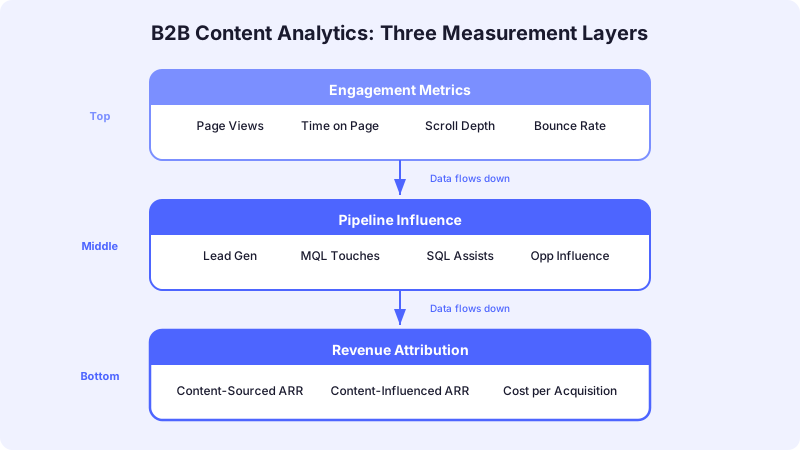
Layer 1: Engagement Metrics
These are the metrics most teams already track. They tell you whether content is reaching an audience and holding attention.
- Organic sessions per post (from Google Search Console or analytics)
- Engaged time on page (not just "time on page," which includes abandoned tabs)
- Scroll depth past 50% and 75% thresholds
- Return visitor rate on educational content
Engagement metrics are necessary but not sufficient. A blog post with 10,000 monthly visits and zero pipeline influence is a vanity metric. A post with 200 visits that generates five enterprise demo requests is a pipeline asset.
Layer 2: Pipeline Influence
This is where most teams stop measuring, and where the real insight begins. Pipeline influence metrics connect content consumption to CRM activity.
Content-sourced pipeline measures deals where the first known touchpoint was a content asset. The buyer found your blog post, case study, or guide before any sales interaction. This metric requires UTM tracking on all content links and a CRM integration that captures the original source.
Content-influenced pipeline is broader. It measures deals where the buyer consumed content at any point in their journey, not just the first touch. A buyer might have been sourced by an outbound email but read three blog posts before requesting a proposal. That content influenced the deal even though it didn't source it.
Content-assisted conversions track specific conversion events (demo requests, trial signups, contact form submissions) where content was in the conversion path. Google Analytics 4 provides multi-channel funnel reports that show which channels assisted conversions.
Layer 3: Revenue Attribution
Revenue attribution answers the ultimate question: how much closed-won revenue can be attributed to content? This requires integrating your analytics, MAP, and CRM into a single attribution model.
Multi-touch attribution (MTA) distributes credit across every touchpoint in the buyer journey. In 2026, 67% of B2B marketing teams still rely on last-touch attribution, according to RevSure's full-funnel attribution analysis, while B2B buyers engage with 27+ touchpoints across extended sales cycles. Last-touch attribution dramatically undercounts content's contribution.
The three most practical MTA models for B2B content teams are:
- Linear attribution: Splits credit equally across all touchpoints. Simple, transparent, but treats a casual blog visit the same as a pricing page review.
- Time-decay attribution: Gives more credit to touchpoints closer to conversion. Better for sales-led motions where later touches are typically higher-intent.
- Position-based (U-shaped) attribution: Gives 40% credit each to the first and last touches, with 20% split among middle touches. Works well when you want to value both awareness content and closing content.
No model is perfect. The goal is consistency, not precision. Pick a model, apply it uniformly, and use the trends it reveals to make better content decisions.
Setting Up Your Measurement Infrastructure
Before you can measure content's pipeline impact, you need four systems connected: your website analytics, marketing automation platform, CRM, and a reporting layer.
Step 1: Implement Full-Path UTM Tracking
Every link in every piece of content needs UTM parameters. This includes internal CTAs, email links, social distribution, and paid amplification. Without UTM discipline, your attribution data will have gaps that make the whole model unreliable.
A consistent UTM naming convention matters more than the specific structure. Use something like:
utm_source: distribution channel (organic, email, linkedin)utm_medium: content format (blog, ebook, webinar)utm_campaign: topic cluster or campaign nameutm_content: specific asset identifier
Step 2: Connect Analytics to Your CRM
The connection between website analytics and your CRM is where most B2B teams hit a wall. You need the ability to see which content a specific contact consumed before and after entering the pipeline. Tools like HubSpot's content attribution reporting and Dreamdata's B2B attribution platform are purpose-built for this.
If you are on a tighter budget, a custom integration using your MAP's API and CRM webhooks can achieve the same outcome. The critical requirement is passing a visitor identifier from your analytics into your CRM contact record.
Step 3: Tag Content by Funnel Stage and Topic Cluster
Every content asset in your CMS should be tagged with its funnel stage (awareness, consideration, decision) and its topic cluster. This tagging enables you to analyze performance at the cluster level, not just the individual post level.
Cluster-level analysis reveals which topics drive pipeline, not just which headlines get clicks. A single viral post might generate traffic without pipeline. A topic cluster with steady mid-funnel traffic might quietly source a third of your enterprise deals. For more on building this structure, the SEO content strategy framework covers the cluster architecture in detail.
Step 4: Build a Recurring Reporting Cadence
Monthly reporting is the minimum. Weekly snapshots for high-velocity pipelines. The report should include:
- Content-sourced pipeline created this period (new deals where content was first touch)
- Content-influenced pipeline this period (deals where content appeared anywhere in the journey)
- Top 10 content assets by pipeline influence (not by traffic)
- Pipeline velocity by topic cluster (which clusters move deals faster)
- Content gap indicators (pipeline stages with low content coverage)
Metrics That Actually Matter for B2B Content
Not all metrics deserve dashboard space. Here are the ones that earn their place.
Pipeline creation rate is the percentage of content-engaged visitors who enter the pipeline within 90 days. This is the single most important metric for connecting content to business outcomes.
Content-attributed revenue is closed-won revenue where content appeared in the buyer journey. Track this monthly and quarterly to show trends.
Cost per content-sourced lead divides your total content investment by the number of leads sourced directly from content. Compare this against your paid acquisition cost per lead. Content should be significantly cheaper, and if it's not, your content analytics setup may be miscounting.
Average deal velocity by content engagement compares deal cycle length for buyers who consumed content versus those who didn't. Content-engaged buyers typically close faster because they arrive better informed. Documenting this effect gives your content program a defensible business case.
Cluster pipeline contribution measures which topic clusters generate the most pipeline value. This metric drives your editorial calendar. If your "integration guides" cluster generates 3x the pipeline of your "industry news" cluster, the resource allocation decision is obvious.
Common Mistakes in B2B Content Analytics
Measuring Content Like a Media Property
B2B content isn't media. A post with 50,000 views from college students is worth less than a post with 500 views from enterprise IT directors. Audience quality matters more than audience size. Segment your analytics by company size, industry, and role whenever possible.
Ignoring the Middle of the Funnel
Most content analytics focus on top-of-funnel (traffic) and bottom-of-funnel (conversions). The middle, where buyers are evaluating options and building internal consensus, is where content has the most leverage. Comparison guides, technical documentation, and use-case breakdowns often don't generate much organic traffic, but they influence deals disproportionately.
Waiting for Perfect Attribution Before Acting
You will never have perfect attribution data. Buyer journeys include dark social, word of mouth, and private Slack conversations that no tracking pixel can capture. According to HockeyStack's B2B web analytics guide, the best B2B teams accept attribution is directional and act on the patterns it reveals rather than waiting for certainty.
Start with what you can measure, then improve the system incrementally. A team that measures content-sourced pipeline with 70% accuracy is in a far better position than a team that measures nothing because the perfect system would take six months to build.
Reporting Traffic When Leadership Wants Revenue
If your content report leads with page views, you've already lost the room. Lead with pipeline and revenue numbers. Show traffic only as a supporting metric that explains where the pipeline came from.
Building Your First Pipeline-Focused Content Report
Here is a practical template for a monthly content pipeline report:
Section 1: Pipeline Summary
- Total content-sourced pipeline (dollar value)
- Total content-influenced pipeline (dollar value)
- Content-attributed closed-won revenue
- Month-over-month trend for each
Section 2: Top Performing Assets
- Rank by pipeline influence, not traffic
- Include funnel stage and topic cluster for each
- Note which assets are new this month vs. evergreen performers
Section 3: Cluster Performance
- Pipeline contribution by topic cluster
- Identify clusters with high traffic but low pipeline (potential targeting issue)
- Identify clusters with low traffic but high pipeline (potential investment opportunity)
Section 4: Recommendations
- Which clusters should get more investment based on pipeline data
- Which content gaps are blocking pipeline progression
- Which existing assets need updates based on declining performance
Connecting Analytics to Content Decisions
Measuring b2b content performance is only valuable if it changes what you do next. The analytics system should feed directly into your content planning process.
When cluster-level data shows that your "product comparison" content drives 4x the pipeline per visitor of your "thought leadership" content, that's a signal to shift resources. When mid-funnel content consistently accelerates deals, that's a signal to build more of it. When a specific post keeps appearing in the journey of your largest deals, that's a signal to create adjacent content that captures similar intent.
The teams that win at B2B content analytics aren't the ones with the fanciest dashboards. They're the ones that close the loop between measurement and action, publishing more of what works and less of what doesn't, every single month.
If you want help building a content analytics pipeline that connects publishing to revenue, book a strategy call with ClusterMagic to see how cluster-based content programs track and report pipeline impact.
Recommended Posts





.svg)