

.svg)
B2B Content Calendar Template: Plan a Full Quarter in One Sitting

Most B2B marketing teams do not fail at content because they lack ideas. They fail because the plan lives in three Slack threads, two abandoned Google Docs, and someone's head. A working b2b content calendar template fixes that by forcing every decision (what, when, who, why) into one place you can review at a glance. This guide walks through a template you can copy and fill in during a single 90-minute planning session, so your next quarter starts with a finished plan instead of a wishlist.
The goal is not a pretty spreadsheet. The goal is a document that survives contact with the real world: sales requests, product launches, broken deadlines, and the editor who quits in week six. A quarter-long view makes that survivable.
Why a quarterly B2B content calendar beats a monthly one
Monthly calendars feel manageable, but they hide the problem B2B content actually has: compounding takes time. SEO pieces need 90 to 180 days to rank. Buyer journeys for most B2B deals run 60 days or longer. A one-month view gives you no runway to build topical depth or line up launches with sales cycles.
A quarterly view flips that. You can see whether week nine has any bottom-of-funnel support for the pillar you published in week one. You can spot the three-week drought around the holidays before it happens. You can commit resources with enough notice that the writer does not find out about the assignment the day it is due.
A good b2b content calendar answers five questions at the row level:
- What is the piece?
- Which pillar or topic cluster does it support?
- Who is the target reader, and what stage of the buying journey?
- Who is accountable for drafting, editing, and publishing?
- When does it go live, and what does it link to?
If your current calendar cannot answer all five for every row, you are not planning. You are wishing.
The template: six columns and four content categories
The template is boring on purpose. Boring survives. You can build it in a spreadsheet, an Airtable base, or a Notion editorial calendar, whichever your team already opens without complaining.
The six columns:
- Week: the publish week, numbered 1 through 13
- Category: pillar, cluster, thought leadership, or repurpose (more on these below)
- Working title: good enough to brief a writer, not final
- Target keyword or topic: the primary phrase or question the piece answers
- Funnel stage: top, middle, or bottom of funnel
- Owner: one named person, not a team
Add columns for status, draft link, and publish date as the quarter progresses. Do not add more upfront. Every extra column you add at the planning stage is a field someone will leave blank.
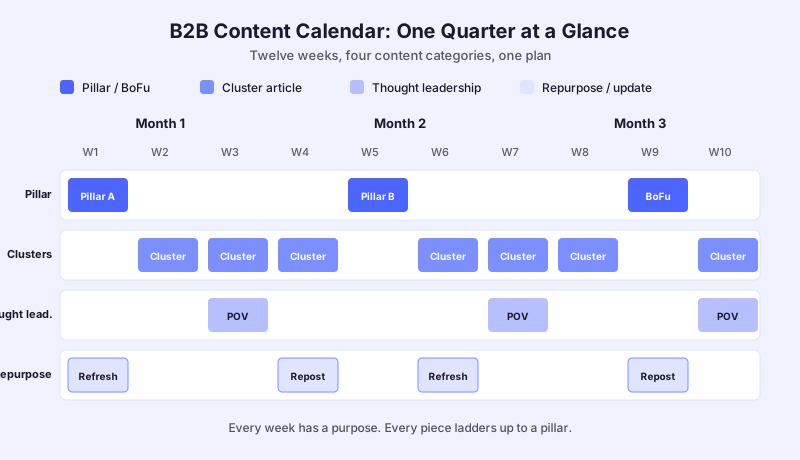
The four categories are what make the calendar work:
Pillar pieces are the comprehensive guides that anchor a topic cluster. Plan one every four weeks. These are your biggest investments and deserve the most lead time.
Cluster articles are the 1,200 to 2,000-word pieces that hang off a pillar. Plan two to three per week. These do the day-to-day work of ranking for long-tail keywords and capturing mid-funnel intent.
Thought leadership is your POV content: takes, trends, customer stories, original research. Plan one every two weeks. This is what gives your brand a voice and earns attention on LinkedIn and in newsletters.
Repurpose and refresh is the most undervalued category. Plan one per week. Either update a piece that ranked well last year or cut an existing article into a LinkedIn post, email, or short video.
How to fill the calendar in a single 90-minute session
You do not need a week of workshops to build a quarter. You need 90 minutes, a clear head, and a little prep.
Preparation (15 minutes, done solo before the session)
Pull three things into a single document:
- Your top 10 performing URLs from the last 90 days (organic traffic and conversions, from GA4 or Search Console)
- Your next three sales priorities from the revenue team, framed as "we need more pipeline for X"
- A rough list of 20 to 30 topic ideas you have been collecting in notes, meeting recaps, and customer calls
Most planning sessions fail because the team tries to generate ideas in the room. Do not generate in the room. Show up with a stockpile and spend the session making decisions.
Step 1: Pick the pillars (15 minutes)
Look at the three sales priorities. Each one usually maps to a pillar topic your content needs to own. If you already have a pillar on that topic, mark which cluster articles would strengthen it. If you do not, this is the quarter to start one.
Pick three pillars maximum. Spreading across four or five sounds ambitious but produces thin coverage everywhere.
This is also where the quality of your topic input matters. A calendar is only as good as the topics going into it. Tools like ClusterMagic handle the upstream work of keyword clustering and topical authority mapping, so the rows on your calendar come from clusters that actually compound instead of one-off search volume. If you are filling the calendar by hand from a keyword spreadsheet, expect to spend more of the session validating that pieces ladder up to something larger.
Step 2: Slot the pillar pieces (10 minutes)
Put one pillar piece in week 1, one in week 5, and one in week 9. This gives each pillar four weeks of runway for supporting cluster articles. Assign each pillar to a named owner, ideally your strongest writer or an outside specialist. Pillars are worth overspending on.
For the mechanics of writing these longer pieces at quality, see our content brief template (the short version: brief hard, edit light).
Step 3: Fill in the clusters (25 minutes)
For each pillar, identify six to eight cluster articles. Use your keyword list and the sales team's priority topics. Slot two to three per week into the weeks between pillars. Assign owners as you go.
Some weeks will feel overloaded. Move pieces, cut if needed. A realistic cluster cadence of two pieces per week beats a fantasy cadence of four that turns into one.
Step 4: Add thought leadership and repurposing (15 minutes)
Drop a thought leadership piece into every other week. These can be opinion articles, customer interviews, or roundups of recent industry news. Assign them to your CEO or a subject matter expert, not the content team.
Then fill in one repurpose or refresh slot per week. Look at your top 10 performing URLs and pick four that could be updated this quarter. Fill the other nine slots with repurposing your new content into LinkedIn posts, email, or short video.
Step 5: Pressure-test (10 minutes)
Walk through the calendar one row at a time and ask:
- Does every piece have a named owner?
- Does every pillar have at least four supporting cluster pieces?
- Is there a bottom-of-funnel piece near the end of the quarter to capture demand generated by earlier content?
- Are the weeks balanced, or is week 7 going to kill someone?
Fix what you find. Then publish the calendar to your team wiki and do not touch it for two weeks. Reality will tell you what needs adjusting.
Common mistakes B2B teams make with content calendars
Three failure patterns show up in almost every audit we do.
Over-planning top of funnel. Teams load up on awareness content because it is easier to write and the keyword volume looks big. Then they wonder why sales cannot use any of it. Aim for roughly 60% middle-of-funnel, 25% top, and 15% bottom. Your calendar should reflect that split.
Treating the calendar as a contract with marketing, not the business. If the calendar is not reviewed with sales and product monthly, it drifts. Sales knows what prospects are asking about right now. Product knows what is shipping. Both inputs belong in the calendar.
No room for reactive content. The best calendars have one blank row per week labeled "flex." That slot absorbs the piece a customer requests, the trend that blows up, or the competitor response nobody saw coming. A fully booked quarter is a brittle quarter.
CoSchedule's marketing calendar and similar tools try to solve these problems with workflow automation. The tools help, but the discipline is what matters. A shared spreadsheet followed religiously will outperform an expensive tool that nobody updates.
Turning the calendar into a publishing rhythm
A calendar is not a plan until it has a rhythm attached. Three standing meetings make the difference:
- Monday 30-minute planning sync: review the week's slots, confirm owners, flag blockers
- Wednesday 15-minute draft check-in: status on drafts in flight
- Friday 45-minute publish review: approve what is going out next week, look two weeks ahead
Keep them short. Keep them on the calendar. If any of the three gets skipped two weeks in a row, the calendar will start rotting.
Publishing cadence also matters more than most teams think. The question is not how much you publish but whether the cadence is predictable enough to build reader habit and topical depth. For more on that, see how publishing velocity shapes SEO growth.
What this means for your team
If you have been operating without a documented B2B content calendar teams can actually follow, the gap between where you are and where you want to be is smaller than it looks. One 90-minute session and a shared spreadsheet close most of it. The compounding starts the week after.
The calendar is not the strategy. Your B2B content marketing plan defines the strategy: who you serve, what you are known for, how you measure success. The calendar is how the strategy gets executed week to week. You need both, but you cannot skip to the calendar without a plan behind it, and you cannot rely on a plan that never makes it onto a weekly grid.
Blocking the 90 minutes on your calendar this week is the single highest-leverage move you can make for next quarter's content performance. The worst version of your calendar is better than the best version of no calendar at all.
Recommended Posts





.svg)