

.svg)
Content Velocity: How Publishing Cadence Drives SEO Growth | ClusterMagic

Most content teams obsess over the quality of individual posts. That focus matters, but it misses a compounding factor that separates fast-growing sites from stagnant ones: content velocity. Publishing one exceptional post a month rarely beats a team that ships three solid, well-optimized pieces every week. The rhythm itself sends a signal that quality alone cannot.
This guide explains what content velocity actually means, why publishing cadence directly influences how Google crawls and ranks your site, and how to find the right pace for your team without burning out your writers or flooding your calendar with thin content.
What Content Velocity Means (and What It Does Not)
Content velocity is the rate at which you consistently publish optimized content over a defined period. The key word is consistently. Publishing thirty articles in January and nothing through February does not create velocity; it creates a spike followed by silence. Search engines detect patterns, and an erratic publication schedule provides no pattern to reward.
Volume and velocity are not the same thing. High volume with inconsistent velocity offers minimal algorithmic benefit. Google's crawlers visit your site based partly on how often you give them new material to index. A reliable cadence trains crawlers to return frequently, which shortens the time between publication and ranking.
Content velocity also does not mean sacrificing E-E-A-T standards. Every piece still needs firsthand perspective, accurate information, and genuine usefulness. The goal is to build a system that produces quality content at a repeatable pace, not to manufacture filler at high speed.
Why Publishing Cadence Affects SEO Rankings
Every new page you publish gives search engine crawlers a reason to revisit your domain. Frequent, consistent publishing increases your crawl budget allocation, which means Google indexes your newest content faster. Sites that publish on a predictable schedule often see new posts appear in search results within hours rather than days.
Beyond indexing speed, cadence compounds your topical authority. When you publish ten posts on content marketing this month and ten more next month, Google builds a clearer picture of your domain expertise. A content clusters approach amplifies this effect by grouping related posts around a central pillar, so each new piece strengthens the semantic authority of the entire cluster.
There is also a compounding traffic effect. Ahrefs data consistently shows that organic traffic accumulates over time rather than arriving all at once. A post published today may not reach peak traffic for six to twelve months. Publishing at a higher cadence means you have more posts entering that compounding phase simultaneously, which creates a wider base of growing traffic streams.
Finding Your Sustainable Velocity
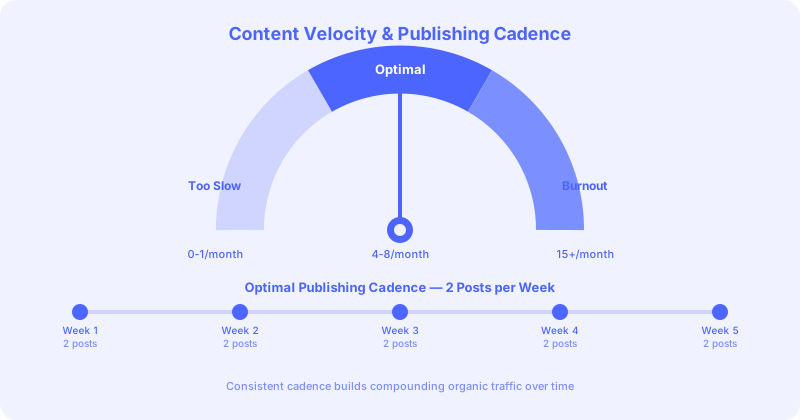
The right publishing cadence depends on three variables: your industry's competitive landscape, your team's actual capacity, and your business model. An e-commerce site in a competitive niche may need daily publication. A B2B software company with a small content team can generate strong results with two to three quality pieces per week.
The cardinal rule: a consistent lower cadence beats an unsustainable higher one. Publishing three times per week every week for a year outperforms publishing daily for two months and then disappearing. Google rewards reliability, and your audience does too. Readers who find your content valuable will return on a schedule that matches yours.
Start by auditing your current production capacity honestly. Count how many finished, quality posts your team actually shipped last quarter, not how many you planned. Divide by the number of weeks. That number is your baseline velocity. From there, look for bottlenecks: brief creation, editing rounds, approval queues. Optimizing the content creation process usually unlocks more velocity than simply adding writers.
Building a Publishing Cadence That Holds
Sustainable cadence depends on having content in the pipeline before you need it. A buffer of four to six finished posts means a sick writer or a delayed approval does not break your schedule. Most teams that maintain high velocity operate with at least two weeks of ready-to-publish content staged at any time.
An editorial calendar structured around your content pillars makes scheduling decisions easier. A content strategy roadmap template provides the planning structure that connects your calendar to your cluster gaps. When you know your clusters and the gaps within them, you are not deciding what to write each week; you are choosing from a prioritized list. Tools that automate keyword clustering and gap identification remove the planning friction that slows many teams down.
Batch creation sessions produce more efficient output than writing one post at a time. When writers produce three posts in a single focused sprint, they build context that carries across pieces, reducing research overhead. Teams exploring automated content creation for SEO can amplify batch production further when the brief quality is already high. This is one of the fastest ways to increase velocity without increasing headcount.
For teams looking to scale content production, the velocity question eventually becomes a systems question. Templates, repeatable brief formats, and clear editorial standards let new writers contribute at full quality faster.
Measuring Whether Your Velocity Is Working
Publishing consistently matters only if you track whether it produces results. The metrics to watch are indexation rate (how quickly new posts appear in Google Search Console), crawl frequency (visible in server logs or GSC coverage data), and the trajectory of non-branded organic sessions over rolling 90-day periods.
Avoid judging individual posts too early. A post published last week tells you almost nothing about its potential. Instead, track cohorts: all posts published in Q1, for example, and how their combined traffic has grown three months, six months, and twelve months later. This cohort view shows whether your velocity is building a compounding asset or producing content that fails to accumulate traction.
If you are increasing velocity but not seeing indexation speed improve, audit your technical SEO: site speed, internal linking structure, and whether your sitemap is submitting new URLs promptly. A well-structured blog content strategy addresses both content production rhythm and the technical environment that lets new content rank.
Velocity Without a Keyword Strategy Is Just Noise
Publishing more content without a clear keyword plan amplifies waste. Teams that publish at high velocity but target overlapping or irrelevant keywords create cannibalization problems and dilute their topical focus. Every post in your cadence should serve a defined cluster, address a specific search intent, and fill a gap your existing content does not already cover.
A structured keyword map turns velocity into compound authority. When each new post slots into a defined position in your topic architecture, the whole site benefits rather than just the individual page. This is the difference between publishing and building.
ClusterMagic automates the cluster mapping and gap identification that makes velocity intentional. Instead of deciding what to publish next based on intuition, you work from a clear picture of which keywords your site is positioned to rank for, which clusters need more supporting content, and where competitors are publishing that you have not matched yet.
If you want to see how a systematic approach to content velocity could work for your specific site, book a walkthrough and we will walk through your current cluster structure together.
The Relationship Between Velocity and Content Freshness
Google's freshness algorithm rewards updated and newly published content for queries where recency matters. Publishing at a consistent cadence naturally keeps your site's overall freshness score high. But cadence also creates opportunities to revisit and refresh older posts, which is often more efficient than producing net-new content from scratch.
A practical cadence model for most B2B content teams: publish two to three new posts per week and refresh one existing post per week. The refreshes update statistics, add new internal links to recent posts, and improve sections where the original treatment was thin. This approach maximizes the return on content already indexed without sacrificing the velocity needed for new keyword coverage.
Content velocity is not a vanity metric. It is a compounding lever. The teams that commit to a sustainable, consistent cadence and pair it with a disciplined keyword strategy are the ones whose organic traffic graphs trend upward year over year, regardless of algorithm updates.
Further reading:
Recommended Posts





.svg)