

.svg)
B2B Content Marketing ROI: Measure Pipeline and Revenue Impact | ClusterMagic

The B2B content marketing ROI problem is not that content does not generate returns. It is that most teams cannot prove it does. 56% of B2B marketers say connecting content to ROI is difficult, and a full 47% do not measure content ROI at all. That measurement gap creates a credibility problem. When budget conversations happen, content marketing is the first line item questioned because the team cannot defend it with numbers.
The data on content's actual performance is clear. SEO delivers an average 748% ROI for B2B, making it the highest-performing channel. Email marketing returns $10-$50 for every $1 spent. The ROI is there. The measurement system usually is not.
Why B2B Content Marketing ROI Is Hard to Measure
Before building a measurement framework, it helps to understand why the default approach fails.
Long sales cycles obscure attribution. B2B deals take months. A prospect might read a blog post in January, attend a webinar in March, download a comparison guide in May, and close in August. Last-click attribution credits the comparison guide and ignores the blog post and webinar that created the opportunity.
Multiple stakeholders touch different content. The average B2B deal involves 10+ stakeholders who each consume different content. If your attribution tracks individual contacts rather than buying groups, you miss the full picture of content influence.
Content serves multiple funnel stages. A single blog post might attract new visitors, nurture existing leads, and support sales conversations simultaneously. Assigning it to one stage undervalues its contribution.
84% of B2B marketers struggle with integrating data across multiple platforms when measuring content performance. Your website analytics, CRM, marketing automation, and ad platforms each tell a partial story. Without integration, the full ROI picture is impossible to assemble.
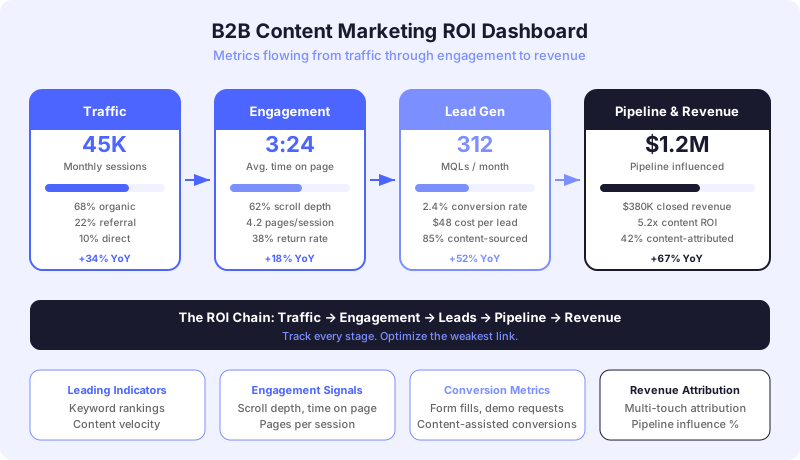
The Three-Layer Measurement Framework
Effective B2B content marketing ROI measurement uses three connected layers. Each layer answers a different question.
Layer 1: Activity metrics. These measure content output and consumption. Traffic, page views, time on page, bounce rate, social shares. Activity metrics confirm that content is reaching an audience. They do not confirm that the audience converts. Use these to diagnose distribution problems, not to prove ROI.
Layer 2: Engagement metrics. These measure meaningful interaction. Email signups, content downloads, webinar registrations, return visits, pages per session. Engagement metrics indicate that content is resonating enough to generate action. They connect activity to lead generation.
Layer 3: Revenue metrics. These connect content to business outcomes. Pipeline influenced, deals accelerated, revenue attributed, customer acquisition cost from organic. Revenue metrics are the only layer that matters for proving ROI to leadership. The other layers support diagnostics.
Most teams measure Layer 1 extensively, Layer 2 partially, and Layer 3 not at all. Flipping that priority is the single most impactful change you can make to your measurement approach.
Setting Up Multi-Touch Attribution
Multi-touch attribution is the technical mechanism that connects content interactions to revenue. Modern attribution models increase attributed revenue by 23% compared to last-click models.
Step 1: Define your attribution model. Linear attribution gives equal credit to every touchpoint. Time-decay gives more credit to touchpoints closer to the conversion. Position-based gives 40% credit to the first and last touch, with 20% distributed among middle touches. Start with position-based. It captures both the content that created awareness and the content that closed the deal.
Step 2: Connect your analytics to your CRM. Your website analytics needs to pass visitor data to your CRM through form submissions, cookie tracking, or identity resolution tools. Platforms like HubSpot, Salesforce, and Marketo offer native content attribution features.
Step 3: Track at the buying group level. B2B attribution should aggregate touchpoints across all contacts associated with an opportunity, not just the primary contact. When the CTO reads a technical guide and the CFO reads the ROI calculator, both touchpoints influenced the deal.
Step 4: Assign revenue credit to content. Once an opportunity closes, distribute revenue credit to every content touchpoint in the buying group's journey according to your attribution model. This produces the content-influenced revenue number that proves ROI.
Key Metrics for B2B Content Marketing ROI
Track these metrics monthly and report them quarterly to stakeholders.
Content-influenced pipeline. The total dollar value of open opportunities where at least one contact engaged with content before entering the pipeline. This metric captures content's role in creating opportunities.
Content-influenced revenue. The total closed-won revenue from opportunities that had content touchpoints. This is your primary ROI metric. Benchmark it against total content investment to calculate actual ROI.
Content velocity. How quickly contacts who engage with content progress through pipeline stages compared to contacts who do not. Faster progression indicates that content is accelerating deals, not just creating them.
Cost per content-attributed lead. Your total content investment divided by the number of leads where content was a touchpoint. Compare this to your cost per lead from paid channels to demonstrate content's efficiency.
Organic traffic to pipeline conversion rate. The percentage of organic visitors who eventually become pipeline opportunities. This connects your organic traffic growth to revenue.
For detailed formulas and calculation methods, see the complete content marketing ROI guide.
Common Measurement Mistakes
Measuring only traffic. Traffic without conversion data tells you nothing about ROI. A post with 10,000 visits and zero conversions has worse ROI than a post with 500 visits and ten demo requests.
Ignoring content's sales enablement role. Content shared by sales reps during deal cycles influences revenue but never appears in marketing attribution. Survey your sales team quarterly on which content they share most and incorporate that data into your ROI calculation.
Comparing content to paid on a time-matched basis. Paid campaigns produce immediate results that decay when spending stops. Content produces delayed results that compound over time. Measuring both on a 30-day window misrepresents content's long-term value. Evaluate content ROI on a 6-12 month rolling basis.
Not accounting for content costs accurately. Include writer compensation, tool subscriptions, design time, distribution costs, and editing time. Underestimating costs inflates ROI calculations and erodes credibility when leadership audits the numbers.
Building Measurement Into Your Content Strategy
Measurement should not be an afterthought bolted onto an existing content program. Build it into the strategy from the start.
Define your target metrics before creating content. Assign conversion tracking to every content asset at publish time. Review metrics monthly and adjust content priorities based on what produces pipeline, not what produces traffic.
When measurement works, it transforms content marketing from a cost center into a proven revenue channel. The teams that can prove B2B content marketing ROI are the ones that get budget increases. Everyone else gets budget cuts.
ClusterMagic builds the content cluster architecture and measurement frameworks that connect B2B content to pipeline and revenue.
Book a strategy session to build a content program with built-in ROI measurement.
Written by Deanna S.
Recommended Posts





.svg)