

.svg)
B2B Content Marketing Trends for 2026: What's Working Now

B2B content marketing is going through one of its biggest structural shifts in a decade. The teams winning right now are not publishing more. They are publishing smarter, building topical authority, and showing up in places their buyers actually look. This post covers the b2b content marketing trends that matter in 2026, with real data behind each one.
If you want context on the fundamentals first, start with our primer on what B2B content marketing actually is before reading ahead.
1. AI Search Visibility Is Driving B2B Content Marketing Trends in 2026
The most significant structural change in B2B buyer behavior is happening at the top of the funnel. B2B buyers are adopting AI-powered search at three times the rate of general consumers. Platforms like ChatGPT, Perplexity, and Gemini are increasingly where early-stage research begins, not Google.
The implication is straightforward: if your content is not structured to be cited by AI-generated answers, you are invisible to a growing share of your market before buyers ever reach your website.
Generative Engine Optimization (GEO) is the practice of structuring and optimizing content so that AI systems select, cite, or recommend it when answering buyer questions. While traditional SEO prioritizes keywords, backlinks, and technical performance, GEO prioritizes authority, clarity, and contextual depth. AI models favor comprehensive, well-structured content that directly answers complex questions with specificity.
What GEO Means for Your Content
Content that covers a topic in full depth, uses clear headings, and makes direct declarative statements performs better in AI-cited answers than content that hedges everything or buries answers in introductory padding.
This is also why topical authority (covered next) is increasingly central to content strategy, not just a nice-to-have.
2. Topical Authority Has Replaced "More Pages" as the Growth Model
For years, the default B2B content playbook was to publish more. More blog posts, more keyword variations, more pages. That model has run out of road.
In 2026, the content teams pulling ahead are building topic clusters: structured groups of content organized around a central pillar page, with supporting pieces that cover subtopics in depth and link back to the pillar. The approach is not new, but its importance has accelerated significantly. Sites implementing topic cluster structures see internal PageRank increases of up to 34% for cluster pages within 60 days, and organic traffic increases averaging 40% over time.
Why Topic Clusters Outperform Scattered Content
Google's Helpful Content system evaluates the depth and breadth of your coverage across a topic, not just how many pages you have. A brand that owns 15 tightly interlinked pieces on "B2B demand generation" will consistently outrank a brand with 60 scattered posts on loosely related keywords.
The same logic applies to AI search: the single most effective thing a B2B company can do to increase AI visibility is to build genuine topical authority through a coherent, well-maintained cluster of high-quality content on a focused set of topics.
If you are building out a cluster-based approach, our guide on how to increase organic keywords with a cluster-based ranking strategy walks through the mechanics.
3. Thought Leadership Rooted in First-Hand Experience
Generic content is getting harder to rank and easier to ignore. Buyers are increasingly tuned in to what feels produced versus what feels earned. According to CMI's 2026 B2B Content Marketing research, thought leadership is expected to be one of the most influential content types this year, specifically the kind grounded in first-hand experience and unique perspectives from people who genuinely understand their buyers' problems.
This is a correction from the AI-content surge of 2023 to 2025, when many teams over-indexed on volume at the expense of voice. The pendulum is swinging back toward human perspective, real examples, and original data.
47% of B2B marketers plan to increase their use of original research and data-driven thought leadership content in 2026. Publishers of original data report 64% higher conversion rates than teams relying solely on curated content.
The practical takeaway: prioritize content where your team's direct experience is the main asset. Customer stories, proprietary data, practitioner-level guides, and opinionated takes on industry debates are harder to replicate and more likely to earn citations from both human readers and AI systems.
4. Video and Multimedia Investment Is Accelerating
Video is no longer an experimental B2B channel. Marketers are routinely naming it an essential format, and a growing share of content budgets is being shifted toward video and multimedia for 2026. The momentum is visible in both enterprise content programs and mid-market teams that historically treated video as a nice-to-have.
Case studies and video content demonstrate significantly higher engagement among known visitors: buyers already in consideration stages consume this content at much higher rates than static posts. For B2B teams, this points to a specific opportunity: video case studies, product walkthroughs, and expert interview series that buyers return to as they move through a longer consideration cycle.
Short-form video (LinkedIn, YouTube Shorts) is also proving effective for top-of-funnel awareness, particularly when paired with written content that goes deeper on the same topics. The two formats reinforce each other rather than compete.
5. AI Is Shifting From Drafting to Editing and Research
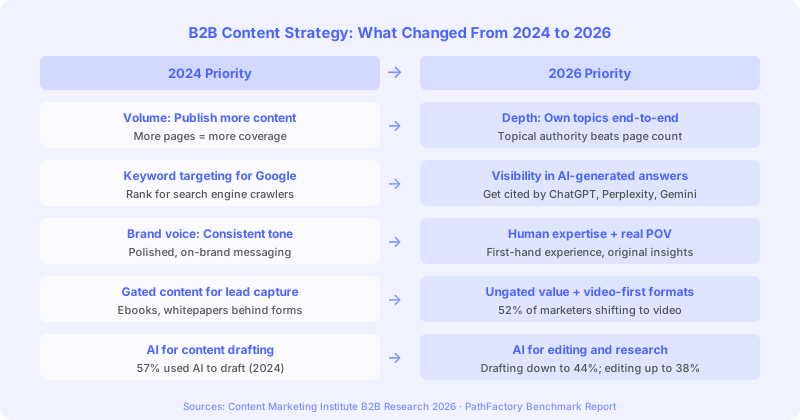
The way content teams are actually using AI has changed materially in one year. In 2024, 57% of B2B marketers used AI for drafting content. That number has dropped to 44%. Meanwhile, use of AI for editing has climbed from 19% to 38%.
This reflects a maturation in how teams think about AI's role. The first wave was "AI writes the first draft." The current wave is "AI accelerates research, editing, and optimization while humans own the narrative and expertise."
The teams seeing the best results are using AI to:
- Research competitive content gaps and identify untreated subtopics
- Edit for clarity, concision, and consistency of voice
- Generate structural outlines and heading hierarchies
- Repurpose long-form posts into social, email, and video scripts
This fits the pattern in trend three: human expertise owns the content, AI handles the production layer. Teams that try to use AI to generate thought leadership wholesale are producing content that reads like thought leadership but lacks the substance that earns trust.
6. Content Budgets Are Increasing, With Expectations to Match
B2B content budgets are growing. The average planned budget increase for 2026 is 14%, and 31% of marketers now budget between $15,000 and $45,000 per month for content marketing, up from 19% in 2025. Nearly a third of enterprise B2B marketers are raising spending significantly.
This matters for two reasons. First, it raises the competitive floor: if your competitors are investing more in quality content, maintaining the status quo means losing ground. Second, it signals that content marketing is earning boardroom credibility as a measurable revenue channel rather than a branding expense.
The budget growth also comes with sharper accountability expectations. If you are not already tracking content-attributed pipeline, now is the time to build that infrastructure. Our guide on how to measure content marketing ROI covers the attribution models that work best for B2B teams.
7. B2B Influencer and Creator Partnerships Are Emerging
The B2B influencer is not the B2C influencer. This is not about follower counts. It is about credibility and reach within a specific professional community.
Buyers now research vendors across AI summaries, community threads, LinkedIn discussions, podcasts, and short-form video. They often encounter brands for the first time through a trusted practitioner (an operator, consultant, or domain expert with a real audience in the right niche) rather than through a brand's owned channels.
LinkedIn's 2026 B2B marketing insights note that creator and influencer partnerships are emerging as a meaningful way for B2B brands to extend credibility in channels they cannot easily own directly.
Partnering With B2B Creators Without a Big Budget
A well-placed co-authored post, a podcast appearance with a niche expert, or a genuine partnership with an operator-turned-creator in your space can generate outsized trust signals at relatively low cost.
What This Means for Your Content Team
The through-line across every trend here is the same: breadth without depth is not a strategy anymore. Publishing volume for its own sake, targeting keywords without topical structure, and using AI to replace human perspective are all patterns that are losing ground in 2026.
The content teams pulling ahead are:
- Building topic clusters that give them genuine topical authority in a focused area
- Structuring content for AI citation alongside traditional search rankings
- Investing in original research, real POVs, and video to differentiate from the content flood
- Measuring what matters and using that data to focus, not scatter
If your current setup is a list of standalone blog posts without a clear pillar structure, the place to start is building an integrated content strategy that ties your content to a coherent topical map. That structural shift, more than any individual tactic, is what separates high-performing B2B content programs from the rest.
ClusterMagic is built specifically for this: grouping your existing and planned content into topic clusters so you can see gaps, build with intention, and measure topical authority over time. If you are thinking through how to put any of these trends into practice, it is a good place to start.
Recommended Posts





.svg)