

.svg)
What Is an Integrated Content Strategy and How Do You Build One? | ClusterMagic

Most content teams produce plenty of material. Blog posts, social updates, email campaigns, sales decks, webinar scripts. The volume is there. What's missing is the connective tissue. Each channel operates in its own silo, targeting its own goals, measured by its own metrics. The result: duplicated effort, inconsistent messaging, and a buyer journey that feels disjointed. An integrated content strategy solves this by treating every piece of content as part of a single system rather than a standalone output.
This guide covers what integrated content strategy actually means in practice, why alignment matters more than volume, and how to build one from scratch.
What Is an Integrated Content Strategy?
An integrated content strategy is a planning approach that connects all of your content activities across channels, formats, and funnel stages into a unified system. Instead of treating SEO blog content, social media, email nurture sequences, and sales enablement materials as separate workstreams, an integrated approach designs them to reinforce each other.
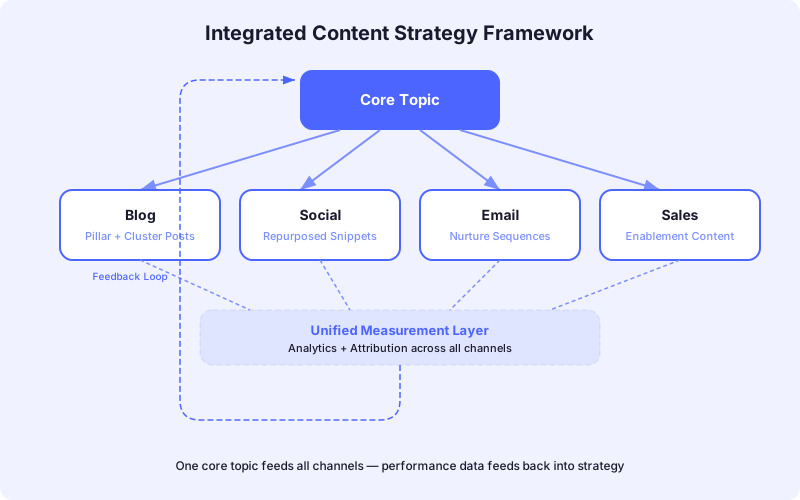
The core principle is simple: every piece of content should serve a defined role within a larger system. A blog post targets a keyword cluster and attracts organic traffic. A social post distributes that blog content and drives engagement. An email sequence nurtures the readers who engaged. A sales deck closes the loop with messaging that echoes the same themes. Each asset references the same core narrative.
This is different from multichannel content marketing, which simply means publishing across multiple channels. Integrated content marketing goes further by ensuring those channels share a common strategy, consistent messaging, and coordinated timing.
Why Most Teams Fail at Integration
The Content Marketing Institute's 2026 B2B research found that 97% of B2B marketers report having a content strategy, yet only 61% say that strategy has improved over the past year. The gap between having a strategy and having one that actually works is where integration breaks down.
Three common failure modes account for most integration problems. Channel-first planning happens when teams plan content for each channel independently, leading to inconsistent messaging and redundant effort. Missing keyword architecture means SEO content isn't mapped to the same themes driving social and email, so traffic and nurture sequences don't connect. No shared measurement framework results in each channel optimizing for its own vanity metrics rather than business outcomes.
Why Integrated Content Strategy Matters for SEO
Search engines reward sites that demonstrate topical authority across a subject area. An integrated strategy accelerates topical authority because every content asset, whether it lives on your blog, in a webinar transcript, or in a downloadable guide, reinforces the same topic clusters.
When your content cluster architecture aligns with your social amplification strategy, you generate more backlinks and social signals pointing to the same topic hubs. When your email campaigns drive returning traffic to pillar pages, engagement metrics improve. These signals compound.
The practical SEO benefit is that integrated teams cover more keyword territory without producing more content. A single research report can generate a pillar blog post, a series of social excerpts, an email nurture campaign, and a sales one-pager. Each derivative asset targets different keywords and intents while linking back to the same hub. That's how you build authority faster than competitors who treat each channel as a separate content factory.
The Five Pillars of an Integrated Content Strategy
1. Unified Topic Architecture
Everything starts with your topic map. Before deciding what to publish on any channel, define the core subject areas your brand needs to own. These become your pillar topics, and every piece of content, regardless of channel or format, should map back to one of them.
Build your topic architecture by starting with keyword research, then expanding outward to identify the questions, pain points, and use cases that connect to each topic cluster. Your topic map should be channel-agnostic at this stage. The decision about where to publish comes later.
A solid topic architecture typically includes 3-5 pillar themes for a focused brand, with 8-15 subtopic clusters under each pillar. This structure gives you enough depth to build genuine authority without spreading too thin.
2. Content Strategy Alignment Across the Funnel
Content strategy alignment means every piece maps to a specific stage of the buyer journey. Top-of-funnel content builds awareness and captures search demand. Middle-of-funnel content educates and builds trust. Bottom-of-funnel content enables purchase decisions.
The alignment failure most teams make is over-indexing on top-of-funnel blog content while starving the middle and bottom of the funnel. According to HubSpot's 2026 marketing research, 79% of marketing teams expect budget increases in 2026, but investment often concentrates on awareness content rather than conversion-stage materials.
Map your existing content to funnel stages first. You'll likely discover that 70-80% of your library targets the awareness stage, with significant gaps at the consideration and decision stages. Filling those gaps should be your first priority, since that's where integrated content strategy directly impacts revenue.
3. Channel Role Definition
Each channel in your ecosystem needs a defined role. Stop treating every channel as a distribution mirror where you blast the same content everywhere. Instead, assign each channel a specific job.
Your blog is your SEO engine: it captures search demand, builds topical authority, and serves as the hub for your content clusters. Social media is your amplification and engagement layer: it distributes blog insights, sparks conversations, and drives traffic back to owned content. Email is your nurture system: it moves engaged readers through the funnel with personalized sequences. Sales enablement content is your closer: it packages insights into formats that directly support the buying process.
When each channel has a clear role, content planning becomes dramatically simpler. You're not brainstorming independently for five channels. You're creating one core asset and intentionally adapting it for each channel's specific job.
4. Shared Measurement Framework
Integrated content marketing demands integrated measurement. If your blog team measures traffic, your social team measures engagement, and your email team measures open rates, nobody is measuring the system as a whole.
Build a measurement framework with three layers. Leading indicators track content production and distribution velocity. Engagement indicators track how audiences interact across channels: time on page, social shares, email click-throughs, return visits. Outcome indicators track what actually matters: pipeline influenced, deals accelerated, and revenue attributed to content touchpoints.
The Semrush content audit workflow provides a practical model for auditing existing content performance across these dimensions. Connecting Google Search Console data with your CRM's attribution model closes the loop between organic traffic and revenue.
5. Content Repurposing System
Repurposing is the operational backbone of integrated content strategy. Without a system for turning one core asset into channel-specific derivatives, integration remains theoretical.
A practical repurposing workflow looks like this: Start with a long-form blog post or research report as your anchor asset. Extract 5-8 key insights for social posts. Repackage the data into an email nurture sequence. Create a one-page summary for sales enablement. Record a short video walkthrough for YouTube or LinkedIn. Each derivative targets a different audience segment, keyword, or funnel stage while maintaining consistent messaging.
The teams that execute this well don't treat repurposing as an afterthought. They plan for it during the content brief stage, identifying derivative formats before the anchor asset is even drafted.
How to Build an Integrated Content Strategy: Step by Step
Step 1: Audit Your Current Content Ecosystem
Before building anything new, map what already exists. Pull an inventory of all published content across every channel. Categorize each piece by topic cluster, funnel stage, channel, and format. Look for patterns: which topics are overcovered? Where are the gaps? Which channels have content that doesn't connect to anything else?
This audit typically reveals that 30-40% of existing content serves no strategic purpose because it was created for a channel-specific goal without connection to a broader plan.
Step 2: Define Your Core Topic Clusters
Build your topic architecture using keyword research as the foundation, then layer in audience research, sales team input, and competitive analysis. Each topic cluster should include a pillar theme, 8-12 supporting subtopics, target keywords at each funnel stage, and a list of questions your audience asks about the topic.
Your keyword mapping should assign primary and secondary keywords to each planned content piece, with clear rules about which topics get covered on which channels.
Step 3: Map Content to the Full Buyer Journey
For each topic cluster, plan content that covers every funnel stage. Top-of-funnel assets capture search demand and build awareness. Mid-funnel assets address specific objections and educate on solutions. Bottom-of-funnel assets enable purchase decisions with case studies, comparison guides, and ROI calculators.
The key insight: the same topic cluster should have assets at every funnel stage, not just at the top. A cluster about "content strategy" should include an awareness-stage explainer, a consideration-stage framework guide, and a decision-stage service comparison.
Step 4: Build Your Production and Distribution Calendar
Create a unified content calendar that shows what's being published across all channels, when it's being published, and how each piece connects to others. The calendar should make dependencies visible: if a blog post publishes on Monday, the social distribution happens Tuesday through Thursday, and the email featuring that content goes out Friday.
The CMI research on B2B marketing effectiveness found that 74% of marketers who reported improved results credited strategy refinement as the primary driver. A unified calendar is where that refinement becomes operational.
Step 5: Establish Feedback Loops
Integration isn't a one-time setup. It requires ongoing feedback loops between channels. Your SEO team should share keyword performance data with social and email teams so they know which topics are gaining traction. Your sales team should report which content assets actually help close deals so the content team can produce more of what works.
Monthly cross-channel reviews keep the integrated system calibrated. Review what's working, identify gaps, and adjust the editorial calendar based on performance data rather than assumptions.
Common Integrated Content Marketing Mistakes
Treating integration as a distribution problem. Publishing the same blog post link on every channel is not integration. Each channel needs content adapted to its specific format, audience expectations, and strategic role.
Skipping the topic architecture step. Without shared topic clusters, content teams on different channels inevitably drift toward covering whatever feels timely, which fragments your topical authority signal.
Measuring channels in isolation. If blog traffic is up but pipeline is flat, something in the integrated system is broken. Channel-level metrics only tell you part of the story.
Over-automating distribution. Automated cross-posting tools save time but produce generic, low-engagement content. Automation should handle scheduling and tracking, not creative adaptation.
What Comes Next
An integrated content strategy doesn't require more content. It requires better architecture, clearer roles, and shared measurement across every channel and funnel stage. The teams that get this right produce less content but generate more pipeline because everything they publish reinforces a unified system.
If your content efforts feel fragmented across channels and you want to build a system that compounds, book a strategy session with the ClusterMagic team to map out an integrated content architecture for your brand.
Recommended Posts





.svg)