

.svg)
What Is B2B Content Marketing? A Complete Introduction for 2026 | ClusterMagic

B2B content marketing is the practice of creating and distributing valuable content to attract, educate, and convert business buyers. Unlike consumer marketing, where a single person makes a quick purchase decision, b2b content marketing targets buying committees of six to ten people who research independently before ever contacting a vendor. According to Content Marketing Institute's 2025 benchmarks report, 87% of B2B marketers say content marketing helped them build brand awareness in the past 12 months.
If your company sells to other businesses and you want to understand how content fits into your growth engine, this guide covers the fundamentals: what B2B content marketing actually means, how it differs from B2C, which formats work, and how to connect content to revenue.
Why B2B Content Marketing Matters More Than Outbound
The B2B buying process has shifted online. Gartner's B2B buying journey research shows that buyers spend just 17% of their purchase journey talking to vendors. The remaining 83% is spent reading content, comparing options, and building internal consensus without any sales involvement.
This means your content is doing the selling long before your sales team gets involved. Companies that publish useful, specific content earn trust during that independent research phase. Companies that rely only on outbound tactics miss the window entirely.
Content compounds where ads do not. A well-optimized guide published today continues driving traffic and qualified leads 12 months from now. Paid campaigns stop delivering the moment budget runs out. The DemandSage B2B marketing statistics report found that 89% of B2B buyers research products online before making a purchase, which means organic visibility through content is where pipeline begins.
For teams already familiar with the concept and ready to build a full plan, our B2B content marketing strategy guide covers execution in depth.
How B2B Content Marketing Differs from B2C
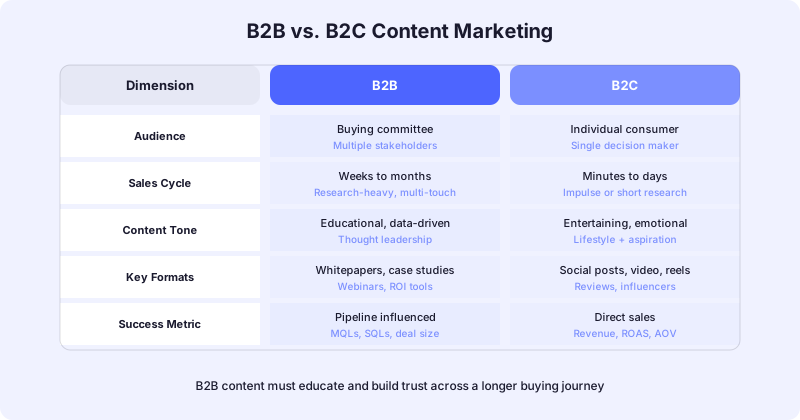
B2C content often aims for an emotional response and a fast conversion. B2B content has a fundamentally different job. It needs to educate multiple stakeholders, build credibility over weeks or months, and help buyers justify the purchase internally.
Key differences that shape your approach:
- Longer sales cycles require content at every stage, not just one conversion point. A SaaS deal might take three to six months from first touch to signed contract.
- Multiple decision-makers mean you need content for different roles: the champion who found you, the CFO who needs ROI justification, and the technical evaluator checking integrations.
- Higher purchase stakes mean buyers expect depth, specificity, and proof. Generic advice does not move B2B deals forward.
- B2B buyers need to build an internal business case. Your content should help them sell the solution to their own organization.
This does not mean B2B content has to be boring. The best B2B content reads like a smart colleague explaining a complex topic clearly. It is specific, backed by evidence, and written for people who are good at spotting fluff.
The Core Components of a B2B Content Strategy
A B2B content marketing strategy tells your team what to publish, who each piece is for, what buying stage it serves, and how you will measure success. Without this structure, content production becomes a random collection of blog posts that fails to build authority or drive pipeline.
Audience research comes first. You need to understand not just your ideal customer profile (the company) but the individual roles within the buying committee. HubSpot's buyer persona research guide offers a practical framework for conducting the interviews that surface what each stakeholder actually cares about.
Keyword research connects audience intent to content topics. Every piece of content should target a specific keyword cluster that maps to a question your buyers are asking. Building topical authority across a subject area, rather than publishing isolated articles, is what earns ranking momentum over time.
A content calendar maps output to the buyer journey. Awareness-stage content targets broad, educational keywords. Consideration-stage content addresses solution comparisons. Decision-stage content supports vendor evaluation. Teams that only produce top-of-funnel content generate traffic but struggle to convert it.
Measurement ties content to revenue. The metrics that matter in B2B are pipeline influenced, content-assisted conversions, and time-to-close for content-influenced deals. Traffic is a leading indicator, not the goal itself. For a detailed measurement framework, see our content marketing ROI guide.
B2B Content Formats That Drive Pipeline
Not every content format works equally well in B2B. The formats that consistently move buyers through the funnel share one trait: they provide specific, actionable value that helps the reader solve a real problem or make a decision.
Long-form guides and how-to content are the SEO foundation. They attract organic traffic from buyers searching for answers during the awareness and consideration stages. A comprehensive guide that ranks for a target keyword continues generating leads without additional spend.
Case studies with real numbers are the most powerful decision-stage asset. "We helped Company X reduce churn by 34% in 90 days" is far more persuasive than any category-level claim. Specificity builds trust.
Comparison and alternative pages address buyers who are actively evaluating vendors. A transparent comparison that honestly discusses strengths and limitations earns more credibility than a one-sided pitch. For examples of this format and others done well, see our roundup of B2B content marketing examples.
Original research and data-driven thought leadership differentiate your brand from competitors publishing the same recycled advice. Companies that produce proprietary data or share unique operational insights build authority that generic content cannot match.
ROI calculators and interactive tools help buyers build the internal business case. In B2B, the buyer often needs to justify the purchase to someone else. Tools that quantify the value make that internal selling process easier.
How SEO Powers B2B Content Marketing
SEO is the engine that makes B2B content marketing compound over time. Without search optimization, your content depends on manual distribution for every view. With it, a single guide can generate qualified traffic for years.
B2B buyers use search at every stage of the buying process. They search for problem definitions early on, solution comparisons in the middle, and vendor-specific terms near the decision point. Organic search is the only channel that reaches buyers during independent research without requiring ongoing ad spend.
The foundation of B2B SEO is topic cluster architecture. Instead of publishing random articles, you build comprehensive clusters around the topics your buyers care about. A pillar page covers the broad topic, and supporting cluster content addresses specific subtopics. Each piece links to the others, signaling to search engines that your site is a genuine authority on the subject.
This is exactly what content clusters and pillar pages are designed to accomplish. For teams looking for a practical guide to building these clusters from scratch, our SEO content strategy framework walks through the full process.
Semrush's B2B content marketing data shows that companies with an SEO-first content approach generate significantly more organic traffic than those publishing without keyword strategy. The compounding effect accelerates as your domain builds authority across related topics.
Common B2B Content Marketing Mistakes
Understanding what not to do is just as valuable as knowing what works. These mistakes account for most B2B content programs that produce volume without driving results.
Publishing without a keyword strategy. Content that does not target a specific search intent rarely ranks and rarely reaches the right audience. Every piece should have a primary keyword, a secondary set, and a clear position in your topic cluster.
Writing for search engines instead of buyers. Keyword stuffing and thin content might have worked a decade ago. Modern B2B content needs to be genuinely useful. If a reader finishes your article without learning something specific, the content failed.
Ignoring the middle and bottom of the funnel. Many B2B teams over-invest in awareness content and under-invest in the consideration and decision stages where conversion actually happens. A balanced strategy covers all three.
No internal linking structure. Isolated blog posts do not build topical authority. Every new piece should link to related content on your site, and existing content should be updated to link to new pieces. Our internal linking strategy guide explains how to build this systematically.
Reporting only on traffic. Leadership does not fund content programs because of pageviews. Report on pipeline influenced by content, content-assisted conversions, and revenue contribution. Content Marketing Institute's annual research consistently shows that teams reporting on revenue metrics receive more budget than those reporting on traffic alone.
How to Get Started with B2B Content Marketing
Starting a B2B content program does not require a large team or a six-figure budget. It requires focus, consistency, and a willingness to prioritize depth over breadth.
Step 1: Identify one topic cluster. Pick a subject that sits at the intersection of what your buyers search for and what your product solves. Do not try to cover five topics simultaneously.
Step 2: Build your first cluster. Write a comprehensive pillar post targeting the broadest keyword. Then write three to five supporting posts targeting specific subtopics. Link them together intentionally.
Step 3: Publish consistently for 90 days. One to two posts per week is sufficient for most teams. Consistency matters more than volume. Use a content calendar to maintain cadence.
Step 4: Measure and adjust. After 90 days, check Google Search Console for impressions and ranking positions. Look for keywords ranking in positions 10 to 30; those are the pieces worth updating to push toward page one.
Step 5: Expand to cluster two. Once your first cluster shows traction, repeat the process with the next highest-priority topic.
For teams that want this entire workflow handled, from keyword research through cluster architecture and content production, book a ClusterMagic walkthrough to see how the platform executes this process end to end.
Recommended Posts





.svg)