

.svg)
B2B Content Marketing Strategy: A Complete Guide for 2026 | ClusterMagic

B2B buyers do not make purchasing decisions quickly or alone. The average B2B buying group involves six to ten decision-makers, and Gartner research shows that buyers spend only 17% of the total purchase journey talking to vendors. The other 83% is spent researching independently, reading content, and building internal consensus.
That's why a strong B2B content marketing strategy matters more than any outbound tactic. When your content shows up during that independent research phase, you earn trust before the first sales call happens.
How B2B Content Marketing Differs from B2C
B2C content is often designed to spark an emotional response and drive a fast conversion. B2B content has a different job. It needs to educate, build credibility, and stay useful over a buying cycle that can run weeks or months.
The key differences:
- Longer sales cycles mean content has to nurture at multiple stages, not just convert at one.
- Multiple decision-makers means content must address different roles and concerns (champion, budget holder, technical evaluator).
- Higher purchase stakes mean buyers scrutinize content more carefully and expect technical depth.
- B2B content often needs to help buyers build an internal business case, not just satisfy their own questions.
This doesn't mean B2B content has to be dry or jargon-heavy. The best B2B content is specific, credible, and written like a smart colleague explaining something useful.
Audience Research for B2B: Know Who You're Writing For
Before writing a single piece, you need to know who is in the buying committee and what each person cares about. An ideal customer profile (ICP) describes the company you're targeting. Buyer personas describe the people inside that company who influence the decision.
For most B2B companies, the buying committee includes:
- The champion (the person internally selling your solution)
- The budget holder (often a VP or CFO who needs ROI justification)
- The technical evaluator (who assesses integration, security, or implementation risk)
- The end users (who care about ease of use and how it affects their day)
Each role has different questions. A champion wants proof of outcomes. A technical evaluator wants integration docs and architecture details. Your content strategy needs to serve all of them.
Run customer interviews, review sales call recordings, and talk to your customer success team. The questions buyers ask in sales conversations are the exact questions your content should answer. HubSpot's buyer persona research guide outlines a practical interview framework for this process.
The Content Types That Work in B2B
Not all content formats perform equally in B2B. The ones that consistently drive pipeline:
- Case studies: specific, outcome-focused, with real numbers. "We helped Company X achieve Y in Z timeframe" is more credible than any category-level claim.
- Comparison guides: buyers are evaluating you against alternatives. A well-written comparison page that honestly addresses your strengths and limits builds more trust than a one-sided pitch.
- Technical how-tos: if your product solves a technical problem, show how. Step-by-step guides attract the technical evaluators who influence vendor selection.
- Thought leadership: original perspectives on industry trends, backed by data or experience. Generic takes don't build authority. Specific, contrarian, or data-backed positions do.
- ROI calculators and interactive tools: B2B buyers need to justify purchase decisions internally. Tools that help them build the business case have high engagement and high conversion rates.
Blogs and long-form guides are the foundation because they support SEO. But the content types above are what move deals.
Why SEO Is the Backbone of B2B Content
B2B buyers use search throughout the buying process. They search for problem definitions, vendor comparisons, implementation questions, and category terms. Organic search is the channel that reaches buyers during independent research, which is when most of the decision is actually being made.
SEO-driven content builds compounding value. A guide that ranks today continues driving traffic and pipeline in 12 months without additional spend. Paid channels stop the moment the budget stops.
Building topical authority is how B2B content teams win in search. Rather than publishing random articles, a topical authority strategy means owning a cluster of related keywords by publishing a comprehensive pillar piece and supporting cluster content. For teams that want this built and managed for them, ClusterMagic handles the full topic cluster workflow — keyword research, content production, and publishing. For a full breakdown of how this works, see our guide to content clusters and pillar pages.
Semrush's B2B content marketing research shows that companies with a documented content strategy and an SEO-first approach generate 3x more organic traffic than those without.
Building a Content Calendar Around the Buyer Journey
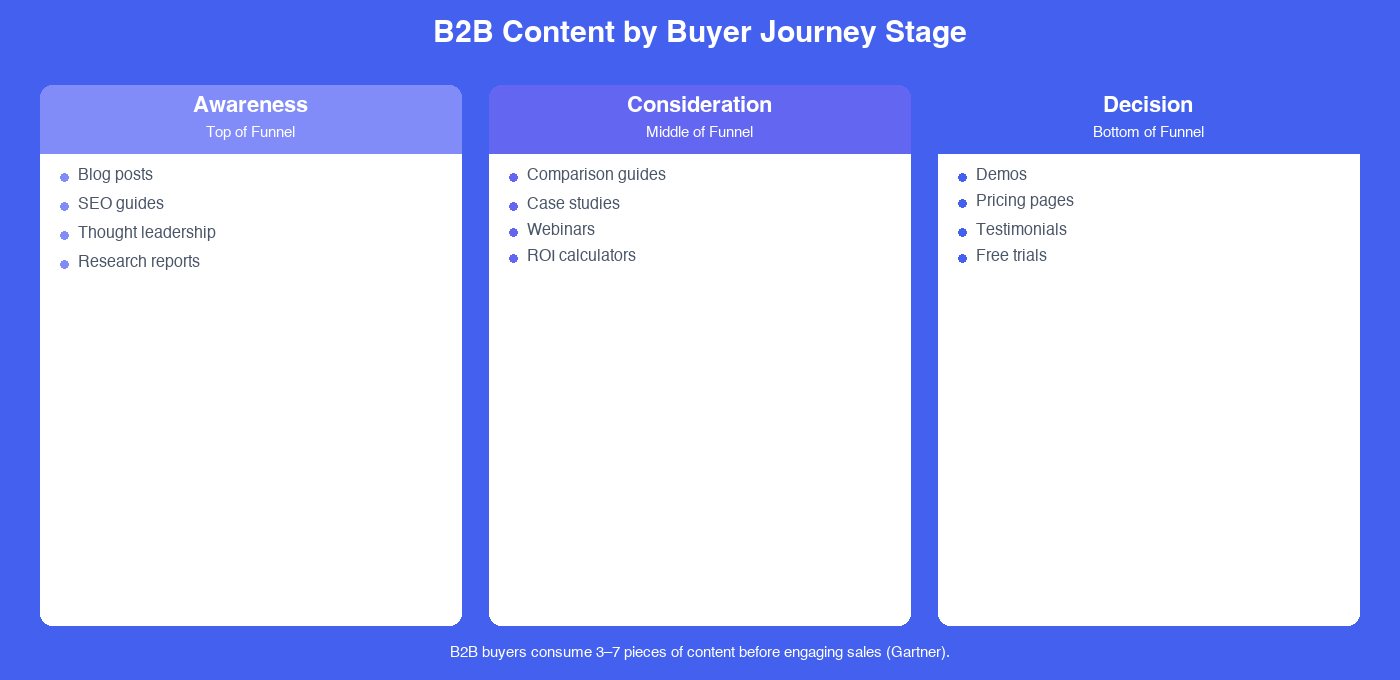
Your content calendar should map to three stages: awareness, consideration, and decision. Each stage needs different content, different keywords, and different calls to action.
Awareness stage content targets broad, problem-focused keywords. The reader knows they have a problem but hasn't identified a solution category yet. Educational guides, research reports, and thought leadership pieces belong here.
Consideration stage content targets solution-focused keywords. The reader is evaluating approaches or categories. Comparison guides, case studies, and product-adjacent how-tos work at this stage.
Decision stage content targets vendor-specific and bottom-of-funnel keywords. The reader is comparing vendors. Pricing pages, detailed case studies, implementation guides, and demo-adjacent content belong here.
A well-structured calendar publishes content at all three stages. Teams that only publish awareness content build traffic but struggle to convert it. Teams that only publish decision content have no top-of-funnel.
Distribution: Where B2B Buyers Actually Read Content
Publishing is not distribution. A post sitting on your blog with no promotion reaches almost no one in the first weeks after publishing.
B2B content distribution channels that work:
- LinkedIn: the highest-value organic reach platform for B2B. Long-form posts, document carousels, and short-form commentary on your published content all perform. LinkedIn's B2B marketing research consistently shows it drives more B2B pipeline than any other social platform.
- Email newsletters: direct access to your list, no algorithm. Re-publishing your best content to subscribers extends its reach significantly.
- Sales enablement: your sales team should be sharing content during active deals. A well-timed case study or comparison guide can accelerate a stalled deal.
- Syndication and partnerships: publishing content on industry media sites or partner newsletters reaches audiences who don't know you yet.
- Organic search: the only channel that compounds over time without additional distribution spend.
For SaaS and tech companies specifically, see our guide to content marketing for SaaS companies for channel-specific tactics.
Measuring B2B Content Marketing: Pipeline, Not Just Traffic
Traffic is a leading indicator. Pipeline is what leadership cares about. Your B2B content measurement framework should connect content to revenue. The B2B content marketing ROI guide covers the specific attribution models that work for longer B2B sales cycles. For a full breakdown of the metrics and attribution models worth building, see our guide to measuring content marketing ROI.
The metrics that matter:
- Pipeline influenced: how many open or closed deals touched your content at some point. Most CRMs and marketing automation tools can track this with UTM parameters and multi-touch attribution.
- Content-assisted conversions: demo requests, trial signups, or content downloads that came through organic search or email.
- Organic traffic by funnel stage: growing awareness traffic is good. Growing consideration and decision traffic means more qualified visitors.
- Time to close for content-influenced deals: buyers who consume multiple pieces of content before a demo often close faster and with higher contract values.
Traffic and rankings are useful for diagnosing content performance. But when reporting to leadership, frame everything in pipeline and revenue contribution. The Content Marketing Institute's annual B2B research shows that teams who report on revenue metrics receive more budget and organizational support than those who report only on traffic.
What to Build First
The most common mistake in B2B content marketing is starting with too many content types at once and executing all of them poorly. Start with one channel and one content type. For most B2B teams, that means SEO-driven long-form content.
Build a list of 20 to 30 target keywords organized by funnel stage. Write the three highest-priority pieces first. Measure what happens after 90 days. Then expand.
A documented strategy, consistent execution, and clear measurement are what separate B2B content programs that drive pipeline from the ones that produce content nobody reads. A B2B content marketing plan template gives you a practical starting document for getting those elements down on paper. For a deeper look at how content fits into a B2B content strategy for lead generation, that guide connects content decisions directly to pipeline goals.
How to Prioritize Your First 90 Days
Most B2B content teams stall because the backlog is overwhelming and everything feels equally important. The first 90 days should be narrow, deliberate, and measurable. Here is a practical framework for getting traction without spreading too thin.
Days 1 to 30: Foundation
Pick one topic cluster that sits directly at the intersection of what your buyers search for and what your product solves. Build a pillar post targeting the broadest keyword in that cluster. Write two supporting cluster posts targeting specific subtopics. Before publishing, make sure each post has a clear primary keyword, proper internal links to the others, and a logical next step for the reader.
A well-structured content brief template for each piece keeps writers on track and ensures the cluster hangs together as a unit, not just as separate articles.
Days 31 to 60: Fill the Cluster
Publish three to four more supporting posts in the same cluster. Use keyword mapping to confirm each post has a unique primary keyword and that no two posts are cannibalizing each other. Run a quick content gap analysis to check whether competitors have covered angles you missed. Update your pillar post with new internal links to the supporting pieces as they go live.
Days 61 to 90: Measure and Calibrate
At 90 days, check which posts are gaining impressions in Google Search Console. Look for keyword clusters that are starting to rank in positions 20 to 50, those are the ones worth updating or expanding to push toward page one. Identify which pieces are driving demo requests or trial signups. Report to leadership using pipeline-influenced metrics, not traffic numbers alone.
A sample B2B content calendar for this period:
| Week | Deliverable |
|---|---|
| 1 | Pillar post published |
| 2 | Supporting post 1 |
| 3 | Supporting post 2 |
| 4 | Supporting post 3 |
| 5 | Supporting post 4 |
| 6 | Supporting post 5 |
| 7 | Pillar post updated with new internal links |
| 8 | Cluster gap analysis, identify missing subtopics |
| 9 | First gap post published |
| 10 | Second gap post published |
| 11 | LinkedIn distribution of top-performing pieces |
| 12 | 90-day performance review and cluster two planning |
This calendar is achievable for a two-person team and creates real topical depth within a single quarter. The goal at the end of 90 days is not to have published a lot. It is to have a cluster that shows early ranking signals, a reporting framework in place, and a clear plan for what to build next.
If you want to see how ClusterMagic works for building and managing this entire workflow, including keyword research, cluster architecture, and content production, the process above is exactly what the platform is designed to execute.
Recommended Posts





.svg)