

.svg)
Content Marketing for SaaS Companies: What Works and What Doesn't | ClusterMagic

Most SaaS teams that invest in content marketing for SaaS companies get a version of the same disappointing result: a growing blog, flat organic traffic, and no clear line between content and revenue. The problem isn't effort. It's that most advice on SaaS content strategy focuses on tactics without ever asking whether those tactics are actually working.
This post is about what we've observed to be genuinely effective, and what consistently drains budget without payoff. If you want the step-by-step playbook, the companion guide to saas content marketing covers that. This one is the honest "why" conversation first.
Why the Standard Advice Falls Short
Search for "SaaS content strategy" or "saas blog strategy" and you'll find the same checklist repeated: write educational blog posts, target long-tail keywords, publish consistently, build backlinks. That's not wrong, exactly, it's just incomplete in a way that costs companies real money.
The core problem is that most SaaS content programs are optimized for publishing, not for outcomes. Teams measure success by volume (posts per month, word count, keyword coverage) rather than by whether the content is actually moving buyers. And because SEO results take months to materialize, it's easy to keep running an ineffective program for a long time before anyone questions whether the effort is worth it.
There's also a stage problem. Content strategy looks very different depending on whether you're a seed-stage startup trying to build initial credibility, a growth-stage company trying to scale organic acquisition, or a mature product trying to defend its search footprint. A lot of advice treats SaaS as monolithic, a single set of tactics that applies equally to everyone. It doesn't.
What Actually Drives ROI in Content Marketing for SaaS Companies
The research here is fairly consistent across independent sources. First Page Sage's 2026 B2B SaaS SEO benchmarks put average SEO ROI at 702% measured over three years, with a break-even point around month seven. That's a strong return, but it requires a multi-year commitment and a strategy built for compounding returns, not quick wins.
The content programs that hit those numbers tend to share a few characteristics.
Topical authority compounds in a way that isolated posts can't. Search engines reward sites that demonstrate genuine depth on a subject, not just one well-written article, but a coherent body of work that covers a topic from multiple angles. For SaaS companies, this means building content clusters around the problems your product solves, not just chasing any keyword with reasonable search volume. According to Ahrefs' research on topical authority, sites with comprehensive, interlinked coverage on specific topics outrank isolated high-DA pages, often significantly.
Bottom-of-funnel content tends to convert better than you'd expect. Comparison pages, alternative guides, and use-case-specific landing pages attract buyers who are already in decision mode. These aren't glamorous to write, but data from Directive's SaaS content research consistently shows them driving 2–3x higher conversion rates than broad educational content. The irony is that most teams under-invest here because they feel too "salesy." They're actually just high-intent.
Product-integrated content outperforms generic how-tos. The best-performing content for SaaS companies shows the product solving real problems, not just discusses the problem in the abstract. Tutorials, walkthroughs, and workflow guides that reference your actual product, without feeling like a brochure, tend to perform well on both traffic and conversion dimensions. They also differentiate you from the AI-generated content flooding most SaaS categories.
Companies that connect content to pipeline see 30% higher growth rates than those without clear attribution models, according to research from Digital Gratified on SaaS content ROI measurement. This isn't about vanity tracking, it's about knowing which content genuinely influences deals, not just which pages get traffic. Our guide to measuring content marketing ROI covers the attribution models and metrics worth building for a SaaS context.

What Commonly Fails and Why
The honest list of things that waste SaaS content budgets is longer than most teams want to admit.
Random blog publishing without a cluster architecture produces almost no compounding value. A post on pricing strategy, followed by one on team management, followed by one on SaaS metrics, even if individually well-written, sends no coherent topical signal. These posts compete weakly against established sites with real authority in each topic area. The traffic ceiling is low, and there's no internal linking structure to reinforce any of it. This is one of the most common failure modes we see in early-stage SaaS content programs.
Generic "thought leadership" is cheap to produce and cheap to ignore. When 91% of B2B marketers use content marketing, the bar for attention is higher than it used to be. Broad observations about industry trends, listicles of best practices, or restatements of what everyone already knows are easy to write and easy to skip. The content that earns links, trust, and return visitors takes a genuine point of view, which requires actual expertise, not just good writing.
Traffic-first measurement incentivizes the wrong things. When content teams are evaluated on pageviews, they optimize for pageviews. That means targeting high-volume keywords that attract researchers, students, and casual readers, not buyers. When a board asks about content ROI and the answer is "we grew traffic 40%," that's not a revenue story. Kalungi's framework for measuring content marketing impact recommends tracking content-influenced pipeline, marketing-qualified leads from specific pieces, and deal size of content-sourced prospects, not engagement rates.
Early-stage teams often invest in content before they have product-market clarity. Content amplifies what's already working, it doesn't fix a positioning problem. A startup that hasn't nailed its ICP or value proposition will produce content that sounds vague, attracts the wrong audience, and doesn't convert.
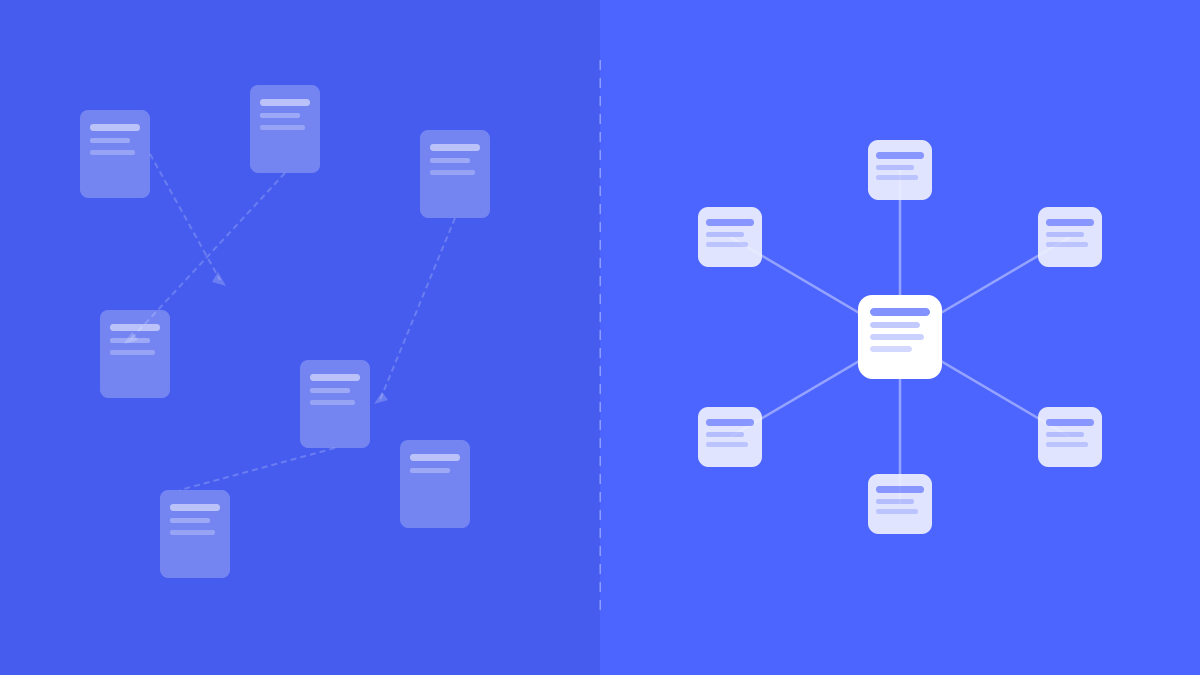
Topical Authority vs. One-Off Posts
This distinction matters more than almost anything else in a SaaS content strategy.
A one-off post targeting a keyword might rank, might get traffic, and might even convert occasionally. But it doesn't build anything. There's no flywheel, no reinforcement, no compounding effect. It lives or dies on its own merits, and when a competitor publishes something better, it gets displaced.
A topical cluster, by contrast, builds a defensible position over time. When you publish a comprehensive pillar page, a dozen supporting posts that link to it, and internal links that create a semantic web across the whole cluster, you're telling search engines that you actually own this topic. You also make it harder for competitors to displace you, because they'd have to outrank not one post but an entire architecture of content.
The practical implication is that SaaS teams should narrow their content focus, not expand it. A startup covering five topic clusters adequately will almost always outperform one covering fifteen clusters thinly. Depth before breadth is the right call at every stage until you have meaningful authority somewhere.
This is why a solid content brief template matters at the execution level, each piece needs to know its place in the cluster, which keywords it's supporting, and how it connects to adjacent content. Without that structure, even good writers produce one-off posts by default. For SaaS teams that want the cluster architecture owned and executed for them, ClusterMagic builds and manages topic cluster programs as a service. If you want to learn more about how that works in practice, it's worth a conversation before your next content quarter kicks off.
How to Know If Your Content Strategy Is Working
Most SaaS content programs run for 12 to 18 months before anyone seriously evaluates whether the strategy is sound. That's a long time to run the wrong play.
A few signals that your strategy is working:
Organic sessions from non-branded keywords are climbing. This is the base indicator. If most of your organic traffic is people searching for your company name, your content isn't pulling in new audiences, it's just serving people who already know you.
You're ranking for an expanding set of keywords in the same cluster. Not random keywords, keywords that form a coherent topic map. If you're building a cluster around, say, B2B content operations, you should see rankings appearing not just for your pillar keyword but for the supporting terms around it.
Content is showing up in sales conversations. When prospects mention a blog post, cite something they read on your site, or come into a demo already educated on your category, content is doing its job. This is one of the strongest qualitative signals, and it's chronically undertracked.
Organic leads are converting at a reasonable rate. The benchmark varies by product and price point, but if organic traffic is growing while organic-sourced pipeline stays flat, something in the content mix isn't aligned with buyer intent. Building a clear content strategy ROI measurement system helps diagnose exactly where the disconnect lives.
If you're 12 months in and none of these signals are moving, the strategy deserves a hard look. The saas seo strategy companion post goes deeper on the mechanics of building and measuring a cluster-based program.
What This Means by Company Stage
One last thing worth saying directly: the right content strategy depends heavily on where you are.
At the seed to Series A stage, the goal of content is usually building initial credibility, owning a narrow topic area, and supporting early sales conversations. A focused cluster of 15–20 posts on the exact problem you solve is worth more than a broad blog covering adjacent topics. Product comparisons and alternative guides are especially valuable here, they capture buyers actively shopping.
At Series B and beyond, the goal shifts toward scaling what's already working and defending territory you've earned. The B2B content marketing ROI guide covers the attribution models that become essential at this stage for justifying larger content investments. This is when it makes sense to expand to adjacent clusters, invest in broader brand content, and build out the middle of the funnel with case studies and product-specific how-tos. It's also when content attribution starts to matter more, because the investment is larger and the organization needs to justify it.
Matching strategy to stage isn't about moving slowly, it's about not wasting resources on plays that only work once you're further along. A blog content strategy built around your stage and ICP is the right foundation before you invest in distribution or promotion.
Content marketing for SaaS companies is a long game. The teams that win it aren't the ones that publish the most, they're the ones that build the most coherent, interconnected, buyer-relevant body of work in their category. That takes discipline, structure, and a willingness to say no to content that doesn't fit. For the step-by-step process on building that architecture, the saas content marketing guide covers cluster structure, keyword research, and measurement in detail.
Recommended Posts





.svg)