

.svg)
Blog Post Templates: 5 Proven Structures That Work

The difference between a blog post that ranks and one that doesn't often comes down to structure, not writing talent. Search engines and readers both reward posts where information is organized in predictable, scannable patterns. That is why most teams working at scale rely on blog post templates: reusable skeletons that take the guesswork out of what goes where, so writers can focus on substance instead of reinventing the outline every time.
The problem is that most template roundups are either too generic to use or so rigid they flatten every topic into the same shape. The five templates below are different. Each one matches a specific search intent and content goal, and each has a structural logic that earns rankings when the topic actually fits the format.
Why templates matter more than most writers admit
Writers tend to resist templates because they feel like creative straitjackets. In practice, the opposite is true. A good template removes the low-value decisions (what goes in the intro, where to put the summary table, how to close) so the writer can spend energy on the parts that actually differentiate the post: original examples, real data, sharp opinions.
Templates also solve three specific problems at scale:
- Consistency: Readers who land on multiple posts from your site experience a coherent voice and layout. That builds trust and boosts return visits.
- SEO signals: Search engines reward clear H2 hierarchies, scannable lists, comparison tables, and structured data. Templates bake these in by default.
- Production speed: A writer handed a template finishes a draft in roughly half the time it takes to start from a blank page. On a calendar with 20 posts a month, that math compounds fast.
Orbit Media's annual blogging statistics study has shown for years that writers who follow a repeatable process report stronger results than writers who start fresh every time. Process is not the enemy of quality. It is the foundation.
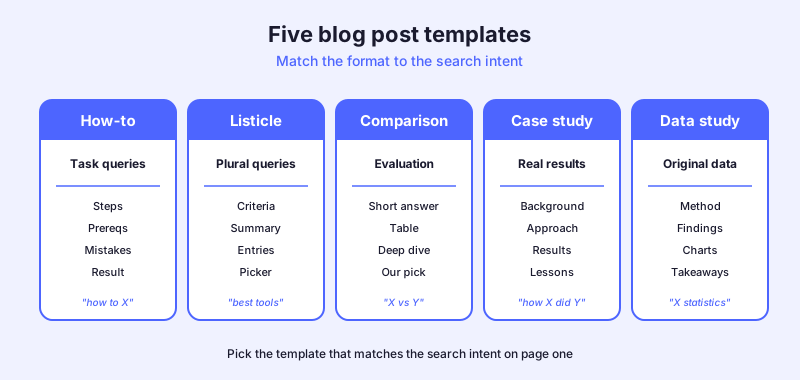
Five blog post templates that consistently work
Every template below covers three things: when to use it, the structural outline, and a short note on how to make it rank. Pick the one that matches your topic and search intent, then fill it in.
1. The how-to template
When to use it: Any query where the user wants to accomplish a specific task. These are the workhorses of instructional content, and they dominate results for "how to," "how do I," and "steps to" queries.
Structure:
- Hook: One or two sentences naming the outcome the reader wants.
- Why this matters: Two to three sentences on the stakes. Skip the throat-clearing.
- What you need before you start: A short list of prerequisites, tools, or inputs.
- The steps: Numbered H2 or H3 sections, one per step. Each step answers "what do I do" and "how do I know it worked."
- Common mistakes: A short section addressing the two or three most frequent ways people get stuck.
- What good looks like: A brief description or example of a successful finished result.
- Wrap-up: One paragraph pointing to the next logical action.
Ranking tips: use imperative verbs in step headings, include at least one visual per major step, and add a short FAQ block at the bottom if search results show a People Also Ask box for the query.
2. The listicle template
When to use it: Queries with a plural intent: "best tools for X," "top strategies for Y," "examples of Z." Listicles match how users skim, which is why they consistently earn clicks and shares.
Structure:
- Hook: One sentence framing why the list exists (what problem it solves).
- How we picked: Two to four sentences on the criteria. This builds credibility and is critical for YMYL or purchase-intent queries.
- Quick-reference table or summary: A scannable version of the list for readers who will not read every entry.
- Each list item: A consistent mini-structure. Name or headline, one-line summary, a paragraph of explanation, a specific example, and a "best for" tag.
- How to pick the right one: A brief decision framework so the reader can choose.
- Wrap-up: A recommendation or honest "it depends" closer.
Ranking tips: keep list item structures parallel (same subheads across every entry), include the number in the title, and make sure the summary table is actual HTML, not an image, so search engines can read it.
3. The comparison template
When to use it: Bottom-of-funnel queries with explicit alternatives: "X vs Y," "alternatives to Z," "X or Y for small teams." These posts tend to convert because the reader is already evaluating options.
Structure:
- Hook: State the decision the reader is trying to make.
- The short answer: One paragraph with your honest recommendation by use case. Readers who want the TL;DR should find it in the first 200 words.
- Comparison table: A side-by-side with five to eight attributes (pricing, target user, key features, integrations, support).
- Deep dive on each option: What it does well, what it does poorly, who it is for, pricing.
- Head-to-head scenarios: Two or three real-world cases where one clearly beats the other.
- Our pick: A clear recommendation, ideally with a hedge for edge cases.
Ranking tips: comparison posts live and die by the table. Make it comprehensive, accurate, and updated. Link to the vendors' official pages as sources. HubSpot's best CRM comparison page is a strong reference for how to structure a competitive comparison at scale.
4. The case study template
When to use it: When you have a real result worth telling. Case studies are high-trust content that supports both SEO and sales, and they outperform generic posts on conversion metrics almost every time.
Structure:
- Headline outcome: The result, upfront. "How X grew organic traffic 3x in six months."
- Background: Who the subject is, what they were trying to do, what the situation looked like before.
- The challenge: The specific problem that triggered the work. Be concrete.
- The approach: What was actually done, in enough detail that a reader could replicate the playbook.
- The results: Real numbers, with before and after, plus context on timeframes.
- What we learned: Honest reflection on what worked, what did not, and what we would do differently.
- How to apply this to your situation: A short section translating the story into a playbook for the reader.
Ranking tips: include specific numbers in the title and H2s. Case studies without metrics read as fluff. If the subject agrees, include a photo or logo for credibility. The Animalz case study collection is worth bookmarking for examples of how to structure SaaS case studies that read as honest rather than promotional.
5. The data study template
When to use it: When you have access to original data (your own survey, product data, scraped dataset, internal analytics) that says something the rest of the industry is not saying. Data studies are link magnets because they give other writers something to cite.
Structure:
- The headline finding: The single most interesting stat, stated as the hook.
- Why this matters: Two or three sentences on the implications for readers.
- Methodology: How you collected the data, sample size, timeframe, caveats. Transparency matters for both credibility and link attribution.
- Key findings: Three to seven major insights, each with its own H2, a chart, and a short analysis.
- What changed and what stayed the same: If you have historical data, comparisons go here.
- What this means for practitioners: Translate the numbers into actions.
- Download the dataset: Optional but valuable. Offering the raw data drives backlinks.
Ranking tips: every chart should have a descriptive alt tag and a caption, and the post should include pull quotes that are easy for other bloggers to lift and cite. Backlinko's 11.8 million search results study is a good template to study for how to present an original dataset.
Picking the right template for the right topic
The most common mistake teams make is defaulting to one template for everything. The how-to template is strong but flattens topics that would rank better as comparisons or case studies. The listicle format gets overused for queries where readers actually want a direct answer.
The honest test is simple: look at the current top 10 results for your target keyword. If eight of them are listicles, your post should be a listicle. If six are comparison posts, you need a comparison post. Search engines are telling you what format they think satisfies the query, and fighting that signal is a losing strategy unless you have a very strong differentiating angle.
This is the unglamorous part of content planning: deciding which keyword gets which format before a writer touches a draft. Teams that cluster their keywords by intent first (informational, commercial, transactional) and then assign formats accordingly consistently outperform teams that just pick topics from a brainstorm. Tools like ClusterMagic exist specifically to do this grouping at scale, turning a messy keyword list into intent buckets so you can see at a glance which topics want a how-to and which want a comparison. That upstream clarity is what makes templates actually work.
For a broader view on building out a full publishing operation, the blog content strategy guide covers how formats fit into a full editorial calendar.
How to adapt a template without breaking it
Templates are starting points, not prison walls. A few principles for adapting them well:
- Structural bones: Keep the skeleton (hook, context, main body, takeaway) consistent. The tone, examples, and depth can move around.
- Section discipline: Extra sections dilute the main point and hurt dwell time. If a section would not survive a ruthless edit, cut it. Resist adding sections just to be thorough.
- Section length: Match it to search intent. Top-of-funnel readers skim. Bottom-of-funnel readers want depth. Use your H2 lengths accordingly.
- Measure and iterate: After three months, look at which template formats are actually ranking for you and double down. Kill the ones that are not working.
Once a template has proven it works for your site, consider codifying it in a content brief template so writers and editors are working from the same shared reference. That is how consistency compounds.
Templates and the rest of your workflow
Templates are one part of a bigger system. They live inside editorial briefs, connect to your publishing cadence, and feed into your QA checklist. A template in isolation will not fix a messy operation, but a template inside a solid content creation workflow removes a huge amount of friction.
The best teams treat their templates as living documents. When a post underperforms, they ask whether the structure failed or the topic was wrong. When a post overperforms, they look at what structural choices drove it and bake those lessons back into the template. After a year of that practice, your templates become genuinely yours, tuned to your audience and your keywords.
What to do next
Pick one template and use it on the next three posts you write. That is the fastest way to see the benefit. Measure the time-to-draft and the ranking outcomes against posts written without a template, and the difference will make itself obvious.
Templates are not a magic shortcut. What they do is let you stop wasting creative energy on the low-value parts of writing and spend it on the parts that actually move rankings: original examples, specific data, and genuine opinions backed by experience. The post structure can be borrowed. The substance has to be yours.
Recommended Posts





.svg)