

.svg)
Content Creation Workflow Template: Build a Repeatable Process | ClusterMagic
Why Ad Hoc Content Production Breaks at Scale
Small content teams can often get by without a formal process. There are only two writers, everyone knows what good looks like, and reviews happen in Slack. The system works, loosely, as long as volume stays low.
The moment you add a third writer, a second editor, or a guest contributor, the informal system breaks. Quality becomes inconsistent. Posts miss strategic requirements. Revisions pile up because the first draft didn't have a complete brief. Publishing timelines slip because no one owns the handoff between stages.
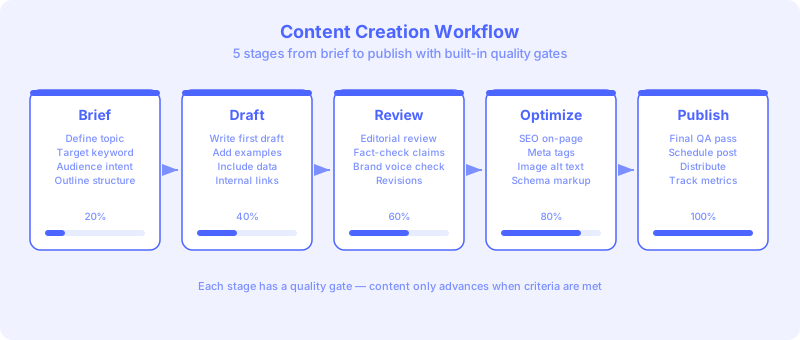
A content creation workflow solves this by making every stage of production explicit and assigning clear ownership for each one. This post walks through a complete content workflow template you can adapt for your team, from the first keyword assignment through to publishing and performance tracking.
Stage 1: Brief
Every piece of content in a well-run production process starts with a brief. The brief is the strategic document that tells the writer exactly what the post needs to accomplish, who it's for, and what it must include to compete for its target keyword.
A complete brief prevents most first-draft revisions. When writers have clear guidance on search intent, required sections, word count targets, and internal links, they produce drafts that are structurally sound even if the prose needs editing. When writers work from a vague topic or a keyword alone, the editor ends up doing strategic work that should have happened before writing started.
The minimum viable brief for SEO content includes:
- Primary keyword and two to three secondary keywords
- Search intent (what the person searching for this keyword actually wants)
- Target word count range based on what's currently ranking
- Required H2 and H3 headers with notes on what each section should cover
- Three to five internal links to include with anchor text suggestions
- One to two external sources to reference or link to
- Key questions the post must answer (often derived from "People Also Ask" boxes)
- CTA or conversion goal for the post
The brief creation step is also where you assign the post to a writer and set a due date for the completed draft. The content brief template guide covers each of these fields in detail and includes a downloadable template you can plug into your workflow immediately.
Stage 2: Draft
The draft stage is where most of the word count happens. The writer works from the brief and produces a complete first draft. "Complete" is the key word: a first draft should include every section specified in the brief, a working introduction and conclusion, all required internal links placed with appropriate anchor text, and any data or external sources cited.
Partial drafts create more editorial work than complete rough drafts. A complete draft that needs prose editing takes 30-45 minutes to review. A draft missing two sections and the internal links requires the editor to either complete those sections themselves or return the draft to the writer, adding a full revision cycle.
Set clear expectations for what "done" means at the draft stage. One effective standard: a draft is not done until it would pass a basic quality check by the writer themselves. That means reading it once end to end, checking that all brief requirements are met, and fixing obvious errors before submitting for review. This single step eliminates most of the trivial revision cycles that slow down content production.
For teams using AI writing assistance, the same standard applies. Teams considering automated content creation for SEO should still hold every draft to this bar. AI-assisted drafts that aren't reviewed by the writer before submission tend to have coherence issues, incorrect facts, and generic phrasing that requires significant editing. The writer still owns the draft, regardless of how it was produced.
Stage 3: Review
The review stage has two distinct layers that are often collapsed into one, to the detriment of quality. The first layer is editorial review: is the writing clear, accurate, and does it meet the brief requirements? The second layer is SEO review: does the post use the target keyword correctly, are the headers structured well, and are all internal links present and properly anchored?
Combining these into a single review pass works at low volume. It breaks at scale. A documented content approval workflow that separates editorial and SEO review prevents this bottleneck. When one person is responsible for both editorial quality and SEO compliance on every post, they become the bottleneck. Errors slip through because the reviewer is context-switching between two different types of evaluation.
The cleaner approach is to sequence the reviews. Editorial first, SEO second. The editor reviews for clarity, accuracy, structure, and brand voice. Once the editorial pass is complete and the writer has made any requested changes, a second reviewer (or a checklist the writer self-applies) confirms SEO requirements: keyword placement, header structure, internal links, meta description, and image alt text.
For small teams where one person handles both functions, use a two-pass review structure for the same reviewer. Review the post twice in separate sessions with a different checklist for each pass. The cognitive separation improves catch rates for both types of issues.
Stage 4: Optimize
The optimize stage happens after editorial and SEO review are complete but before the post is published. This is where you handle final on-page optimization tasks: formatting the post for the CMS, writing or reviewing the meta title and description, setting the featured image and alt text, confirming category and tag assignments, and verifying that all internal links resolve to the correct URLs.
Optimization is also where you should run a final SERP check. Pull up Google and search for your target keyword. Look at the top three to five results. Check: Is your post's H1 well-differentiated from what's already ranking? Are there common questions in the "People Also Ask" box that your post doesn't address? Has the SERP format changed in a way that affects what kind of content performs well (for example, a featured snippet opportunity that your post could capture with a formatted answer)?
This check takes five minutes and regularly surfaces improvements that would have been easy to make before publishing but are harder to prioritize once the post is live. It's worth building into your standard optimize stage checklist.
The content creation process optimization guide goes deeper on how to systematize this stage so that it's fast and consistent rather than ad hoc.
Stage 5: Publish
The publish stage is deceptively simple. You push the post live. But it includes several steps that get skipped when teams treat publishing as just clicking a button.
At minimum, your publish checklist should cover: confirming the post is scheduled or published at the correct date and time, submitting the URL to Google Search Console for indexing, adding the post to your internal link update queue (more on this below), and sharing the post through owned distribution channels.
The internal link update step is the one most teams skip, and it costs them real SEO value. When you publish a new post, existing posts on related topics should link to it. These backward links pass authority to the new post and help Google understand how it connects to your existing content. Without them, new posts take longer to get indexed and start ranking.
Your process should include a step where someone identifies two to three existing posts that should link to the newly published piece, makes those edits in the CMS, and updates the post-index to reflect the new links. This takes 10-15 minutes per post and meaningfully accelerates ranking timelines.
The scale content production guide covers how to systematize the backward-linking step so it doesn't get dropped as your publishing volume increases.
Stage 6: Post-Publish Performance Review
A content production workflow that ends at publish is only half a system. The other half is the feedback loop that tells you whether the content is working and what to do about it.
Set a 30-day and 90-day review for every published post. At 30 days, check whether the post has been indexed and whether it's appearing for any keywords. At 90 days, check ranking position for the target keyword, organic sessions from search, and engagement signals like time on page and bounce rate.
Posts that are indexed but not ranking after 90 days need a diagnosis, not a shrug. The most common causes: keyword difficulty is too high for your current domain authority, the content doesn't fully satisfy search intent, or the post is getting cannibalized by another post on your site targeting the same keyword. Each issue has a different fix, and identifying it correctly is faster than guessing.
Build this review into your calendar as a scheduled task rather than leaving it to initiative. Most content teams have good intentions about reviewing post performance but never do it consistently unless it's on the calendar with a clear owner.
Adapting the Template to Your Team
The five-plus-one-stage workflow described here is a starting point. Most teams need to adapt it to match their specific situation.
For solo content creators: Collapse the review stages into a self-review checklist. The key is still to separate the editorial pass from the SEO pass, even if the same person does both. Write the checklist, follow it for every post, and you'll catch issues that slip through when review is purely intuitive.
For agencies managing multiple clients: Add a client review stage between the optimize and publish stages. Document exactly what the client is reviewing and what they can and can't change without triggering a strategic discussion. Undefined client review stages are where agency timelines evaporate.
For teams using AI assistance: The workflow structure stays the same. A structured AI SEO content workflow maps where automation fits at each stage. AI tools can accelerate the draft and optimize stages, but they don't replace the brief, review, or performance stages. If anything, they make the brief more important, not less, because AI output quality is proportional to brief quality.
The blog content strategy guide covers how to connect this workflow to your broader publishing plan so that each post is serving a strategic purpose rather than just filling a slot in the calendar.
Running Your Workflow With ClusterMagic
ClusterMagic fits into the brief stage of this workflow. It analyzes your keyword targets, maps them to content clusters, and generates briefs that include all the SEO requirements your writers need before they start writing. The result is first drafts that require less editorial rework and posts that are structured correctly for search from the start.
If you want to see how ClusterMagic fits into your existing production process, book a walkthrough and we'll walk through your workflow together.
Sources:
Recommended Posts





.svg)