

.svg)
Content Optimization for Search Engines: What to Focus On in 2026 | ClusterMagic

Search engine optimization has always been a moving target, but the shifts between 2024 and 2026 have been structural, not incremental. AI Overviews now appear on roughly 65% of search results pages. Google's ranking systems increasingly reward demonstrated expertise over keyword density. And the gap between content that ranks and content that doesn't has widened.
Content optimization for search engines in 2026 is less about technical tricks and more about strategic alignment: matching your content to what searchers actually need, proving your authority on the topic, and structuring your pages so both humans and algorithms can extract value quickly.
This guide covers what to focus on right now, what to stop doing, and how to prioritize your optimization efforts for maximum impact. For the tactical on-page checklist, the SEO content optimization techniques guide goes deeper into implementation details.
The Optimization Priorities Have Shifted
If you learned SEO five years ago, your playbook needs updating. Several practices that used to matter have been deprioritized, while factors that were once secondary now dominate rankings.
What Matters More in 2026
Search intent alignment is the single highest-impact optimization factor. Google's NLP systems parse meaning, not just keywords. A page targeting "best project management software" needs to be a comparison with specific recommendations, not a general essay about project management. Pages that mismatch intent get filtered out regardless of how well they're optimized otherwise.
Content depth and completeness determines whether your page satisfies the query or sends searchers back to the results. According to ClickRank's ranking factor analysis, comprehensive content that addresses the full scope of a topic consistently outperforms thin pages targeting the same keyword, even when the thin pages have stronger backlink profiles.
E-E-A-T signals (experience, expertise, authoritativeness, trustworthiness) have moved from quality rater guidelines into observable ranking effects. Google's helpful content documentation explicitly asks whether content demonstrates first-hand experience and whether readers would trust the source. These aren't abstract concepts. They translate into concrete page elements: author bios, cited sources, original data, and evidence of direct experience.
What Matters Less Than It Used To
Exact-match keyword density has been declining in importance for years, but many teams still optimize for it. Google's language models understand synonyms, related terms, and semantic context. Writing naturally about a topic covers keyword variations without deliberate insertion.
Word count as a ranking signal is a myth that persists despite evidence against it. A 500-word page that perfectly answers a specific question can outrank a 5,000-word guide that buries the answer. Optimize for completeness relative to the intent, not for a target word count.
Meta keyword tags have been ignored by Google since 2009. If you're still filling these in, redirect that effort elsewhere.
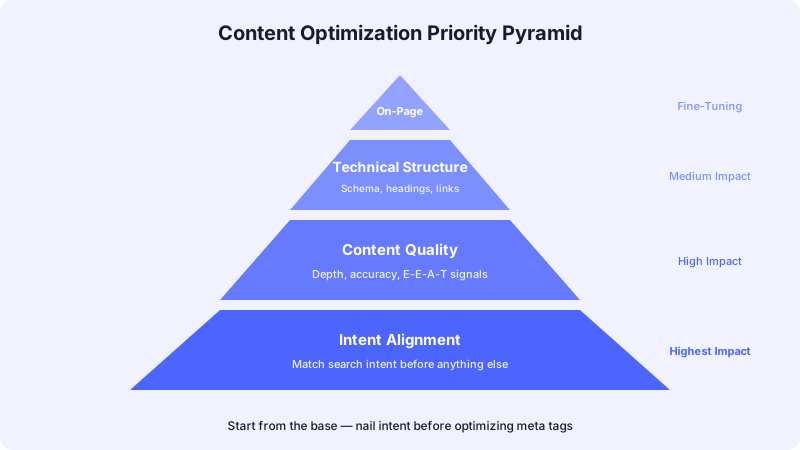
Content Optimization for Search Engines: A Priority Framework
Not all optimization activities deliver equal returns. Here's a framework for prioritizing your efforts.
Priority 1: Align Content With Search Intent
Before optimizing a single heading or meta tag, confirm that your content matches what the searcher expects to find. There are four intent types, and each requires a different content format:
- Informational: The searcher wants to learn something. Format: guides, tutorials, explainers.
- Commercial investigation: The searcher is comparing options. Format: comparisons, reviews, feature breakdowns.
- Transactional: The searcher wants to buy or sign up. Format: product pages, pricing pages, landing pages.
- Navigational: The searcher wants a specific page. Format: brand pages, login pages, documentation.
The fastest way to check intent is to search your target keyword and examine the top five results. If they're all comparison articles and your page is a how-to guide, you have an intent mismatch that no amount of on-page optimization will fix.
Priority 2: Demonstrate Expertise and Experience
Google's ranking systems are getting better at distinguishing content written by someone with direct experience from content assembled by someone who researched the topic for 30 minutes. The E-E-A-T and helpful content framework now plays a measurable role in competitive rankings.
Concrete ways to demonstrate E-E-A-T:
- Author pages with real credentials, professional history, and links to published work
- First-person insights that reflect direct experience ("In our testing..." or "After managing 200+ campaigns...")
- Original data or analysis that can't be found elsewhere
- Cited sources that link to specific studies, documentation, or primary sources (not homepages)
- Updated dates showing the content is maintained, not abandoned
If your content reads like it could have been written by anyone with access to Google, it will struggle to rank in competitive spaces. The content that wins in 2026 carries a point of view backed by evidence.
Priority 3: Structure Content for Scanning and Extraction
Both human readers and search algorithms process structured content faster. This applies to how you organize the page and how you format individual sections.
Heading hierarchy should follow a logical outline. Every H2 should be a major section that could stand alone as a topic. H3s subdivide those sections. Skipping levels (H2 to H4) confuses both readers and crawlers.
Front-load the answer. For informational queries, put the direct answer in the first paragraph or section. Don't bury it behind three paragraphs of background. Google extracts featured snippet content from pages that answer queries directly and early.
Use structured data where applicable. FAQ schema, HowTo schema, and Article schema help search engines understand your content type and display rich results. Google's structured data documentation provides implementation details for each type.
Tables and lists are more parseable than paragraphs for comparative information. If you're presenting features, pricing tiers, or step-by-step processes, structured formats perform better than prose.
Priority 4: Optimize On-Page Elements
With intent, quality, and structure addressed, refine the on-page elements that influence click-through rate and crawlability.
Title tags should be 50-60 characters, include the primary keyword near the beginning, and communicate clear value. A title like "Content Optimization for Search Engines: 2026 Priority Guide" tells the searcher exactly what they'll find.
Meta descriptions don't directly affect rankings but do affect click-through rate. Write 150-160 characters that summarize the page's unique value and include a reason to click. Avoid descriptions that could apply to any page on the topic.
Internal links connect your content to the broader topic architecture of your site. Every optimized page should link to 2-4 related pages within your site and receive links from relevant pages in return. This reinforces topical relevance signals. The SEO content strategy explainer covers how internal linking supports cluster-based ranking.
Image optimization includes descriptive alt text, compressed file sizes, and next-gen formats (WebP or AVIF). Images should add information, not just decoration. A diagram that illustrates a concept is more valuable than a stock photo that fills space.
Optimizing Content for AI Search
AI Overviews now dominate more than half of all search results pages. Optimizing content for traditional rankings is no longer sufficient if you also want visibility in AI-generated answers.
The data is encouraging for content optimizers: Sitebulb's 2026 SEO expert predictions note that 97% of AI Overview citations come from pages already in the top 20 organic results. Ranking well in traditional search is the prerequisite for AI search visibility. You don't need a separate strategy; you need the same strategy executed better.
That said, certain content formats are more likely to be cited in AI Overviews:
- Direct, concise answers to specific questions (within the first 1-2 sentences of a section)
- Structured lists and step-by-step processes that AI can extract and reformat
- Data points with clear context that an AI summary can reference
- Definitions and explanations that answer "what is" queries definitively
Content that rambles before reaching its point, buries key information in long paragraphs, or relies heavily on images to convey meaning is less likely to be extracted by AI systems.
The Content Update Optimization Cycle
Optimization isn't a one-time activity. Content that ranks today can slip tomorrow as competitors publish, search intent shifts, and freshness signals decay.
When to Update Existing Content
- Declining rankings: If a page drops 5+ positions for its target keyword over 60 days, investigate and update
- Outdated information: Statistics, tool recommendations, and process descriptions age quickly in fast-moving industries
- New competitors: When a new page enters the top 5 for your target keyword, analyze what it offers that yours doesn't
- Changing intent: Sometimes the SERP shifts. A keyword that showed informational results may start showing transactional results. Your content needs to match.
The Update Process
- Re-analyze the SERP for your target keyword. Note what the top 3 results cover that you don't.
- Check Search Console for queries that bring impressions but few clicks. These queries reveal what searchers expect to find on your page but may not be finding.
- Add missing sections that address gaps identified in steps 1 and 2.
- Remove outdated information that could undermine trust.
- Refresh internal links to include newer, relevant content published since the original. The content gap analysis guide can help identify what you're missing.
- Update the published date to reflect the revision.
Teams that update their top 20 performing pages quarterly see more sustained ranking stability than teams that only publish new content. Optimization is maintenance, not a project.
How to Optimize Content for Search Engines: A Quick-Reference Checklist
For each piece of content, confirm these elements before publishing:
Intent and Quality
- [ ] Target keyword intent matches content format
- [ ] Content covers the topic comprehensively relative to top-ranking competitors
- [ ] Author expertise is visible (bio, credentials, experience references)
- [ ] At least one original insight, data point, or perspective that competitors lack
Structure
- [ ] Heading hierarchy follows a logical outline (H2 > H3 > H4)
- [ ] Direct answer to the primary query appears within the first 200 words
- [ ] Lists or tables used for comparative or sequential information
- [ ] Structured data markup applied where applicable
On-Page Elements
- [ ] Title tag under 60 characters with primary keyword near the start
- [ ] Meta description 150-160 characters with clear value proposition
- [ ] 2-4 internal links to related content on your site
- [ ] 3-5 external links to specific, authoritative sources
- [ ] All images have descriptive alt text and are compressed
Technical
- [ ] Page loads under 2.5 seconds on mobile (Core Web Vitals threshold)
- [ ] Content is fully accessible on mobile without horizontal scrolling
- [ ] URL is clean, readable, and includes the target keyword
- [ ] No duplicate content issues with other pages on the site
Turning SEO Content Optimization Into a System
The teams that rank consistently don't optimize harder. They optimize more systematically. Every piece of content goes through the same quality checks. Every published page gets reviewed on a quarterly cycle. Every content decision is informed by search performance data.
Build the system once, then run it. Document your optimization checklist, your update cadence, and your performance thresholds. Train your team on the process. Then let the system compound results over months and years.
If you want help building a content optimization system that scales with your publishing volume, book a strategy call with ClusterMagic to see how cluster-based programs handle optimization at every stage of the content lifecycle.
Recommended Posts





.svg)