

.svg)
12 SEO Content Optimization Techniques That Work | ClusterMagic

Publishing new content is expensive. Optimizing what you already have is often faster, cheaper, and more reliable for driving organic growth.
SEO content optimization is the practice of improving existing pages so they rank higher, attract better-fit readers, and convert more of them into leads or customers. Done systematically, it compounds the value of your content library instead of letting posts decay into the long tail of forgotten URLs.
These 12 techniques cover the full optimization stack, from keyword alignment and structure to technical details and conversion paths. Apply them in order and you will have a repeatable process you can run on any page in your library.
1. Audit Search Intent Before Changing Anything
The most common optimization mistake is editing content without first confirming you understand what the ranking page needs to accomplish. Search intent is the underlying goal behind a query, and Google's algorithm is increasingly good at identifying whether your content matches it.
Before rewriting a word, search your target keyword and study the top five results. Are they listicles, guides, comparison pages, or product pages? Are they long or short? What questions do they answer in the first 300 words? If your current page structure does not match the dominant format in the results, that is the first thing to fix, not the prose.
Aligning with search intent often produces significant ranking improvements with minimal content changes. It is always step one.
2. Sharpen the Primary Keyword Placement
Your primary keyword should appear in four places: the title tag, the H1 heading, the first 100 words of the body, and at least one H2 subheading. This is not keyword stuffing. It is giving Google clear signals about what the page covers.
Check your keyword mapping to confirm each page owns a distinct primary keyword. If two pages share the same target term, they will compete with each other, a problem called keyword cannibalization that suppresses rankings for both.
One page, one primary keyword. Secondary and semantic keywords can appear naturally throughout the body without forcing them.
3. Expand Semantic Keyword Coverage
Google's understanding of language has advanced to the point where ranking for a keyword requires demonstrating genuine topical coverage, not just repeating the exact phrase. Semantic keywords are the related terms, subtopics, and questions that belong to the same subject area.
Run your primary keyword through a tool like Clearscope, Surfer, or Google's "People Also Ask" results. Identify the concepts and phrases that appear consistently across top-ranking pages and confirm your content addresses them. Filling semantic gaps often lifts rankings faster than acquiring new backlinks.
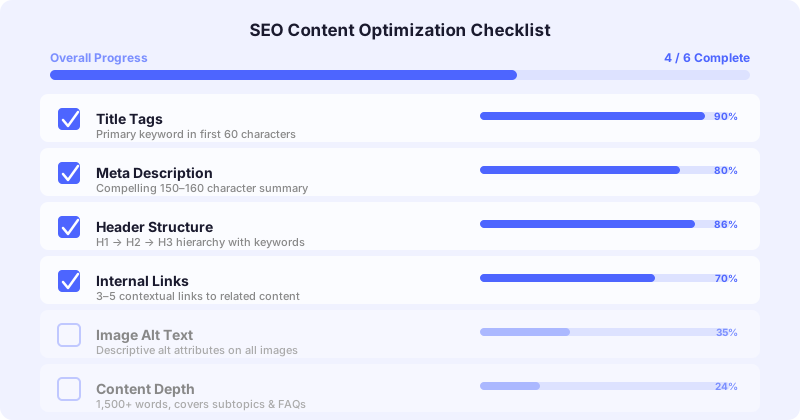
This technique is particularly effective for posts that rank on page 2, where a small relevance boost is often enough to break onto page 1. The on-page content optimization checklist provides a step-by-step format for tracking these improvements across every page you touch.
4. Rewrite the Title Tag for Click-Through Rate
Your title tag is your paid advertisement in the SERP, and you are not charged per click, only per missed opportunity. A title that earns a 5% CTR will always outperform one with a 2% CTR, even if both rank at position 4.
High-performing title patterns include specific numbers ("7 Techniques"), outcome-focused framing ("How to Rank Faster"), year-based freshness signals ("2026 Guide"), and benefit-forward language that answers "what's in this for me?" in under 65 characters. Research by Backlinko found that title tags between 40 and 60 characters achieve the highest organic CTR.
Pull CTR data from Google Search Console, find pages with high impressions but below-average CTR, and test new title tags on those pages first. It is low-effort, high-leverage.
5. Strengthen the Introduction
Readers decide within the first few sentences whether they will stay on a page. Search engines track engagement signals including time on page, scroll depth, and return visits. A weak introduction hurts both.
The introduction should do three things immediately: confirm the reader is in the right place, name the problem or question clearly, and signal what they will learn or accomplish by reading. It should not include generic warm-up sentences, background context that belongs deeper in the post, or vague promises.
The first paragraph should make a specific, credible claim that earns the reader's next five minutes. Edit every introduction until it does.
6. Restructure Headings for Scannability and Keyword Coverage
Most readers scan before they read. If the heading structure does not tell the full story of the page, many readers will leave without engaging with the body content at all.
Audit your H2 and H3 headings as a standalone list. They should form a logical outline of the topic, include natural variations of your primary and secondary keywords, and answer the specific questions your target reader is asking. Avoid heading text that is clever but uninformative ("The Secret Ingredient" tells a scanner nothing useful).
A well-structured heading hierarchy also helps Google understand the depth and organization of your content, which supports featured snippet eligibility. For a complete walkthrough of how to write SEO-friendly content from heading structure to body copy, that guide covers the writing side of optimization in detail.
7. Improve Content Depth Without Adding Fluff
There is a meaningful difference between long content and thorough content. Google does not reward word count. It rewards completeness. A 1,500-word post that answers every relevant question outperforms a 3,000-word post padded with repetition.
Assess depth by comparing your page against the top-ranking results for your keyword. What subtopics do they cover that you do not? What questions appear in the "People Also Ask" box that your content does not address? What supporting evidence (data, examples, original insights) could strengthen a claim you are currently stating without proof?
Add what is missing and cut what adds length without adding value. Both moves improve the page.
8. Optimize Images and Media
Images slow down pages when they are not compressed, and they waste a ranking opportunity when the alt text is generic or missing. Every image on a page should have descriptive alt text that includes relevant keywords naturally, not forced.
Compress images to the minimum file size that maintains acceptable visual quality. Use next-gen formats (WebP, AVIF) where your CMS supports them. Google's Core Web Vitals documentation confirms that image optimization directly affects Largest Contentful Paint scores, which influence rankings. The technical SEO for content teams guide covers Core Web Vitals and other technical factors that content teams need to understand. Add descriptive file names before uploading: content-optimization-checklist.png signals relevance to both Google Image Search and crawlers reading file paths.
For posts with charts or original graphics, consider whether the image could earn a featured snippet if optimized with a clear title, relevant alt text, and surrounding descriptive text.
9. Strengthen Internal Linking
Internal links distribute ranking authority across your site, help Google understand your content architecture, and guide readers toward high-value pages they might not find otherwise. Most content libraries are significantly under-linked.
Audit each optimized page for two things: outbound internal links to relevant supporting content, and inbound links from other pages that should reference it. A page with zero internal links pointing to it is effectively invisible to both crawlers and readers who navigate by clicking.
Use your internal linking strategy to connect pages intentionally: pillar pages should link to cluster pages, and cluster pages should link back to the pillar. The architecture should reflect the topic hierarchy, not the publication date.
10. Add or Update External Citations
External links to credible, specific sources improve E-E-A-T signals and build trust with readers. Avoid linking to homepages. Link to specific pages: a published study, a methodology document, a government statistic, an original data source.
Audit your existing external links for two issues: broken links (which damage user experience and send crawlers to dead ends) and outdated sources (a 2019 statistic in a 2026 guide undermines credibility). Update both on every page you optimize.
Citing specific, recent data also creates a reason for other sites to link to your content if they reference the same source, a natural link acquisition strategy that does not require outreach.
11. Build a Clearer Conversion Path
Most content optimization focuses entirely on ranking signals and ignores what happens after the reader arrives. A page that ranks at position 1 and converts nobody is not actually performing.
Every piece of optimized content should have at least one clear next step: a related post that goes deeper on a subtopic, a resource that helps the reader apply what they just learned, or an offer relevant to where they are in the decision process. The CTA should appear naturally within the content, not only as a footer element the reader may never reach.
Match the offer to the intent. A top-of-funnel educational post should lead to another educational resource or a low-friction subscription, not a pricing page. The conversion path should feel like a logical continuation, not an interruption.
12. Document Your Optimization Process in a Content Brief
Optimization decisions made on an ad hoc basis are hard to scale and impossible to delegate. Building your process into a standard content brief template means every future piece of content is planned with optimization in mind from the start.
A brief that includes search intent, primary and secondary keywords, required subtopics, internal link targets, and conversion goals turns optimization from a retroactive task into a proactive standard. The best time to optimize a piece of content is before it is written.
For teams scaling up output, a documented content creation process with optimization checkpoints at brief, draft, and publish stages dramatically reduces the volume of content that needs retroactive rescue.
Putting the Techniques Together
These 12 techniques are most effective when applied as a system, not a checklist of isolated fixes. Start with a search intent audit, confirm your keyword placement, and then move through structure, depth, technical details, and conversion sequentially.
A single page optimized thoroughly using this process will outperform a dozen pages each touched by only one or two techniques. Prioritize depth of optimization over breadth of coverage, especially for your highest-traffic pages and your most competitive keywords.
If you want to see how ClusterMagic identifies which pages in your library need which type of optimization first, book a walkthrough and we will show you the prioritization workflow in action.
Recommended Posts





.svg)