

.svg)
How to Write SEO Friendly Content That Ranks and Reads Well | ClusterMagic

Good writing and SEO are not opposing forces. The best-ranking content on any search results page reads naturally, answers questions directly, and holds attention from the first paragraph to the last. Learning how to write SEO friendly content does not mean stuffing keywords into sentences or writing for an algorithm. It means writing clearly for a specific audience while structuring your work so search engines understand what it covers and who it serves.
This guide takes a writer-centric approach to SEO friendly content writing. If you have been handed a keyword brief and felt unsure where to start, this is the process that turns a keyword target into a well-structured piece that ranks. For teams that want the brief itself handled, ClusterMagic generates research-backed content briefs that guide writers through exactly this process.
Start with Search Intent, Not Keywords
Every search query has an intent behind it. Someone typing "how to write SEO friendly content" wants a tutorial, not a product page or a definition list. Before you write a single word, identify what the searcher expects to find.
Open an incognito browser window, type your target keyword into Google, and study the top five results. Look at three things: the content format (is it a tutorial, a listicle, a comparison?), the depth (are top results 800 words or 2,500 words?), and the angle (what specific subtopics do they all cover?). This ten-minute exercise tells you what Google has already determined satisfies the intent for this query.
If every top result is a step-by-step tutorial and you write an opinion piece, you will not rank regardless of your writing quality. Match the format. Then differentiate through better examples, clearer structure, and original insights that the existing results lack.
Understanding intent is the foundation of writing SEO content that performs. The content brief template guide walks through building a complete brief that captures intent, audience, and competitive context before writing begins.
Structure Your Content for Scanners and Readers
Most visitors scan before they read. Nielsen Norman Group's research on reading patterns confirmed that web users read in an F-shaped pattern, focusing on headings, bold text, and the first sentences of paragraphs. Your structure needs to work for both the scanner who is looking for a specific answer and the reader who will work through the whole piece.
Use Descriptive H2 and H3 Headings
Headings serve two audiences simultaneously. For readers, they create a navigable outline of your content. For search engines, they signal the topical structure of the page. Write headings that describe what the section delivers, not clever or vague labels.
A heading like "The Secret Sauce" tells neither the reader nor Google what follows. A heading like "How to Structure Headings for SEO and Readability" does both jobs. Include your target keyword or a close variant in at least one H2 to reinforce topical relevance.
Keep Paragraphs Short and Purposeful
Four sentences maximum per paragraph. Each paragraph should make one point. If you find yourself covering two ideas in a single paragraph, split it. Short paragraphs create white space that makes the page feel approachable rather than dense.
Front-Load Key Information
Put the most important information at the beginning of each section. Journalists call this the inverted pyramid. In SEO content, it serves a dual purpose: readers get their answer quickly, and Google can extract featured snippet content from the opening sentences of your sections.
Write Your Introduction to Earn the Click-Through
The first 100 words of your post carry disproportionate weight. They appear in search snippets, they determine whether a visitor stays or bounces, and they signal to Google what the page is about. Include your primary keyword naturally in the opening paragraph without forcing it.
A strong SEO introduction has three elements: a statement that connects with the reader's situation, a clear description of what the post will deliver, and enough specificity to differentiate from competing results. Avoid throat-clearing phrases like "In today's fast-paced digital landscape" or "As we all know." Start with substance.
Compare these openings:
Weak: "Content marketing has become increasingly important for businesses in 2026. In this article, we will discuss how to write content that is optimized for search engines."
Strong: "Good writing and SEO are not opposing forces. The best-ranking content on any search results page reads naturally, answers questions directly, and holds attention."
The second version makes a claim, sets a tone, and gives the reader a reason to continue. The first version says nothing specific and sounds like every other post on the topic.
Place Keywords Naturally, Not Mechanically
Keyword placement matters, but keyword stuffing destroys readability and triggers spam filters. The goal is natural integration at structurally important points rather than hitting a density percentage.
Place your primary keyword in these locations:
- The title tag and H1 (handled by your CMS, usually auto-generated from the title)
- The first 100 words of the body
- At least one H2 heading
- The meta description
- The alt text of at least one image
Secondary keywords and related phrases should appear in the body content where they fit naturally. If you are writing thoroughly about a topic, related terms will appear organically. You do not need to manufacture every variation.
Read your draft aloud. If a keyword placement sounds awkward when spoken, it reads awkwardly too. Rephrase the sentence until the keyword sits naturally within the flow. Google's natural language processing is sophisticated enough to recognize topical relevance without exact-match repetition in every section.
The SEO content optimization techniques guide covers advanced placement strategies including semantic keyword use and entity optimization for writers who want to go deeper.
Write for Depth, Not Just Length
Word count alone does not determine rankings. A 2,500-word post that repeats the same points in different ways will underperform a 1,500-word post that covers the topic thoroughly with unique insights in every section.
Depth means answering the follow-up questions your reader would naturally have. If you explain a technique, show an example. If you cite a statistic, explain what it means in context. If you recommend an approach, acknowledge when it does not apply. This type of writing builds trust with readers and signals expertise to Google's quality assessment systems.
Google's own guidance on helpful content asks creators to consider whether their content provides substantial value compared to other pages in search results. The bar is not "did you cover the topic" but "did you cover it better or differently than what already exists."
Practical ways to add genuine depth:
- Include specific examples from real scenarios, not hypothetical ones
- Reference data with links to the actual source (not a homepage)
- Provide templates, frameworks, or checklists readers can apply immediately
- Address common mistakes or misconceptions that other posts skip
- Share context that only someone with hands-on experience would know
Make Every External Link Count
External links to authoritative sources strengthen your content's credibility and provide genuine value to readers. But the quality of those links matters far more than the quantity.
Link to specific pages, not homepages. Instead of linking to semrush.com, link to the specific Semrush knowledge base article that explains the feature you reference. Instead of linking to Google broadly, link to the exact Search Central documentation that supports your point.
Every external link should pass a simple test: would the reader gain something useful by clicking it? If the answer is no, the link is decoration. Remove it.
Build Internal Links That Create Pathways
Internal links connect your content into a structured network that helps readers find related material and helps search engines understand your site's topical architecture. Every post you publish should include two to four internal links to related content on your own site.
Link with descriptive anchor text that tells the reader what they will find. "Click here" is wasted anchor text. "The keyword mapping guide" tells both the reader and Google what the destination page covers.
When writing a new post, think about two types of internal links: links forward to existing content that provides deeper coverage of a subtopic you mention, and links that will be added backward from older posts once your new piece is published. The keyword mapping guide explains how to assign primary keywords to specific URLs so that your internal linking stays structured rather than random.
Optimize Meta Titles and Descriptions for Clicks
Your meta title and description are your search result ad copy. They determine whether someone clicks your result or scrolls past it. Google rewrites meta descriptions roughly 60% of the time, but providing a well-crafted one improves your odds of controlling the message.
Meta title best practices for writers:
- Include the primary keyword near the beginning
- Keep it under 60 characters to avoid truncation
- Add a value proposition or differentiation after the keyword
- Avoid clickbait that the content does not deliver on
Meta description best practices:
- Summarize the specific value the reader will get
- Include a call to action or reason to click
- Stay between 150 and 160 characters
- Use active voice and concrete language
A meta description like "Learn how to write SEO friendly content with a writer-first approach that covers structure, keyword placement, and depth techniques" tells the searcher exactly what they will get. A description like "This comprehensive guide covers everything you need to know about SEO content" tells them nothing specific.
Use Images and Visuals to Reinforce Content
Visual elements break up text, illustrate concepts, and create additional ranking opportunities through image search. Every post should include at least one meaningful visual that adds to the reader's understanding.
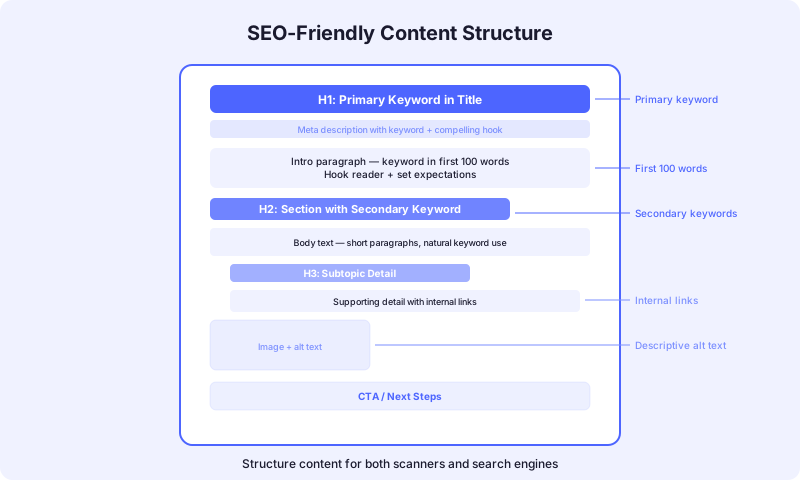
Alt text for images should describe what the image shows and naturally incorporate relevant keywords where appropriate. Alt text like "diagram" is useless. Alt text like "content structure showing heading hierarchy and paragraph flow for SEO articles" is descriptive, accessible, and topically relevant.
Visuals are most effective when they illustrate a concept that is hard to explain with text alone. Process flows, comparison tables, frameworks, and annotated examples all add genuine value. Decorative stock photos add nothing.
Edit for Clarity Before Optimizing for SEO
The best SEO writing process separates the writing and optimization phases. Write your first draft focused entirely on clarity, structure, and reader value. Then edit for SEO as a second pass.
In your SEO editing pass, check:
- Primary keyword appears in the title, first 100 words, and at least one H2
- Secondary keywords appear naturally in the body
- Headings are descriptive and scannable
- Paragraphs are under four sentences
- Internal and external links are placed at natural reference points
- Meta title and description are written and within character limits
- At least one image has descriptive, keyword-relevant alt text
This separation keeps your writing natural. If you try to optimize while drafting, the text tends to become stiff and mechanical. Write first, optimize second.
For teams producing content at scale, ClusterMagic's content briefs include keyword targets, intent analysis, and competitive context so writers can focus on the writing while the SEO framework is already built into the brief. Schedule a walkthrough to see how it works.
Checklist: The SEO Friendly Content Writing Process
Use this sequence for every piece you write:
- Research intent by reviewing top-ranking results for your target keyword
- Outline with descriptive H2 and H3 headings that cover the topic thoroughly
- Draft focused on reader value, clarity, and depth
- Optimize by placing keywords at structural points and adding links
- Edit for paragraph length, readability, and flow
- Write meta title and description
- Add images with descriptive alt text
- Review internal and external links for relevance and specificity
Writing SEO content does not require a different skill set than good writing. It requires a structured process that ensures the fundamentals of discoverability are in place while the quality of the writing does the actual work of engaging readers. Master the structure, trust your writing ability, and let the process handle the rest.
Recommended Posts





.svg)