

.svg)
On Page SEO Checklist: 15 Elements That Actually Move Rankings | ClusterMagic

Most on page SEO checklist guides read like they were written for someone who has never seen a website. You already know what a title tag is. What you need is a system that ensures nothing gets missed when your team publishes at scale. This checklist covers the 15 elements that measurably affect rankings, organized in the order you should address them.
A Semrush analysis of over 10 million keywords confirms that pages ranking in positions one through three consistently nail these fundamentals. An Ahrefs study found that 91% of web pages get zero traffic from Google, often because basic on-page elements are neglected. The gap between ranking and not ranking is usually not sophistication. It is consistency.
The On Page SEO Checklist: Foundation Elements
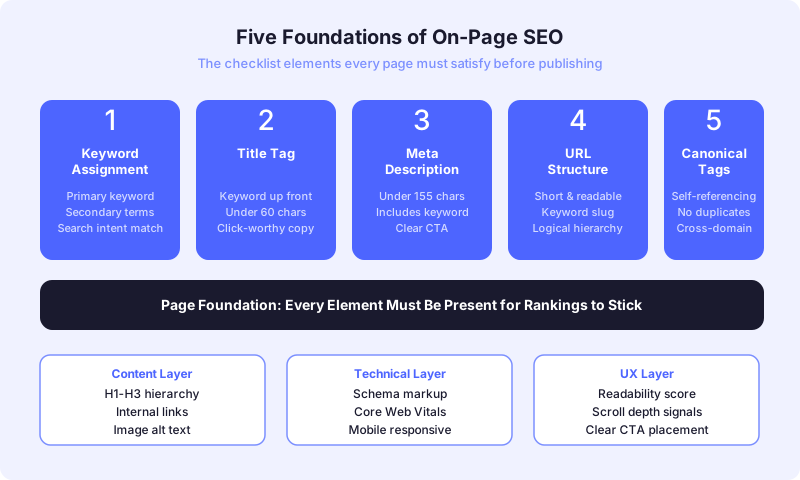
These first five items should be locked in before you write a single paragraph. They define what Google understands about your page.
1. Primary keyword assignment. Every page needs one primary keyword. Not three, not a vague topic. One keyword that defines the page's role in your site architecture. If you have not mapped keywords to pages yet, keyword mapping is the prerequisite step.
2. Title tag optimization. Keep it under 60 characters. Google rewrites title tags 33.4% of the time, with titles exceeding 60 characters being 57% more likely to get rewritten. Place your primary keyword within the first half of the title. Make the tag specific enough to earn the click.
3. Meta description that earns clicks. Meta descriptions do not directly affect rankings. But they affect click-through rate, which feeds into how Google evaluates your page's usefulness. Write 150-160 characters that describe what the reader gets. Include the primary keyword naturally and add a clear reason to click.
4. URL structure. Short, descriptive, hyphen-separated. Include the primary keyword. Avoid parameter strings, dates, or unnecessary folder depth. A clean URL signals relevance to both search engines and users.
5. Canonical tag verification. Every page should have a self-referencing canonical tag unless you are intentionally consolidating duplicate content. Incorrect canonicals silently prevent pages from ranking.
Content Structure Checklist
Content structure determines how well Google (and readers) can parse your page. Get this wrong and even great content underperforms.
6. H2 headings with keyword variants. Use H2 tags for major sections. Include your primary keyword in at least one H2 and use semantically related terms in others. Heading structure gives Google a content outline. Skip the H1 for body content since your title tag handles that job.
7. First 100 words include the primary keyword. Google weighs early content signals heavily. Your primary keyword should appear naturally within the opening paragraph. Forced keyword stuffing hurts readability and does not help rankings.
8. Paragraph length under four sentences. Long paragraphs reduce readability scores and increase bounce rates. Every paragraph should make one point and move on. This is not a style preference. It is an SEO content optimization technique backed by engagement data.
9. Image optimization. Every image needs a descriptive alt tag containing relevant keywords. Compress files to keep page weight low. Use descriptive filenames instead of IMG_0042.jpg. Alt text is both an accessibility requirement and a ranking signal.
10. Schema markup implementation. Milestone Research's study of 4.5 million queries found that rich results achieve a 58% click-through rate compared to 41% for standard results. FAQ schema hits 87% CTR. Add relevant structured data (article, FAQ, how-to, product) to every page that qualifies.
Technical On Page Elements
These items affect how search engines crawl and render your page. Ignoring them caps your ceiling regardless of content quality.
11. Core Web Vitals compliance. Largest Contentful Paint under 2.5 seconds, First Input Delay under 100 milliseconds, Cumulative Layout Shift under 0.1. These are measurable thresholds that Google uses as ranking signals. Test every page through PageSpeed Insights before publishing.
12. Mobile responsiveness. With 62.73% of web traffic coming from mobile devices, a site that is not mobile-optimized loses the majority of its potential audience. Test rendering across screen sizes. Ensure tap targets are at least 48px and text is readable without zooming.
13. Internal link placement. Each new page should link to 2-4 relevant existing pages, and those existing pages should link back. Internal links distribute authority and define content relationships. If you are building topic clusters, your internal linking strategy determines how effectively authority flows between hub and spoke pages.
14. External link quality. Link to 3-5 authoritative external sources per post. Point to specific pages (research studies, documentation, data reports), not homepages. External links to relevant, trusted sources signal that your content exists within a credible information ecosystem.
15. Page load speed audit. Beyond Core Web Vitals, audit total page weight, render-blocking resources, and server response time. Use lazy loading for below-the-fold images. Minimize JavaScript execution time. Speed is a ranking factor and a user experience factor simultaneously.
The Quality Check Before Publishing
Run this quick validation pass on every page before hitting publish.
- Primary keyword appears in the title tag, first 100 words, and at least one H2
- Meta description is between 150-160 characters with a clear value statement
- All images have descriptive alt text and are compressed
- Internal links point to relevant cluster pages (not random posts)
- Schema markup is validated using Google's Rich Results Test
- Page passes Core Web Vitals thresholds
- Mobile rendering looks correct on at least two device sizes
This is the difference between publishing content and publishing content that ranks. The teams that treat on-page optimization as a system, not an afterthought, are the ones building compounding organic traffic.
If your team needs help building content clusters and pillar pages that give this checklist a structural foundation, ClusterMagic builds the architecture so your on-page work actually compounds.
Book a free strategy session to see how cluster-based content turns individual page optimization into site-wide authority growth.
Written by Deanna S.
Recommended Posts





.svg)