

.svg)
Content Syndication Best Practices for SEO Growth | ClusterMagic

Most content teams treat syndication as a distribution tactic: publish a post, then push it to a few platforms to squeeze extra reach out of it. That framing misses the bigger opportunity. Content syndication best practices, when applied correctly, compound your organic growth by building backlinks, broadening topical authority, and surfacing your content to audiences who would never have found you through search alone.
The catch is that syndication done carelessly can work against you. When search engines index a syndicated copy before your original, or when partners republish your posts without proper attribution, the SEO signal you worked to build fragments across multiple URLs instead of concentrating on yours. This guide walks through how to syndicate strategically, protect your rankings, and connect syndication directly to organic growth rather than treating it as an afterthought.
What Content Syndication Actually Is (and Is Not)
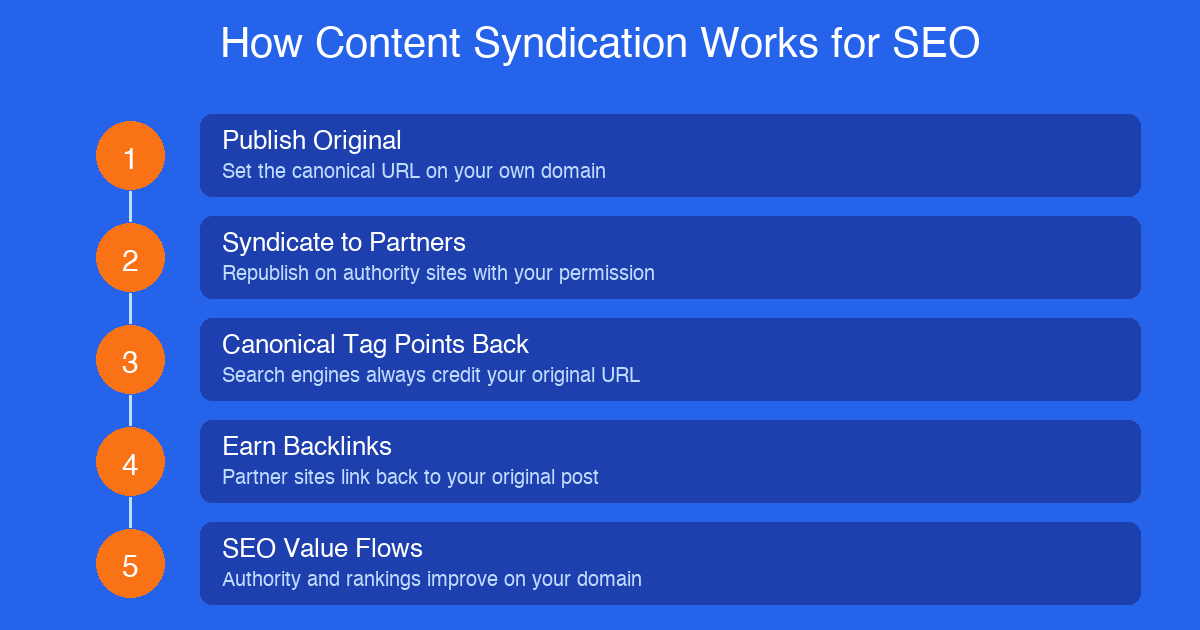
Content syndication is the authorized republication of content you originally published on your own site. A partner platform republishes the article, credits your site as the source, and links back to the original. Done right, readers on the partner site can find the full piece on yours.
Syndication is not the same as guest posting. A guest post is original content written specifically for another publication. Syndicated content is the same piece, republished with permission. Both have value, but they serve different purposes and require different technical handling.
Syndication is also not scraping or unauthorized copying. When a bot lifts your content and republishes it without attribution, that is duplicate content and Google treats it differently. Properly authorized syndication, with canonical tags or noindex directives, is a recognized practice that Google explicitly accommodates, as covered in Google's own guidance on cross-domain content duplication.
Why Syndication Belongs in an Organic Growth Strategy
Most guides position syndication as a lead gen play: more eyeballs, more clicks, more pipeline. That is true for B2B marketers running paid syndication networks. For content teams focused on organic, the value is different.
Syndication on high-authority domains builds backlinks you would otherwise have to earn through outreach. When a respected industry publication republishes your article and links to the original, that link carries real authority. A single placement on a domain with strong topical relevance can move a keyword more than several lower-authority links.
Syndication also expands your content's indexed footprint in a controlled way. Readers who encounter your content on a partner platform and click through to your site contribute to engagement signals. New audiences discover your brand and may link to or share your content independently, extending the reach further.
For teams already investing in scaling content production, syndication is a way to extract more value from content that already exists rather than producing more net-new posts. That math matters when you are running a lean operation.
Content Syndication Best Practices: The Technical Foundation
Use Canonical Tags Before Anything Else
The canonical tag is the single most important technical element in any syndication arrangement. When you ask a partner to include rel="canonical" pointing back to your original URL, you are telling search engines: this copy exists here, but the original is over there, and that is the one that should rank.
Without a canonical tag, search engines may index the syndicated version first and treat it as the original, especially if the partner site has higher authority than yours. Once that happens, recovering the ranking signal for your original URL is possible but time-consuming.
Before agreeing to syndicate with any partner, confirm they can and will implement the canonical tag. If they cannot, the next best option is a noindex directive on the syndicated page, which prevents it from being indexed at all. This removes the risk of the copy outranking the original entirely.
Publish and Index Your Original First
Timing determines who gets credit. Search engines generally attribute ownership to the version they index first, not the version that was technically written first. Publish your post, confirm it has been indexed in Google Search Console, and only then submit it to syndication partners.
A 48-to-72-hour window before syndicating is a reasonable baseline. For posts you are actively trying to rank for competitive keywords, wait until the page appears in search results before syndicating. This is not a hard rule, but it significantly reduces the risk of a partner's version being treated as the original.
Use Excerpts When Technical Controls Are Not Available
Some platforms do not support canonical tags or noindex directives. In those cases, publishing an excerpt rather than the full article limits the duplicate content exposure. A two-to-three paragraph excerpt with a clear "Read the full article" link to your site gives readers enough to engage while keeping the full indexable content on your domain.
This approach also creates a reason for readers to click through, which is not a bad outcome even when technical controls are available.
How to Choose Syndication Partners
The quality of your syndication partners matters more than the volume of placements. A single republication on a well-regarded industry publication in your niche is worth more than ten placements on generic content aggregators.
Evaluate partners on three criteria: topical relevance, domain authority, and technical willingness. Topical relevance means the platform's audience overlaps meaningfully with yours. A post on B2B content strategy syndicated to a SaaS-focused publication will land better than the same post on a general marketing blog with a broader but less targeted readership.
Domain authority is worth checking with tools like Ahrefs or Moz before committing. Higher-authority domains pass more link equity when they link back to your original, which is part of the point. Technical willingness means they will implement the canonical tag or noindex without pushback.
Common platforms worth considering:
- Medium supports canonical tags natively through its import tool and has strong domain authority across many topics.
- LinkedIn Articles does not pass strong link equity but expands reach to professional audiences and can drive direct referral traffic.
- Industry-specific publications in your niche are usually the highest-value placements for both authority and audience quality.
For a list of the specific platforms best suited to SaaS and B2B content, the broader framework in content marketing for SaaS companies is worth reviewing before you build your syndication target list.
Building Syndication Into Your Content Workflow
Syndication should not be a manual afterthought. Build it into the production process so that every post has a clear distribution plan before it publishes.
Decide syndication targets at the brief stage, not after the post is live. When you identify a post as a candidate for syndication in the content brief, you can write the excerpt at the same time as the full article, confirm the partner is ready to receive it, and schedule the submission for 48-72 hours after publication. This eliminates the lag that often happens when syndication is treated as a separate workflow.
A practical approach:
- Flag posts as syndication candidates during content planning, based on topic fit and partner relevance
- Identify the target platform and confirm canonical tag support before writing begins
- Write a 200-to-250-word excerpt as part of the draft process
- Publish the full post to your site, confirm indexation
- Submit the excerpt or full article to the partner with attribution language and the canonical tag requirement
- Monitor in Google Search Console to confirm your original is the indexed version
If you are still building out your content production process, the post on how to write a content brief covers how to add distribution fields to your brief template without adding complexity to the writing process.
What to Monitor After Syndication
Set up a baseline before syndicating so you have something to measure against. Record the ranking position for your target keywords, the number of referring domains pointing to the original URL, and the organic traffic to the page. Check these metrics again at 30 and 90 days post-syndication.
Signs that syndication is working: the original URL gains referring domains, keyword rankings improve or hold steady, and referral traffic from partner platforms drives new visitors to your site. Signs of a problem: the syndicated version outranks your original for the primary keyword, or Search Console shows the partner URL is being indexed as the canonical.
If a syndicated version outranks your original, contact the partner and request that the canonical tag be corrected or that the noindex tag be added. Google Search Console's URL inspection tool will show you which version Google has selected as canonical, which is the clearest diagnostic available.
Common Syndication Mistakes That Hurt Organic Performance
Syndicating before indexation is the most common mistake and the most preventable. Always verify your original is indexed before submitting to any partner.
Not confirming canonical tag implementation leaves you exposed. It is not enough to ask a partner to add the tag. Check the published page's source code to confirm it is there and points to the correct URL.
Syndicating to irrelevant platforms for volume dilutes your brand signal and contributes little organic value. Fifty placements on low-relevance aggregator sites will not move a keyword. Two placements on trusted industry publications might.
Neglecting your existing content library in favor of syndicating new posts is a missed opportunity. Older posts with some organic traction but not yet on page one are strong syndication candidates. A content gap analysis can surface which existing posts are ranking on pages two or three and would benefit most from additional backlink support through syndication.
Syndication as an Organic Growth Lever
The shift from treating syndication as a distribution volume play to treating it as an organic growth tool changes how you approach every decision in the process: which partners to pursue, which posts to syndicate, how to time submissions, and how to evaluate results.
More placements is not the goal. More organic authority is. That means being selective, getting the technical setup right every time, and measuring outcomes in terms of ranking movement and backlink quality rather than total repubs.
When syndication is embedded in a broader content strategy built around topic clusters and keyword authority, it compounds. Each well-placed syndication generates a backlink, each backlink strengthens the cluster, and the cluster builds the kind of topical depth that earns durable rankings rather than short-lived spikes. For a closer look at how content clusters and pillar pages work as the foundation of that strategy, that guide is worth reading alongside this one.
If you want to see how a managed content program handles syndication planning alongside cluster strategy and brief production, see how ClusterMagic works.
Recommended Posts





.svg)