

.svg)
How to Increase Organic Search Visibility: A Content Team Framework | ClusterMagic

Why Most Content Teams Fail to Increase Organic Search Visibility
The gap between publishing content and building organic search visibility keeps widening. Teams publish blog posts, check the SEO boxes, and wait for rankings that never arrive. The problem is rarely the content itself. It is the absence of a system that connects what you publish to how search engines evaluate your site.
To increase organic search visibility in 2026, your content team needs more than a keyword list and an editorial calendar. You need a framework that coordinates topic selection, publishing rhythm, technical foundations, and cross-team collaboration into a single repeatable process. This guide provides that framework.
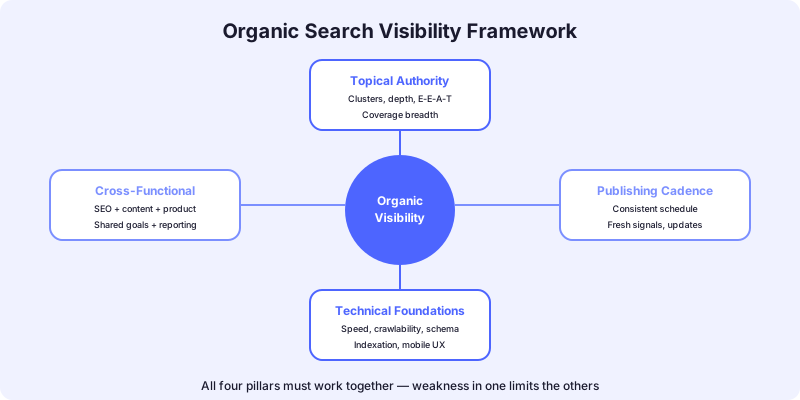
The Content Team Visibility Framework: Four Pillars
Every content team that consistently grows organic search traffic operates on four interconnected pillars. Remove one, and the other three lose effectiveness. The framework works because each pillar reinforces the others, creating compound returns that isolated tactics cannot match.
The four pillars are:
- Topical authority: Depth and breadth of coverage on your core subjects
- Publishing cadence: Consistency and velocity of new content entering the index
- Technical foundations: The infrastructure that allows search engines to discover, crawl, and rank your content efficiently
- Cross-functional alignment: Coordination between content, SEO, product, and development teams
Teams that treat these as separate workstreams end up with siloed efforts that compete for attention rather than building on each other. The framework only works when all four pillars inform every content decision.
Pillar 1: Build Topical Authority Through Content Clusters
Single-page SEO strategies are increasingly ineffective against competitors who cover entire topic areas comprehensively. Search engines evaluate your site's authority on a subject by looking at the breadth and depth of your coverage, the internal linking structure connecting related pages, and whether your content satisfies multiple search intents within a topic.
Content clusters are the structural foundation of topical authority. A pillar page covers a broad topic at a high level, while 8 to 15 cluster posts address specific subtopics in depth. Internal links connect the cluster so that authority flows across every page in the group.
To identify the right clusters for your team, start with a content gap analysis that compares your existing coverage against competitors ranking for your target terms. Map out which subtopics you have already covered, which ones are missing entirely, and which existing pages need to be updated or expanded.
Prioritize clusters around topics where you have genuine expertise and where the competitive landscape leaves room for a well-organized challenger. A mid-authority site that covers a topic more thoroughly and more clearly than scattered competitors with higher domain authority can absolutely win.
For a deeper look at the cluster model, see the content clusters and pillar pages guide.
Pillar 2: Establish a Publishing Cadence That Compounds
Publishing one exceptional article per month will not improve organic search visibility fast enough to justify the investment. The math is simple: more indexed pages targeting more keywords create more opportunities for search traffic. But the cadence has to be sustainable.
According to Search Engine Land's analysis of visibility systems, visibility becomes structural when content production is consistent enough to train crawlers to return frequently. An erratic schedule, where you publish ten posts in January and nothing in February, provides no pattern for search engines to reward.
The right cadence depends on your team's actual capacity, not aspirational targets. Audit how many finished, optimized posts your team shipped last quarter. Divide by the number of weeks. That baseline number is your starting velocity. From there, look for bottlenecks in brief creation, editing queues, and approval cycles.
A content velocity framework built around realistic capacity and supported by batch creation sessions will outperform a more ambitious schedule that breaks down after six weeks. Three quality posts per week published every week for a year is worth more than daily publishing that stops after two months.
Pillar 3: Fix Technical Foundations Before Scaling Content
No volume of excellent content overcomes fundamental technical barriers. Pages that load slowly, cannot be crawled efficiently, or have duplicate content issues will underperform regardless of quality.
The technical items with the highest direct impact on organic visibility include:
- Core Web Vitals: Largest Contentful Paint under 2.5 seconds and Cumulative Layout Shift below 0.1, per Google's Web Vitals documentation
- Crawl efficiency: Clean XML sitemaps submitted through Google Search Console, no orphan pages, no excessive redirect chains
- Indexation hygiene: Proper canonical tags, no duplicate content across pagination or filtered URLs
- Mobile-first readiness: Google indexes mobile versions first, so your mobile experience determines your rankings
Technical SEO is the content team's job too, not just the developer's. Content teams that understand how their work gets discovered, crawled, and indexed make better decisions about structure, linking, and formatting. Run a quarterly technical audit alongside your content audit. Flag crawl errors, broken internal links, and pages returning 4xx or 5xx status codes.
Use Google Search Console's Coverage report to monitor how many of your published pages are actually indexed. If your indexation rate is below 80%, your content production is partially wasted because pages that are not indexed cannot rank.
Pillar 4: Cross-Functional Alignment Creates Compound Visibility
Content teams that operate in isolation produce content that ranks for informational queries but fails to connect to product pages, landing pages, or revenue-generating sections of the site. Cross-functional alignment turns organic search traffic into business outcomes.
Search Engine Land's framework for SERP visibility in 2026 describes content as the connective tissue that feeds every other channel. When content, product, and development teams collaborate on shared visibility goals, each new piece of content strengthens the site's overall search footprint rather than existing in isolation.
Practical alignment looks like this:
- Monthly trend sprints: Content, product, and SEO teams meet to identify 1 to 2 emerging topics to cover quickly
- Shared keyword maps: Product and content teams use the same keyword research to align blog content with product page optimization
- Internal linking standards: Every new blog post links to relevant product or feature pages, and product pages link back to supporting content
- Unified reporting: Track organic visibility metrics alongside product and revenue metrics so leadership sees the connection
Teams that run isolated content calendars disconnected from product launches, feature updates, and sales priorities miss the compounding effect. A blog post published the same week as a product update, covering the problem that product solves, creates more visibility than either effort alone.
Implementing the Framework: A 90-Day Roadmap
The framework does not require a team overhaul. It requires sequencing. Here is a practical 90-day plan to grow organic search traffic using all four pillars.
Days 1 to 30: Foundation
- Complete a content gap analysis against your top 5 organic competitors
- Audit your existing content for indexation status, broken links, and outdated information
- Set a realistic publishing cadence based on actual team capacity
- Identify 3 to 5 topic clusters to build or expand
Days 31 to 60: Execution
- Begin publishing on your established cadence with a 2-week content buffer
- Run a technical SEO audit and fix critical crawl and indexation issues
- Establish monthly cross-functional sprint meetings
- Add backward links from existing posts to every new publication
Days 61 to 90: Measurement and Adjustment
- Track indexation rate, crawl frequency, and non-branded organic sessions on a rolling 90-day basis
- Compare content cohort performance: how is traffic growing across all posts published in the first 30 days?
- Identify which clusters are gaining traction and allocate more resources to them
- Adjust publishing cadence based on real capacity and early results
Avoid judging individual posts during this window. A post published last week reveals almost nothing about its ranking potential. Track cohorts and trends, not individual page performance.
Measuring Organic Search Visibility Beyond Rankings
Traditional rank tracking tells you where individual pages appear for specific queries. It does not tell you whether your overall organic search visibility is growing. The metrics that matter at the framework level are:
- Indexed page count: Are the pages you publish actually entering Google's index?
- Non-branded organic sessions: Is your traffic from people who do not already know your brand growing?
- Click-through rate by query type: Are your titles and descriptions earning clicks in an increasingly competitive SERP?
- Topical coverage ratio: What percentage of your target topic cluster is covered by indexed, ranking content?
As Search Engine Land notes, rankings alone will not earn budget or executive trust in 2026. The headline metrics that matter are revenue, profit, and brand strength across the full search ecosystem. Keep tracking rankings, but treat them as supporting signals rather than primary success criteria.
For the full set of organic traffic growth strategies that complement this framework, including link building and long-tail keyword targeting, see the companion guide.
The Framework Works Because It Compounds
Individual tactics produce individual results. A framework that connects topical authority, publishing cadence, technical foundations, and cross-functional alignment produces compound returns. Each new post strengthens the cluster it belongs to. Each cluster strengthens the site's authority on that subject. Each month of consistent publishing trains search engines to crawl and index your content faster.
The teams that increase organic search visibility sustainably are the ones that stop chasing individual ranking wins and start building systems that make every future piece of content more effective than the last.
If your content team needs a structured approach to building organic visibility, schedule a strategy session with the ClusterMagic team to map out your first 90-day sprint.
Recommended Posts




.svg)