

.svg)
Web Traffic Growth: Setting Goals and Hitting Them With Organic Strategy | ClusterMagic

Most teams talk about wanting more traffic without defining what "more" means. A vague goal like "increase web traffic" gives you nothing to measure against and no way to prioritize which channels deserve attention. Web traffic growth starts with setting specific, time-bound targets tied to business outcomes, then selecting the strategies most likely to hit those targets within the timeline.
This guide covers how to set traffic goals that are grounded in data, three quick wins that produce measurable increases within weeks, and the organic strategies that build compounding returns over months. If your website traffic growth strategy has been "publish and hope," this replaces hope with a system.
Why Traffic Goals Need to Be Specific
"Get more traffic" is not a goal. It is a wish. A goal has a number, a timeline, and a clear connection to revenue or leads.
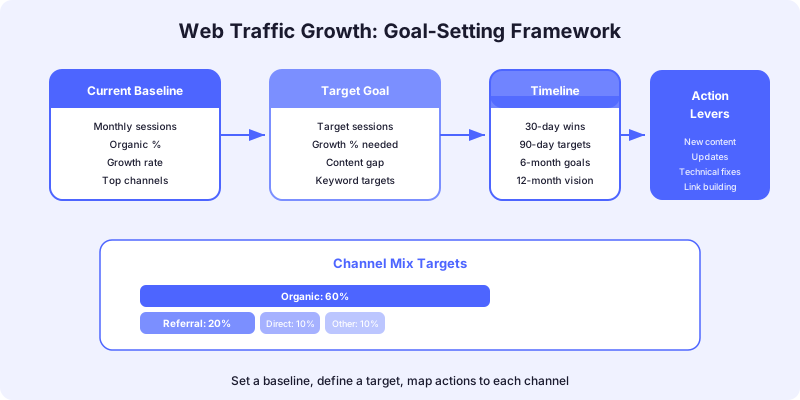
A strong traffic goal looks like this: increase organic sessions from 4,200 per month to 6,500 per month within 90 days by publishing 12 targeted blog posts and optimizing 8 existing pages. That goal is measurable, time-bound, and tied to specific actions.
The reason specificity matters is prioritization. When your team knows the target is 6,500 organic sessions, you can calculate how many new pages need to rank, how much improvement existing pages need, and which keywords offer the most realistic path to that number.
Start by auditing your current traffic sources in Google Analytics. Break down sessions by channel: organic search, direct, referral, social, and paid. Most sites find that organic search accounts for 40% to 60% of total traffic. If organic is underperforming relative to your industry, that gap represents your biggest growth opportunity. To see how your share stacks up against industry benchmarks, the organic traffic percentage benchmarks guide breaks down what to expect by sector and business type.
Three Quick Wins for Immediate Web Traffic Growth
Not every traffic strategy takes months to produce results. These three tactics consistently deliver measurable increases within two to four weeks.
1. Update Underperforming Pages That Already Rank
Pages ranking between positions 8 and 25 for their target keyword are your fastest growth lever. They already have some authority and index presence. Small improvements can push them onto page one, where click-through rates jump dramatically.
Pull your Search Console data and sort by average position. Identify 5 to 10 pages sitting just below page one. For each page, add missing subtopics, update outdated statistics, improve the title tag for click-through rate, and add internal links from stronger pages. Google Search Console's performance report shows exactly which queries drive impressions without clicks, revealing optimization opportunities.
Refreshed pages regain rankings faster than new pages can earn them. This is the single quickest path to measurable traffic gains.
2. Fix Title Tags and Meta Descriptions on High-Impression Pages
Some of your pages get thousands of search impressions but low click-through rates. The problem is often the title tag or meta description. They either do not match search intent or they fail to stand out in the results.
Title tags between 40 and 60 characters achieve the highest organic click-through rates. Write them to communicate a clear benefit and include the primary keyword. Meta descriptions should be under 155 characters and give searchers a reason to choose your result over the nine others on the page.
This fix requires no new content. Just better packaging of content that already exists.
3. Add Internal Links From Strong Pages to Weak Ones
Most sites have a handful of pages that attract the majority of organic traffic and backlinks. These authoritative pages can pass ranking power to weaker pages through internal links.
Identify your top 10 pages by organic traffic. Then find recent or underperforming pages that cover related topics. Add contextual internal links from the strong pages to the weak ones. This redistributes authority and signals to search engines that the linked pages matter. The internal linking SEO guide covers the full framework for building these connections systematically.
Setting a 90-Day Website Traffic Growth Strategy
Quick wins produce early momentum. A 90-day plan builds on that momentum with compounding organic strategies.
Month 1: Foundation. Audit current traffic, fix technical issues, update your top underperforming pages, and build a keyword map. The keyword mapping guide walks through the process of assigning target keywords to specific pages so that each piece of content has a clear role.
Month 2: Content production. Publish 4 to 6 new pieces targeting keywords where you have a realistic chance of ranking. Focus on long-tail terms with clear search intent and keyword difficulty scores below 30. These terms individually bring modest traffic but collectively build a substantial organic base.
Month 3: Optimization and measurement. Review performance data from months 1 and 2. Double down on what is working. Refresh any new content that is not yet ranking. Add internal links from the new content to existing pages and vice versa.
This cycle repeats. Each quarter builds on the previous one. The compounding effect is the reason organic traffic strategies outperform paid channels over time. A paid campaign stops delivering the moment budget runs out. Content that ranks continues delivering traffic for months or years.
Increase Web Traffic Organically: The Core Levers
Beyond the quick wins, sustained organic traffic growth comes from pulling four specific levers consistently.
Content Clustering
Single pages targeting single keywords struggle to rank in competitive spaces. Content clusters build topical authority by covering a subject comprehensively across multiple connected pages. A pillar page covers the broad topic, and supporting posts cover specific subtopics in depth.
The internal links between cluster pieces signal to search engines that your site has genuine expertise on the subject. This approach consistently outperforms isolated blog posts. For a deeper look at how clusters work, see the organic traffic growth guide.
Long-Tail Keyword Targeting
The real volume opportunity lives in long-tail queries. Over 90% of all searches are long-tail terms with lower competition and clearer intent. A library of pages targeting specific queries like "how to increase blog traffic for B2B companies" accumulates traffic across hundreds of terms.
Each page individually may bring 50 to 200 monthly visits. Across 40 or 50 pages, that is 5,000 to 10,000 organic sessions per month. Ahrefs' keyword research guide covers practical methods for finding these opportunities.
Technical SEO Maintenance
Only about 55% of websites meet Core Web Vitals thresholds. Fixing technical fundamentals gives you an immediate edge over nearly half your competitors. Prioritize page speed, mobile usability, crawlability, and proper canonical tag implementation.
A fast, mobile-friendly site that search engines can crawl efficiently ranks better than a slow site with identical content. Technical SEO is not exciting, but it is the foundation everything else depends on.
Backlink Acquisition
Pages with more high-quality backlinks rank higher. The most effective approaches in 2026 include creating original research or data that other sites want to reference, building relationships with industry publications for guest contributions, and producing visual assets like infographics that earn natural links. Moz's link building guide covers the fundamentals of earning authoritative backlinks.
Measuring Web Traffic Growth the Right Way
Traffic volume alone is a vanity metric. The metrics that matter connect traffic to business outcomes.
Track these alongside total sessions:
- Organic sessions by landing page: identifies which content actually drives growth
- Conversion rate by traffic source: organic traffic typically converts at higher rates than social or referral traffic
- Revenue or leads per organic session: the ultimate measure of traffic quality
- Keyword ranking movement: are your target terms trending up, flat, or declining
Set up monthly reporting that compares current performance against your 90-day targets. If organic sessions are growing but conversions are flat, the problem is traffic quality, not traffic volume. If rankings are improving but traffic is not, the problem may be click-through rates on your search listings.
Google's Analytics setup documentation walks through configuring conversion tracking so you can tie organic traffic directly to business results.
When to Adjust Your Strategy
Not every tactic produces results at the same rate. After 30 days, review which quick wins moved the needle and which did not. After 60 days, evaluate whether your new content is indexing and beginning to rank.
Signs your strategy needs adjustment:
- New pages are not appearing in search results within 4 weeks of publication (check indexing and crawlability)
- Updated pages see no ranking improvement after 6 weeks (the updates may not address the actual ranking gaps)
- Traffic is growing but leads or revenue are flat (targeting the wrong keywords or the wrong intent)
The teams that grow traffic consistently are the ones that treat it as an iterative process. Publish, measure, adjust, repeat.
Building a Traffic Growth System
Web traffic growth is not a project with a completion date. It is an ongoing system of goal-setting, content production, optimization, and measurement. The teams that treat organic traffic as a system rather than a series of campaigns are the ones that compound growth quarter over quarter.
If you want help building a content system that drives predictable organic traffic growth, book a strategy call with ClusterMagic to see how structured content programs produce compounding returns for businesses serious about reducing their dependence on paid channels.
Recommended Posts





.svg)