

.svg)
Website Traffic Growth: A Realistic Timeline and Strategy Guide | ClusterMagic
Every marketing team wants more website traffic. The problem is not a shortage of tactics. It is a shortage of realistic expectations about when those tactics produce results, and which ones produce results that last. Website traffic growth from organic search follows a specific pattern: slow gains early, accelerating returns later, and compounding value that paid channels cannot match.
Most "grow your traffic fast" guides skip the timeline entirely, or promise results in 30 days that take 6 to 12 months in practice. This guide takes the opposite approach. It covers what actually drives sustained traffic growth, what the realistic timeline looks like month by month, and where most teams go wrong by giving up too early or investing in the wrong levers.
Why Organic Traffic Is the Growth Channel Worth the Wait
Paid acquisition delivers traffic immediately, but it stops the moment the budget stops. Organic search traffic works differently. A page that ranks on page one generates visits for months or years without additional spend. The compounding nature of organic traffic is what makes it the most valuable growth channel for any site with a time horizon beyond the next quarter.
According to BrightEdge research on organic channel share, organic search drives over 53% of all website traffic across industries. For B2B companies, that number is even higher. The sites capturing that traffic are not doing anything exotic. They are publishing useful content, building topical depth, and giving Google reasons to rank them above competitors.
The tradeoff is patience. Growing website traffic through organic search requires consistent effort over months before the returns become obvious. Understanding the timeline prevents the most common failure: abandoning a working strategy before it has time to compound.
The Realistic Timeline for Website Traffic Growth
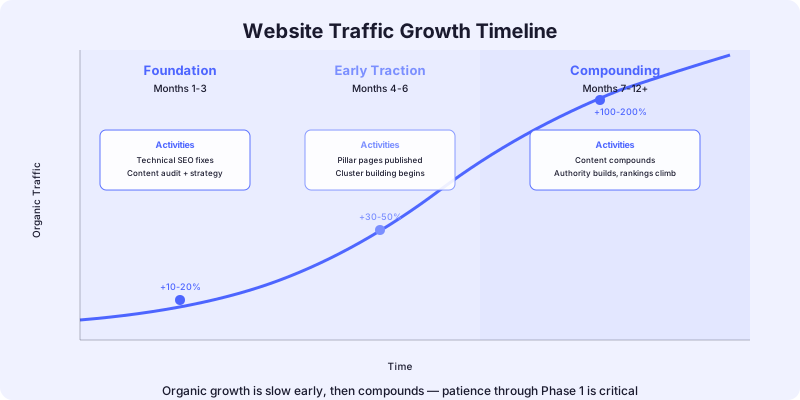
Months 1 Through 3: Foundation and Indexing
The first three months are about building the infrastructure that future growth depends on. Traffic gains during this period are minimal and that is normal. The work happening in this phase includes:
- Technical SEO fixes: Ensuring pages are crawlable, load quickly, and are properly indexed. Use Google Search Console to identify and resolve indexing issues before investing in content.
- Keyword research and mapping: Identifying the topics and keywords that your site can realistically rank for. This means targeting terms where the competition matches your site's current authority, not aspirational keywords that require years of link building.
- Initial content production: Publishing the first round of content, ideally organized into topic clusters rather than random standalone posts.
Expect 0 to 15% traffic increase during this phase. Most new pages will not rank meaningfully in their first 90 days. Google needs time to crawl, index, and evaluate new content against existing results.
Months 4 Through 6: Early Traction
This is when the first signs of real growth appear. Pages published in months 1 through 3 begin climbing from positions 20 through 50 into striking distance of page one. New content published during this phase benefits from the topical foundation built earlier, ranking faster than the initial batch did.
Key indicators of healthy progress at this stage:
- Impressions in Search Console are climbing, even if clicks lag behind
- Several pages have reached positions 5 through 15 for their target keywords
- Long-tail keywords are generating small but consistent traffic
- Internal linking between cluster pages is starting to show an authority-building effect
Expect 20 to 40% traffic increase from your month-1 baseline. The growth is real but still modest. Teams that expected hockey-stick curves often get discouraged here. That is a mistake, because the compounding is just beginning.
Months 7 Through 12: Compounding Growth
This is where patient teams are rewarded. Content published months ago starts reaching page one. Clusters that have been built out with 6 to 10 supporting pages begin ranking for hundreds of related keywords. The site's overall authority rises, which makes every new page rank faster than the one before it.
By month 12 of consistent execution:
- Organic traffic should be 2x to 4x the month-1 baseline
- Multiple pages rank in positions 1 through 5 for their target keywords
- The site ranks for keyword clusters, not just individual terms
- Content refreshes on early posts produce noticeable traffic bumps
The timeline varies based on domain authority, competitive landscape, and investment level. A new domain in a competitive space may need 12 to 18 months to see these results. An established domain with some existing authority can compress the timeline to 6 to 9 months.
Five Strategies That Drive Sustainable Traffic Growth
1. Build Content Clusters Instead of Random Posts
Publishing disconnected articles is the content equivalent of planting seeds in separate pots instead of a garden. Each post has to earn authority on its own, with no support from the rest of the site. Content clusters change that dynamic.
A cluster groups 8 to 15 articles around a single topic, connected through internal links and anchored by a comprehensive pillar page. The cluster structure tells search engines that your site has depth of expertise in this area, which translates to rankings across the entire topic, not just for individual keywords.
Start with one cluster. Build it completely before starting a second. A fully developed cluster outperforms five half-built ones every time.
2. Target Keywords You Can Actually Win
The biggest website traffic growth mistake is targeting keywords that are beyond your site's current ability to rank for. A new site going after "content marketing strategy" (keyword difficulty 80+) will spend months producing content that lands on page 3 and stays there.
Match keyword difficulty to domain authority. If your domain rating is 25, target keywords with difficulty scores under 30. As your authority grows, expand into harder terms. Ahrefs' keyword difficulty scoring provides the most practical framework for this calibration.
The math is simple. Ten pages ranking in positions 2 through 5 for low-difficulty keywords will drive more traffic than one page ranking at position 15 for a high-difficulty keyword. Stack wins, then scale up.
3. Optimize Existing Content Before Publishing More
Every site with more than 20 published pages has untapped traffic potential in its existing content. Pages that rank in positions 6 through 20 are already recognized by Google as relevant. A focused refresh can move them to page one in weeks rather than the months it takes for new content.
The refresh process:
- Identify pages with declining traffic or positions 6 through 20 in Search Console
- Compare your content to the current top-ranking pages for the same keywords
- Add missing sections, update data, improve readability
- Strengthen internal links to and from the refreshed page
- Update the published date after making substantive changes
Content refreshes produce faster traffic gains than new content because the page already has indexed authority. This is one of the highest-ROI activities in any website traffic increase strategy.
4. Fix Technical Issues That Throttle Growth
Technical SEO problems create a ceiling that no amount of content can break through. If Google cannot crawl your pages efficiently, they will not rank, regardless of quality. Common technical issues that suppress traffic growth:
- Slow page speed: Pages loading in over 3 seconds lose both rankings and visitors. Google PageSpeed Insights identifies specific issues to fix.
- Crawl errors: Broken links, redirect chains, and server errors waste crawl budget. Fix them monthly.
- Poor mobile experience: Google uses mobile-first indexing. A site that works poorly on mobile will rank poorly everywhere.
- Missing or incorrect structured data: Schema markup helps Google understand your content and can earn rich snippets that dramatically increase click-through rates.
Run a technical audit at the start of any traffic growth initiative and revisit it quarterly. Screaming Frog's SEO Spider is the most efficient tool for identifying technical issues across a full site.
5. Earn Backlinks Through Content Worth Linking To
Backlinks remain one of the strongest ranking signals. Sites with more quality backlinks rank higher, and pages with more backlinks rank for more keywords. The challenge is that link building requires creating content that other sites genuinely want to reference.
Content types that earn links naturally:
- Original research: Surveys, data analysis, industry benchmarks
- Comprehensive guides: The definitive resource on a specific topic
- Tools and templates: Practical assets that solve a specific problem
- Data visualizations: Charts and diagrams that illustrate industry trends
Producing one link-worthy asset per quarter is more effective than publishing 12 posts that no one links to. The links those assets earn distribute authority across your entire site through internal linking, lifting traffic on pages that may never earn a single external link themselves.
Common Reasons Traffic Growth Stalls
Publishing Without a Strategy
More content does not equal more traffic. A site publishing five posts per week on random topics will be outranked by a site publishing two posts per week within a structured cluster. Volume without strategy creates noise. Strategy with moderate volume creates growth.
Ignoring Search Intent
A page can target the right keyword and still fail to rank because it delivers the wrong type of content. If searchers expect a comparison and you publish a tutorial, the page will not satisfy user intent, and Google will rank a competitor's comparison instead. Check the top-ranking results for every keyword before creating content. The format that dominates page one is the format Google's users prefer.
Measuring Too Early
Traffic growth from organic search follows a J-curve. The first 3 to 4 months look flat. Months 5 through 8 show moderate gains. Months 9 through 12 show acceleration. Teams that evaluate the strategy at month 3 often kill it right before the compounding starts.
Set expectations with stakeholders upfront. Share the timeline in this guide. Review leading indicators (impressions, keyword positions, pages indexed) monthly, but reserve traffic growth judgments for the 6-month mark at minimum.
Not Investing in Internal Linking
Publishing new content without connecting it to existing content wastes potential. Every new page should link to 2 to 4 relevant existing pages, and those existing pages should link back. Internal linking distributes the authority earned by any single page across the cluster, amplifying the traffic impact of every piece.
What Sustainable Traffic Growth Looks Like
Sustainable growth is not a viral spike. It is a steady upward trend that accelerates over time. A site executing a structured organic strategy should see:
- Month 6: 40 to 80% above baseline traffic
- Month 12: 2x to 4x baseline traffic
- Month 18: 4x to 8x baseline traffic with declining cost per visit
These numbers assume consistent publishing (2 to 4 posts per week), structured cluster development, regular content refreshes, and ongoing technical maintenance. Sites in low-competition niches will hit the higher end. Sites in competitive markets may track closer to the lower end but still compound over time.
The ultimate goal is a traffic channel that grows without proportional increases in spending. That is what organic search delivers when the strategy is sound and the execution is patient.
Ready to build a traffic growth plan with realistic projections for your site? Book a strategy session and we will audit your current traffic, identify your best growth opportunities, and map out a 12-month plan.
Recommended Posts





.svg)