

.svg)
Best Ecommerce SEO Solutions Compared for 2026 | ClusterMagic

How to Evaluate Ecommerce SEO Solutions
The phrase "ecommerce SEO solution" covers a wide range of tools, platforms, and services. Some are technical audit tools. Some are keyword research platforms. Some are all-in-one suites that try to do everything. A few are built specifically for the content strategy and topical authority work that drives long-term organic growth.
Choosing the right ecommerce SEO solutions for your business depends on where your current gap is. A store that has never done keyword research needs different tools than a store that has 500 blog posts but no content cluster structure. A team of two needs different software than an enterprise marketing department.
This comparison covers the major categories of ecommerce SEO solutions available in 2026, what each does well, and where each falls short, so you can make a decision based on your actual situation rather than a vendor's feature list.
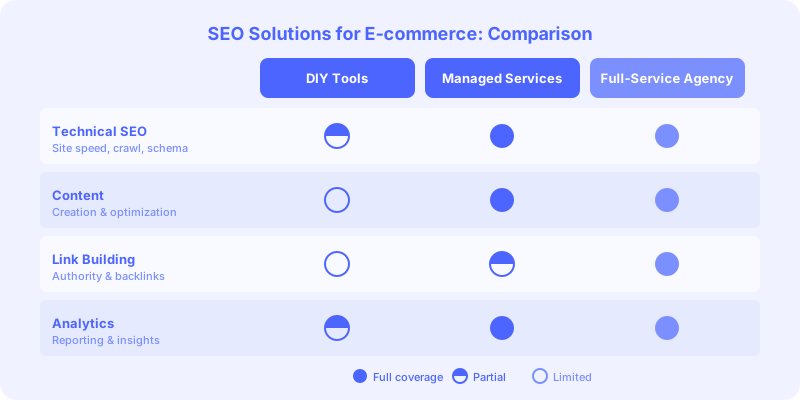
Category 1: All-in-One SEO Platforms
All-in-one SEO platforms attempt to handle keyword research, site audits, rank tracking, backlink analysis, and sometimes content optimization inside a single interface. For ecommerce teams that need to manage multiple SEO functions without purchasing several separate tools, these platforms offer a practical starting point.
Semrush is the most widely used option in this category. It offers strong keyword research, competitive gap analysis, site audit capabilities, and position tracking. For ecommerce brands that want to benchmark against competitors, analyze backlink profiles, and track rankings for product and category pages, Semrush covers a lot of ground. The limitation is cost: enterprise plans run into hundreds of dollars per month, and many features are redundant for teams that only need one or two functions. Cloudways rates it highly for mid-market ecommerce teams.
Ahrefs is the closest competitor to Semrush and is particularly strong for backlink analysis and keyword research. Many SEO practitioners prefer Ahrefs for its keyword data accuracy and the clarity of its keyword difficulty scores. For ecommerce brands actively doing content gap analysis, Ahrefs's Content Gap tool is one of the most practical implementations available. The interface requires more learning time than simpler tools, which is worth knowing before buying a seat.
Where all-in-ones fall short: They provide data but limited strategic direction. A platform that surfaces 10,000 keyword opportunities still requires someone on your team to decide which ones matter, how they cluster together, and in what order to publish. For ecommerce teams that lack an in-house SEO strategist, data-rich platforms can produce analysis paralysis rather than action.
Category 2: Technical SEO Tools
Technical SEO addresses the foundation that content performance depends on: site speed, crawlability, indexation, structured data, and URL architecture. Even excellent content underperforms if the technical foundation has significant issues.
Screaming Frog is the most widely used technical crawler for ecommerce sites. It identifies broken links, duplicate content, missing meta data, redirect chains, and indexation issues across large product catalogs. For ecommerce sites with thousands of product pages, running a regular Screaming Frog crawl catches technical problems before they accumulate into ranking penalties.
Google Search Console is free, essential, and underused. It shows which queries are generating impressions and clicks, which pages are indexed, and which pages have coverage errors. For keyword mapping, Search Console data on which queries already drive traffic to which pages is more accurate than any third-party tool because it comes directly from Google.
DebugBear is a strong option for ongoing performance monitoring, particularly for Core Web Vitals, which remain a ranking factor that affects ecommerce sites disproportionately because of their heavy use of images and JavaScript. DebugBear's 2026 comparison notes that stores using CDN-optimized image delivery are seeing measurable ranking improvements in competitive categories.
Where technical tools fall short: They identify problems but do not create strategy. A technical audit tells you what to fix; it does not tell you which content to produce or how to structure your blog to build authority.
Category 3: Platform-Native SEO Capabilities
Ecommerce platforms have built meaningful SEO functionality directly into their interfaces, reducing the need for third-party tools for basic optimization.
Shopify is the strongest all-around platform for ecommerce SEO at the $500K to $10M revenue range. It handles canonical URLs, sitemap generation, and structured data automatically. The blogging capability is functional but limited compared to a dedicated CMS, which is a consideration for brands planning to publish a high volume of content. SeoProfy's platform comparison ranks Shopify first for most mid-market stores when combined with a well-structured content strategy.
BigCommerce offers strong technical SEO defaults including AMP support, automatic sitemaps, and clean URL structures. It is a better fit for brands that need more complex catalog management or B2B features alongside ecommerce SEO. The built-in structured data implementation is particularly solid for product pages.
WooCommerce on WordPress gives you the most flexibility because it pairs ecommerce functionality with WordPress's content management strengths. For brands that prioritize content volume and need robust blogging alongside a product catalog, the Yoast or Rank Math SEO plugins on WooCommerce create a capable content SEO environment. Rank Math's ecommerce SEO tool roundup covers the plugin integration in detail.
Where platform-native tools fall short: They optimize what exists but do not plan what to create. None of these platforms tell you which topics to publish about, how to structure your content clusters, or where your coverage gaps are relative to competitors.
Category 4: Content Strategy and Cluster Tools
This category addresses the gap that all the above solutions leave open: strategic content planning. An ecommerce brand that knows its technical foundation is solid and has keyword research data still needs to answer: which topics do we publish about, in what order, structured how?
Content strategy tools help ecommerce brands build topical authority by mapping keyword clusters, identifying coverage gaps, and creating a content plan with internal linking architecture.
ClusterMagic is built specifically for this function. It takes your target keyword set, organizes it into topic clusters, maps your existing content against those clusters to identify gaps, and produces a prioritized content plan. For ecommerce seo organic traffic goals, the cluster map becomes the production roadmap: you can see at a glance which pillar pages need to be created, which cluster topics are already covered, and which internal linking opportunities exist between existing posts and product pages.
Clearscope and Surfer SEO are content optimization tools that help writers hit the semantic coverage needed to rank for specific terms. These are useful at the execution stage, after you have decided what to write and before you publish. They do not replace strategic cluster planning but they improve individual post quality.
Where content tools fall short: A tool that only optimizes individual pieces without a cluster strategy produces well-optimized posts that do not reinforce each other. The compounding effect of topical authority requires both good individual posts and a coherent structural strategy.
How to Stack These Solutions Effectively
Most ecommerce brands do not need tools from all four categories simultaneously. A phased approach based on where you are in your SEO maturity makes more sense than trying to use everything at once.
Early stage (less than 12 months of content SEO investment): Start with Google Search Console (free), a content cluster planning tool to map your topic strategy, and your platform's native SEO features. You do not need an all-in-one platform until you have a publishing cadence and enough content to analyze.
Growth stage (12 to 36 months of consistent publishing): Add Ahrefs or Semrush for competitive analysis and backlink monitoring. Use Screaming Frog quarterly to catch technical issues before they compound. Layer in content optimization tools for new posts targeting competitive terms.
Scale stage (established content program): At this stage, you have enough published content that the value of systematic gap analysis, content updates, and cluster expansion is significant. Investing in enterprise tools makes sense when you have the content volume to justify the data depth they provide.
For ecommerce teams planning to scale content production, the constraint shifts from tool access to systematic planning. The question stops being "what tools do we use" and becomes "how do we consistently identify the right next piece to publish."
Making the Decision
The right ecommerce SEO solution mix for your store depends on three factors: your current content maturity, your team size, and where your biggest growth opportunity lives.
If you have no content strategy and want to build one that earns organic traffic systematically, the ecommerce SEO full guide covers the complete approach from technical foundation through content strategy. The first investment is in cluster planning, not expensive all-in-one platforms that give you data without direction.
If you have content but it is not ranking, the problem is usually one of three things: technical issues blocking indexation, insufficient topical depth, or content that does not match what buyers actually search. The ecommerce SEO for beginners guide walks through these common issues with practical fixes for each. Understanding why SEO matters for ecommerce at a strategic level helps justify the investment to stakeholders who question the time horizon. The right tool helps you diagnose which problem you actually have.
Book a walkthrough with the ClusterMagic team and we will look at your current content situation, identify where the biggest gaps are, and show you what a cluster-based content plan would look like for your specific categories.
Recommended Posts





.svg)