

.svg)
Search Engine Optimization for Ecommerce: A Beginner's Roadmap (2026) | ClusterMagic

Every ecommerce store runs on traffic. Paid ads deliver visitors immediately, but the cost per click keeps climbing. Search engine optimization for ecommerce builds a traffic channel that compounds over time and does not disappear when ad budgets get cut. The stores that invest in organic search early create a durable competitive advantage.
If you sell products online and have never approached SEO in a structured way, this guide covers the fundamentals. No jargon dumps, no theory without action steps. Just the core concepts that make ecommerce search engine optimization work and the order in which to tackle them.
How Does SEO Work for Ecommerce Stores
SEO for ecommerce follows the same core principles as SEO for any website, but with specific challenges that product catalogs introduce. Search engines crawl your store, evaluate each page for relevance and quality, then decide where to rank it for related queries.
The difference is scale. A 500-product store can easily generate thousands of URLs through product variants, filter combinations, and sorting options. Without deliberate management, those pages compete with each other instead of working together.
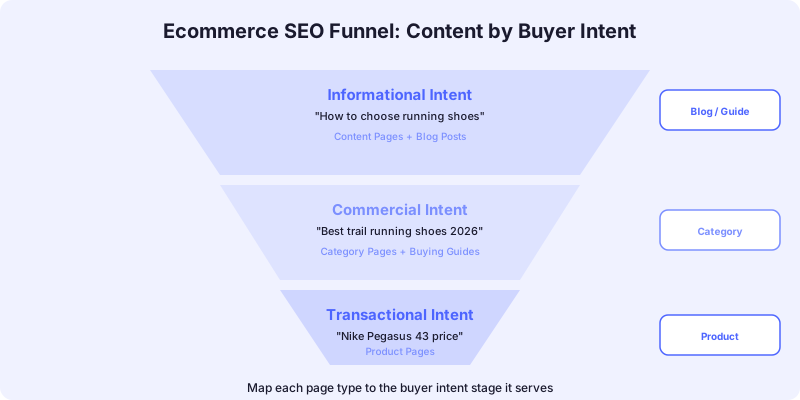
Ecommerce search engine optimization focuses on three page types:
- Product pages target specific, high-intent queries like "men's waterproof hiking boots size 11"
- Category pages target broader commercial terms like "waterproof hiking boots"
- Content pages (blog posts, buying guides) target informational queries like "how to choose hiking boots for wide feet"
Each page type serves a different stage of the buyer journey. Product pages convert ready buyers. Category pages capture comparison shoppers. Content pages attract researchers who become buyers later. A complete ecommerce SEO strategy covers all three.
Keyword Research: Finding What Your Customers Search
Keyword research is the foundation of every ecommerce SEO effort. Without it, you are guessing which terms to optimize for and which pages should target them.
Start with your product categories. If you sell running shoes, your category-level keywords might include "running shoes for women," "trail running shoes," or "lightweight running shoes." These are the terms your category pages should target. Tools like Ahrefs Keywords Explorer or Semrush's Keyword Magic Tool help you find search volume and competition data for these terms.
Product-level keywords are more specific and carry higher purchase intent. Someone searching "Nike Pegasus 41 women's size 8" knows exactly what they want. These long-tail terms individually have lower volume but collectively drive significant revenue because the visitor is ready to buy.
Informational keywords fill the top of your funnel. "Best running shoes for flat feet" or "how often should I replace running shoes" are queries where a well-written blog post can capture traffic and link internally to your product and category pages.
Use a keyword mapping approach to assign each keyword to a specific page. This prevents multiple pages from competing for the same term, a common problem on ecommerce sites with overlapping product descriptions.
Product Page Optimization Basics
Product pages are where organic traffic converts into revenue. Most ecommerce stores get the product listing right but miss the SEO elements that help those pages rank.
Title tags should include the product name, a key attribute, and the brand. Keep them under 60 characters. "Nike Pegasus 41 Running Shoe | Women's" tells both the shopper and the search engine exactly what the page contains.
Meta descriptions do not directly affect rankings, but they affect click-through rate. Write them for the shopper, not for the crawler. Include a benefit and keep them under 155 characters.
Unique product descriptions matter more than most store owners realize. Copying manufacturer descriptions means your page has the same content as dozens of other retailers. Write even a short paragraph that speaks to your specific customer's use case, and you immediately differentiate the page.
Product schema markup tells search engines about price, availability, and reviews in a structured format. When implemented correctly, your listings can display star ratings and pricing directly in search results. Google's product structured data documentation provides the implementation details.
User reviews add fresh, unique content to product pages at scale. Review text naturally contains the language your customers use when searching. Enabling reviews is one of the highest-leverage product page SEO tactics for stores with large catalogs.
Category Pages: The Overlooked Ranking Asset
Most ecommerce category pages are bare. A heading, some filters, a product grid. No descriptive content, no context, no internal links to related resources. These pages rank for almost nothing beyond the exact category name.
Category pages are where the biggest organic traffic opportunity lives for most ecommerce stores. A well-optimized category page can rank for dozens of related terms, pulling in traffic that individual product pages cannot reach.
What a strong category page includes:
- An introductory paragraph (150 to 250 words) that uses the primary keyword naturally and provides context
- A relevant H1 that matches how people search, not your internal taxonomy naming
- Supporting copy below the product grid answering common buyer questions
- Internal links to subcategories, related buying guides, and top-selling product pages
Adding 200 to 300 words of genuinely useful copy to a category page consistently lifts its rankings. This is often the fastest SEO win available to ecommerce stores with existing traffic. For a deeper look at category and product page optimization, the ecommerce SEO traffic guide covers the full framework.
Site Architecture and Internal Linking
How your store's pages connect to each other determines how search engines understand your site's hierarchy and how authority flows between pages.
A clean ecommerce site architecture follows a logical pattern: homepage links to main category pages, categories link to subcategories, subcategories link to individual products. Every product should be reachable within three clicks from the homepage.
Internal linking does more than help navigation. It distributes ranking authority from stronger pages to weaker ones. Your homepage typically has the most authority. Linking from it to your top category pages passes that authority along. Linking from category pages to key products does the same.
Common internal linking mistakes on ecommerce sites:
- Orphan product pages that have no links pointing to them from anywhere else on the site
- Category pages that only link to products, never to related content or other categories
- Blog content that never links back to product or category pages
A structured internal linking strategy connects your content pages to your commerce pages so that informational content supports product discovery rather than existing in isolation.
Technical Foundations for Ecommerce SEO
Technical SEO for ecommerce addresses the structural issues that prevent search engines from properly crawling and indexing your store. These problems are invisible to shoppers but directly impact your rankings.
Duplicate content from faceted navigation is the most common technical issue. When a shopper filters products by color or size, the site generates new URLs. A category page with 10 filter options can produce hundreds of URL combinations, most containing nearly identical content. Use canonical tags to point filter URLs back to the main category page, or configure parameter handling in Google Search Console.
Site speed affects both rankings and conversion rates. Product images are usually the biggest culprit. Compress images, enable lazy loading, and test your pages with Google PageSpeed Insights. Core Web Vitals thresholds matter: Largest Contentful Paint under 2.5 seconds, Cumulative Layout Shift below 0.1.
Mobile usability is non-negotiable. Over 60% of ecommerce traffic comes from mobile devices, and Google uses the mobile version of your site for indexing. If your product pages load slowly or display poorly on phones, your rankings will reflect that.
Building Content Around Your Products
Product and category pages target buyers who already know what they want. But a large portion of your potential customers start with a question, not a product name. Content marketing bridges that gap by capturing informational searches and guiding readers toward your products.
A simple ecommerce content strategy starts with three content types:
- Buying guides: "How to Choose the Right Running Shoe for Your Foot Type" links naturally to your running shoe category
- Best-of roundups: "Best Trail Running Shoes for Rocky Terrain" links to specific products
- How-to articles: "How to Break In New Running Shoes" builds brand visibility for top-of-funnel queries
Each piece of content should link internally to at least two product or category pages. This creates the topical connections that help search engines understand your store's expertise in a given area. Use a content gap analysis to find the informational keywords your competitors rank for that you have not yet addressed.
Shopify's ecommerce keyword research guide provides a practical walkthrough of identifying these informational opportunities specific to product-based businesses.
Where to Start: Your First 30 Days
A beginner ecommerce SEO plan should prioritize actions in a specific order. Trying to do everything simultaneously produces inconsistent results.
Week 1: Audit and fix technical issues. Check for duplicate content from filters, broken links, missing canonical tags, and slow-loading pages. These issues prevent everything else from working.
Week 2: Optimize your top 10 category pages. Add introductory copy, improve H1 tags, and ensure each page has a clear primary keyword. Category page improvements often produce the fastest ranking gains.
Week 3: Improve product page basics. Write unique title tags and meta descriptions for your top 50 products. Add product schema markup if you have not already.
Week 4: Plan your first content pieces. Identify 5 informational keywords from your keyword mapping exercise and outline blog posts that connect to your product categories.
This is not a one-month project. It is a starting framework. Ecommerce SEO compounds over months and years. The stores that build consistent publishing cadences and maintain their technical foundations are the ones that eventually reduce their dependence on paid traffic.
Moving From Beginner to Systematic
Search engine optimization for ecommerce is not a single project with a finish line. It is an ongoing system of keyword research, content creation, technical maintenance, and measurement. The beginners who succeed are the ones who build repeatable processes rather than chasing one-off optimizations.
If you want help building a content system that supports your ecommerce SEO from keyword research through publication, book a strategy call with ClusterMagic to see how a structured content program accelerates organic growth for product-based businesses.
Recommended Posts





.svg)