

.svg)
Ecommerce SEO: How to Drive Organic Traffic to Your Online Store (2026) | ClusterMagic

Running paid ads to an ecommerce store is a fast way to generate revenue. It's also a fast way to burn margin. The brands that win long-term build organic traffic alongside paid, so the cost per acquisition comes down as the site matures.
Ecommerce SEO is the discipline of making your store visible in search without paying for every click. It covers product pages, category pages, technical architecture, and content strategy. Done well, it compounds over time. Done poorly, it creates thousands of pages that confuse search engines and never rank.
This guide covers what actually moves the needle for ecommerce sites in 2026.
The Ecommerce SEO Challenge
Ecommerce sites face SEO problems that most other sites don't. A 10,000-product catalog can generate hundreds of thousands of URLs through filters, facets, and sorting parameters. Thin product descriptions get duplicated across variants. Category pages often have no content at all, just a grid of products.
The core challenges:
- Thin content on product pages that say almost nothing unique
- Duplicate pages created by faceted navigation (color, size, price filters)
- Large crawl surfaces that spread crawl budget across low-value URLs
- Category pages treated as navigation rather than ranking assets
None of these problems are unsolvable. They just require a deliberate approach to site architecture, content, and technical configuration.
Keyword Research for Ecommerce
Ecommerce keyword research operates at three levels. Each level requires a different approach and maps to a different type of page.
Product-level keywords are specific. "Men's waterproof hiking boots size 10" is a product-level search. These queries have high purchase intent and relatively low competition. The challenge is that individual product pages rarely get enough links to rank for competitive terms without support from stronger category and content pages.
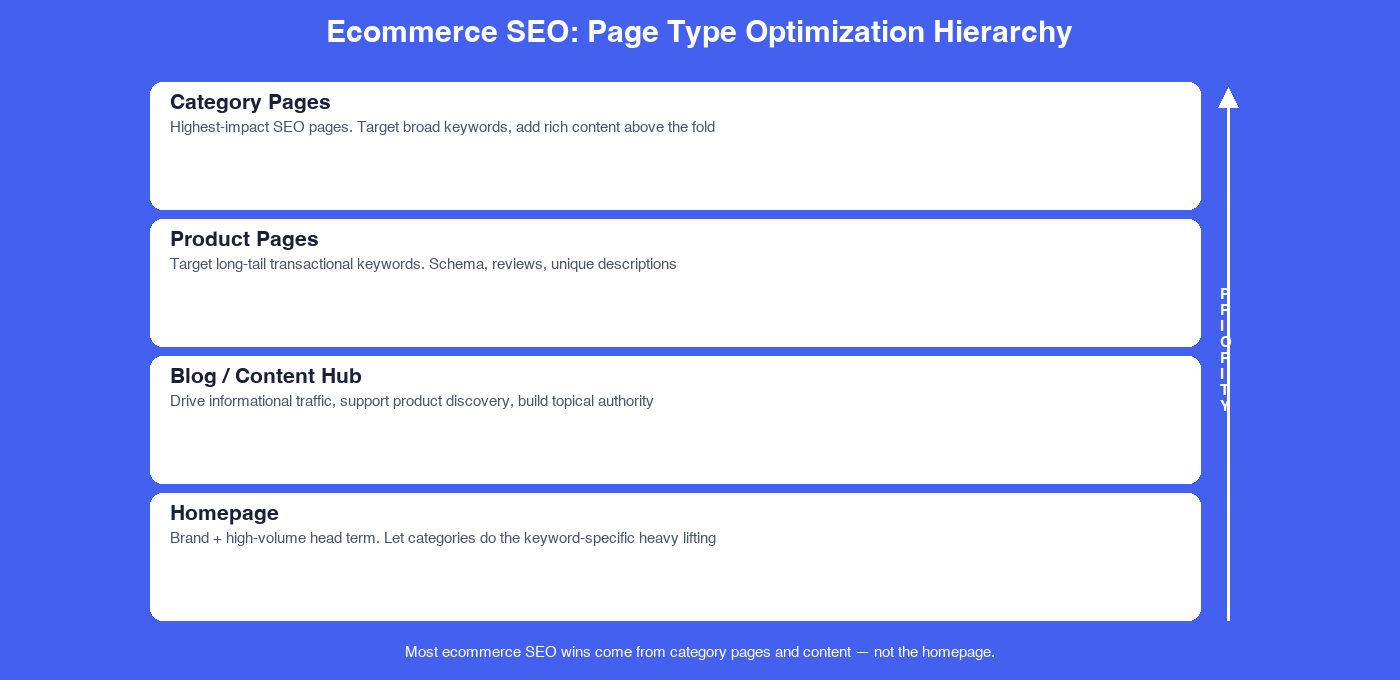
Category-level keywords are broader. "Waterproof hiking boots" or "hiking boots for men" are category terms. These are often higher volume and higher competition. Category pages are where most ecommerce sites have the biggest untapped ranking opportunity. A well-optimized category page with real content can rank for dozens of related terms.
Informational keywords are question-based. "How to choose hiking boots" or "best hiking boots for wide feet" are informational searches. These belong in blog content that supports product discovery. Someone reading a buying guide is one step away from purchasing.
Tools like Ahrefs and Semrush both have ecommerce-specific keyword research workflows that identify product and category terms by search volume and difficulty.
Product Page Optimization
A product page that converts well and ranks well shares a few characteristics. Most ecommerce stores get half of this right.
The SEO elements of a strong product page:
- Title tag: include the primary keyword, brand, and a key attribute (size, color, material). Keep it under 60 characters. "Merrell Moab 3 Waterproof Hiking Boot | Men's" is better than "Product ID 4729."
- Meta description: write it for clicks, not just for crawlers. Include a benefit and a soft call to action. This doesn't affect rankings but it affects click-through rate.
- Structured data (schema): product schema markup tells Google about price, availability, and reviews. Rich results with star ratings and price ranges get significantly more clicks than plain blue links. Google's Search Central documentation covers product schema implementation.
- Product descriptions: write unique descriptions for each product. Copy from manufacturer spec sheets produces duplicate content that doesn't rank. A short paragraph that speaks to the buyer's actual use case performs better.
- User-generated content: reviews add fresh, unique content to product pages at scale. They use natural language that matches how buyers actually search. Enabling reviews is one of the highest-leverage product page SEO tactics for stores with large catalogs.
Category Page SEO: The Underutilized Asset
Most ecommerce category pages look like this: a header, maybe some filters, and a grid of products. No text, no context, no unique content. These pages rank for almost nothing beyond the exact category name.
A category page optimized for SEO includes:
- A short introductory paragraph (100-200 words) that places the category in context and uses the primary keyword naturally
- Supporting copy below the product grid that answers common buyer questions about the category
- Internal links to subcategories and relevant buying guides
- A compelling H1 that matches search intent, not just an internal product taxonomy label
The goal is to give search engines something to evaluate beyond product thumbnails. A category page with 300 words of genuinely useful copy consistently outranks an identical page with no copy. This is one of the quickest wins for stores with existing traffic.
Building an Ecommerce Content Strategy
Product and category pages rank for purchase-intent keywords. But buyers also search informational queries earlier in the purchase process. A buying guide, a comparison article, or a "best of" roundup can capture that traffic and funnel it toward your products. Building this out follows the same principles as any blog content strategy, mapping informational content to audience intent at each stage of the purchase journey.
An ecommerce content strategy maps informational content to product categories:
- "Best [product category] for [use case]" articles that link to relevant category and product pages
- Buying guides that explain what to look for, with internal links to matching products
- How-to content that demonstrates product use and builds organic reach for the brand
Use content gap analysis to find the informational keywords your competitors rank for that you don't. These gaps represent the fastest opportunities for new content investment. Pairing that research with a keyword mapping exercise ensures each new piece of content has a clear primary keyword and doesn't overlap with pages you've already built.
Shopify's ecommerce SEO guide covers how blog content structures connect to product discovery in a practical way.
Technical Ecommerce SEO
Technical SEO for ecommerce has three priority areas.
Faceted navigation and duplicate content is the most common technical problem. When a shopper filters by color, size, or price, the site generates a new URL. A category with 10 filter options can create thousands of URL combinations, most of them nearly identical. The solution is controlling which URLs Google crawls and indexes using canonical tags, robots.txt, or parameter handling in Google Search Console.
Crawl budget matters more on large ecommerce sites than small ones. Google doesn't crawl every page on a site every day. If thousands of low-value filter URLs are consuming crawl budget, your important product and category pages get crawled less frequently. Cleaning up crawlable junk URLs improves crawl efficiency for pages that actually matter.
Site speed and Core Web Vitals affect both rankings and conversion rates. The technical SEO for content teams guide covers how to diagnose and fix Core Web Vitals issues that affect both content pages and product pages. A one-second improvement in page load time increases conversions measurably on mobile ecommerce. Use Google's PageSpeed Insights and prioritize image compression, lazy loading, and server response time. Large image files on product pages are the most common speed culprit.
How to Measure Ecommerce SEO
Traffic is a vanity metric without revenue context. The measurement framework for ecommerce SEO should tie directly to business outcomes.
The metrics worth tracking:
- Revenue per organic session: total organic revenue divided by organic sessions. This is your most important SEO health metric because it captures both traffic quality and conversion rate together.
- Organic conversion rate by landing page type: compare product pages vs. category pages vs. blog posts. This tells you which content type is driving the most qualified traffic.
- Indexed pages vs. total pages: if Google is indexing a fraction of your catalog, find out why. It usually points to a crawl budget or duplicate content issue.
- Ranking positions for category and product keywords: track this by priority keyword cluster, not for every term in your catalog.
For a broader framework on organic growth measurement, see the organic traffic growth guide.
Where to Focus First
If you're starting ecommerce SEO from scratch, the priority order is:
- Fix technical issues first (duplicate content from facets, crawl budget, site speed)
- Optimize your top 20 category pages with real content
- Improve product page title tags and descriptions for your top 50 products
- Add product schema markup sitewide
- Build a content calendar for informational keywords that support your top categories
Trying to optimize everything at once produces inconsistent results. Fixing technical issues before adding content ensures your content investments actually get indexed and ranked. Start with infrastructure, then layer on content.
Ecommerce SEO is slower than paid ads but it builds an asset. The ecommerce SEO full guide covers the complete playbook from technical foundation through content strategy. For specific ecommerce SEO tips you can implement this week, that quick-reference guide covers the highest-leverage actions. Every category page that ranks, every buying guide that drives traffic, and every product page that converts organic visitors adds lasting value to the business. If you want to get started with ClusterMagic to build the content cluster supporting your top categories, the workflow applies directly to ecommerce content programs.
Recommended Posts





.svg)