

.svg)
Long-Tail Keyword Optimization: Techniques That Drive Qualified Traffic | ClusterMagic

Finding long-tail keywords is only half the work. The other half is optimizing your content so those keywords actually rank. Long-tail keyword optimization is the process of structuring, writing, and technically configuring your pages so search engines connect them to the specific queries your audience types. Long-tail terms convert at 36% according to Search Engine Land's keyword research guide, compared to single-digit conversion rates for broad head terms. But that conversion advantage only materializes if you rank for them in the first place.
This tutorial covers the specific optimization techniques that turn a list of long-tail keywords into pages that rank and convert. If you already understand what long-tail keywords are (the long-tail keywords SEO guide covers the fundamentals), this post picks up where that knowledge ends and gets into the execution.
For teams that want long-tail targeting built into their content strategy from day one, ClusterMagic maps keywords to clusters automatically so every piece you publish targets the right long-tail phrases.
On-Page Optimization for Long-Tail Keywords
On-page optimization for long-tail keywords follows the same principles as any keyword targeting, but with adjustments for the specificity and conversational nature of longer phrases. The techniques below apply whether you are creating new content or optimizing existing pages.
Title Tag Optimization
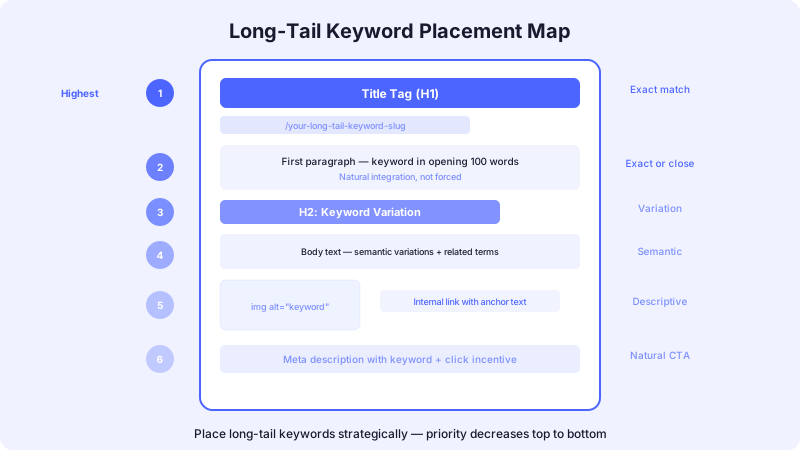
Your title tag is the strongest on-page signal for keyword targeting. For long-tail keywords, the challenge is fitting a multi-word phrase into a title that remains readable and stays under 60 characters.
Place the long-tail keyword as close to the beginning of the title as possible. If your target is "long-tail keyword optimization," a title like "Long-Tail Keyword Optimization: Techniques That Drive Traffic" works because the keyword leads. A title like "7 Techniques for Better SEO with Long-Tail Keyword Optimization" buries the term.
When the long-tail phrase is too long for the title, use the closest natural variation. Google understands semantic equivalence. "How to optimize for long-tail keywords" and "long-tail keyword optimization techniques" are treated as related queries targeting the same intent.
H2 Headings That Mirror Search Queries
Long-tail keywords often take the form of questions or specific phrases that map directly to H2 headings. Structure your content so that at least one H2 mirrors the exact or near-exact phrasing of your target keyword.
A post targeting "how to optimize blog posts for long-tail keywords" should include an H2 like "How to Optimize Blog Posts for Long-Tail Keywords" followed immediately by a direct, actionable answer. This structure aligns with how Google extracts content for featured snippets and People Also Ask boxes.
Map secondary long-tail variations to your H3 headings. If your primary target is "long-tail keyword optimization" and related queries include "long-tail SEO strategy for blogs" and "optimize content for long-tail search," those become natural subsection headings that expand your keyword footprint without forcing unnatural repetition.
Body Content Placement
Within the body text, place your primary long-tail keyword in the first 100 words. Then let it appear naturally two to four more times across the full piece. For a 1,500-word article, three to five total occurrences of the primary long-tail phrase is sufficient. More than that risks keyword stuffing, which is counterproductive.
Secondary long-tail keywords should appear once or twice each in the sections where they are most contextually relevant. You do not need every variation on every page. Google's language models recognize topical coverage without mechanical keyword insertion.
Content Structure Techniques for Long-Tail Targeting
The way you structure content determines how many long-tail keywords a single page can realistically target. Two primary approaches work well, and the right choice depends on search volume and intent diversity.
Dedicated Pages for High-Value Long-Tail Keywords
If a long-tail keyword has monthly search volume above 200 and a clear, distinct intent, it deserves its own page. "Best project management software for remote marketing teams" has a different intent than "project management software comparison chart." Each should have a dedicated page that fully satisfies its specific query.
Check whether a dedicated page is warranted by searching the keyword in Google. If the top results are pages entirely focused on that specific topic, you need a dedicated page. If the top results are broader pages where the topic appears as one section among many, a subsection within a larger piece will work.
FAQ and Subsection Targeting Within Pillar Content
Many long-tail keywords are variations of a broader topic that can be addressed within a single comprehensive page. A pillar page about "content marketing strategy" might include subsections targeting "content marketing strategy for small businesses," "B2B content marketing strategy framework," and "how to measure content marketing strategy effectiveness."
Each subsection uses the long-tail phrase as its H2 or H3, opens with a direct answer, and provides enough depth to satisfy the query. This approach lets a single page rank for dozens of long-tail variations by covering the topic from multiple angles.
The content clusters and pillar pages guide explains how to architect this relationship between comprehensive pillar content and targeted supporting pages.
Technical Optimization for Long-Tail Rankings
URL Structure
Keep URLs clean and include the primary keyword. For long-tail phrases, abbreviate where necessary to avoid excessively long URLs. A page targeting "how to optimize for long-tail keywords in blog content" does not need a URL of /how-to-optimize-for-long-tail-keywords-in-blog-content. A URL like /long-tail-keyword-optimization communicates the topic without unnecessary length.
Avoid dates, numbers, or filler words in URLs. These create maintenance headaches when content is updated and provide no ranking benefit.
Schema Markup for Long-Tail Queries
Structured data helps search engines understand the content type and improves eligibility for rich results. For long-tail keyword content, two schema types are particularly valuable.
FAQ schema applies when your content includes question-and-answer pairs that target long-tail queries. Marking these with FAQ structured data can earn expanded search result listings that show question-answer pairs directly in the results.
HowTo schema applies to tutorial content where the long-tail keyword describes a process. Marking step-by-step instructions with HowTo structured data makes your content eligible for step-formatted rich results.
Both schema types give your content more visual real estate in search results, which improves click-through rates on the specific long-tail queries you target.
Page Speed and Core Web Vitals
Long-tail traffic often comes from mobile devices, particularly for question-based queries that people search conversationally. Ensure your pages meet Core Web Vitals thresholds: Largest Contentful Paint under 2.5 seconds, Interaction to Next Paint under 200 milliseconds, and Cumulative Layout Shift under 0.1.
Pages that fail Core Web Vitals lose their competitive edge on long-tail queries where multiple pages match the intent equally well. In these close rankings, technical performance becomes the tiebreaker.
Optimizing Existing Content for Long-Tail Keywords
New content is not the only path to long-tail rankings. Your existing pages likely already attract impressions for long-tail queries you never deliberately targeted. Mining and optimizing for these hidden opportunities is one of the highest-ROI SEO activities.
Mining Search Console for Hidden Long-Tail Opportunities
Open Google Search Console's Performance report and filter for queries where your average position is between 8 and 25 and impressions are above 100 per month. These are long-tail phrases where Google already sees your content as relevant but has not ranked it high enough to generate meaningful clicks.
Export this list and group the queries by the pages they trigger. You will often find that a single page generates impressions for 10-20 related long-tail queries. Adding dedicated subsections for the highest-impression queries can push those rankings from page two to page one without creating new content.
Updating Content to Target Identified Queries
Once you identify the long-tail phrases your page is underperforming on, update the content:
- Add an H2 or H3 that mirrors the query phrasing
- Write a 150-300 word section that directly answers the query
- Include the long-tail phrase naturally in the first sentence of the new section
- Add internal links from the new section to related content
This approach works because Google already recognizes the page's topical relevance. The update signals that the content now explicitly addresses the specific query, which typically improves position within two to six weeks.
The keyword mapping guide helps prevent cannibalization when multiple pages compete for overlapping long-tail queries. Mapping ensures each long-tail phrase has one designated URL, avoiding internal competition.
Long-Tail SEO Strategy for Voice and AI Search
Voice search and AI-generated responses are changing how long-tail queries are structured and answered. Optimization for these channels requires specific adjustments.
Voice Search Optimization
Voice queries are longer and more conversational than typed searches. A typed search might be "long tail keyword optimization" while a voice search is "how do I optimize my content for long tail keywords." Write content that answers the conversational version of every long-tail query you target.
Include question-format headings (who, what, how, why, when) followed by concise, direct answers in the first one to two sentences. Voice assistants pull answers from content that provides a clear, self-contained response within a short text block.
AI Overview Optimization
Google's AI Overviews synthesize information from multiple sources to answer complex queries. Long-tail content that provides structured, factual, and specific answers is more likely to be cited in these overviews. Format key information in ways that AI systems can easily extract: numbered lists for processes, clear definitions for concepts, and explicit before/after comparisons for techniques.
Long-tail queries are more resistant to AI Overview displacement than head terms because their specificity requires depth that a short summary cannot replicate. A query like "how to optimize existing blog posts for long-tail keywords you found in Search Console" requires a multi-step answer that drives clicks through to the full content.
Measuring Long-Tail Keyword Optimization Success
Track these metrics to evaluate whether your long-tail optimization is working:
Impressions per page in Search Console should increase as your content becomes relevant for more long-tail variations. A page optimized for one primary keyword might generate impressions for 50-100 related long-tail queries.
Average position for target long-tail queries should improve within four to eight weeks of optimization. If positions are not moving after eight weeks, the content may need deeper updates or the competition may require a dedicated page rather than a subsection.
Click-through rate by query reveals which long-tail rankings are actually driving traffic. A query where you rank in position 3 but get zero clicks likely has its traffic absorbed by a featured snippet or AI Overview. A query where you rank in position 6 but get consistent clicks indicates strong title tag and meta description performance.
Conversion rate by landing page is the ultimate measure. Long-tail traffic should convert at higher rates than broad keyword traffic. If it does not, the content may match the keyword but not the intent. Revisit the content to ensure it delivers what the searcher actually needs.
A content gap analysis run quarterly will surface new long-tail opportunities as your competitors publish and as search behavior evolves. Long-tail optimization is not a one-time project. It is an ongoing process of discovery, targeting, and refinement that compounds over time.
For teams ready to systematize their long-tail strategy, ClusterMagic identifies keyword clusters and long-tail gaps across your entire topic architecture so you can optimize with precision instead of guesswork.
Recommended Posts





.svg)