

.svg)
Long-Tail Keywords: The SEO Guide for Smarter Traffic | ClusterMagic

Seventy percent of all search traffic comes from long-tail keywords. That figure has been cited for years, and it remains accurate in 2026 because search behavior has grown more specific, not less. People type complete questions, include their location, describe their situation, and qualify their intent before hitting search. Long-tail keywords capture that precision, and the sites that target them systematically outperform competitors chasing head terms with enormous competition and diffuse intent.
This guide covers what long-tail keywords are, why they produce better conversion rates than broad head terms, and a practical method for finding and targeting them across your content.
What Long-Tail Keywords Actually Are
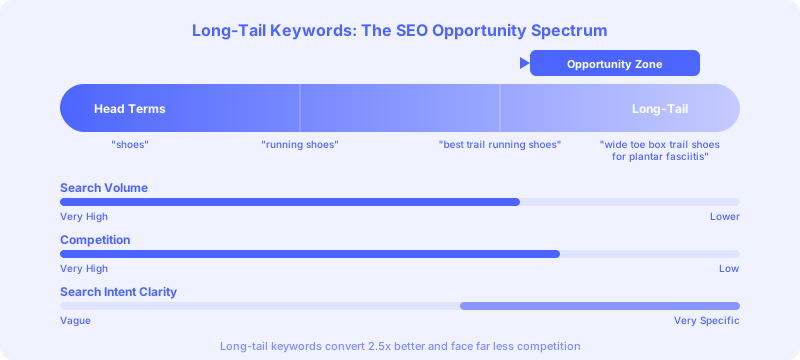
Long-tail keywords are search phrases that are specific, often three or more words long, and indicate clear intent. The term comes from the statistical distribution of search demand: a few head terms get massive volume (the head), and a vast number of specific phrases each get low-to-moderate volume (the long tail). The tail is where most search behavior actually lives.
The defining characteristic of a long-tail keyword is not word count alone. It is specificity and intent clarity. "Best project management software for remote marketing teams under $50 per month" is long-tail not because it is eight words long, but because it tells you exactly who is searching (a marketing manager), what they want (a specific type of software), and what constraint they are operating under (a budget). A searcher this specific is close to a decision.
Short-tail keywords like "project management software" attract searchers at every stage of awareness, from someone who just learned the category exists to someone ready to buy. Long-tail keywords attract searchers who already understand the category and are working through a specific question or comparison. That specificity is why long-tail terms convert 2.5 times better than head terms.
Why Long-Tail Keywords Matter More in 2026
Google AI Overviews now answer broad, informational queries directly in the search results, often without requiring a click. When someone searches "what is content marketing," they may get a full answer in the AI-generated summary at the top of the page. The traffic value of generic informational head terms has shrunk because Google is absorbing the clicks that used to flow to the first organic result.
Long-tail queries are harder for AI Overviews to fully satisfy. A question like "how do I build a content cluster strategy for a bootstrapped SaaS with no dedicated SEO team" requires contextual judgment, nuanced advice, and real-world experience that a summary box cannot replicate. Searchers who ask specific questions are more likely to click through to read a full treatment.
This dynamic makes long-tail keyword strategy more important in 2026 than it was five years ago. Teams that built their entire content strategy around high-volume head terms are seeing traffic declines as AI Overviews absorb generic queries. Teams that built content around specific, intent-rich long-tail phrases are more insulated from that shift because their content serves questions that require depth to answer properly.
How to Find Long-Tail Keywords Worth Targeting
The best long-tail keywords reveal themselves in the places where your audience asks real questions. Here are the most reliable sources:
Google's autocomplete suggestions show you what searchers are typing in relation to your topic. Start typing your primary keyword and note every variation Google offers. These are real searches, ranked by frequency. Google's People Also Ask boxes surface the follow-up questions searchers commonly have after entering a related query.
Keyword research tools like Ahrefs, Semrush, and Google Keyword Planner let you filter by keyword difficulty and volume to surface long-tail phrases your competitors may have missed. Filter for keywords with difficulty scores below 30 and volumes between 100 and 2,000 per month. These are the sweet spots: achievable rankings with meaningful traffic potential.
Your own Search Console data is an underused source. Navigate to the Performance report, filter by queries, and sort by clicks. Many of the queries you already rank for on pages two and three are long-tail phrases you never deliberately targeted. Optimizing existing content for those phrases often produces faster results than creating new posts.
Community forums and platforms like Reddit, Quora, and niche Slack groups surface the exact language your audience uses when they are genuinely confused about something. The questions people ask in communities become the long-tail keywords you target in content. For a step-by-step approach to turning these discoveries into ranking pages, the long-tail keyword optimization guide covers the full workflow from research through on-page execution.
Mapping Long-Tail Keywords to Your Content Clusters
Random long-tail targeting produces isolated posts that rank individually but contribute nothing to your domain's topical authority. The more effective approach is to map long-tail keywords to your content clusters so that each piece reinforces the authority of a central pillar page.
A content cluster built around "content marketing" at the pillar level might include long-tail supporting pages targeting phrases like "content marketing for early-stage B2B startups," "how often should you publish blog posts for SEO," and "content marketing vs. paid ads for lead generation." Each supporting post targets a specific long-tail phrase, and each one internally links back to the pillar and to other supporting posts. This cluster structure turns individual long-tail rankings into collective topical authority.
ClusterMagic automates the process of identifying which long-tail keywords belong together in a cluster and which gaps exist in your current coverage. Instead of manually grouping hundreds of keywords, you can see your entire topic architecture mapped out and choose which long-tail gaps to fill next. Pair this with a strong keyword mapping process to ensure each long-tail phrase has one designated URL targeting it.
Writing Content That Ranks for Long-Tail Keywords
Long-tail keywords signal specific intent, and your content needs to match that intent precisely. If someone searches "how to do a content gap analysis for a competitor," they want a step-by-step process, not a definition of what content gap analysis means. Answer the specific question in the first two lines of the relevant section, then provide the depth and context that makes the answer trustworthy and complete.
Structure matters. An H2 that mirrors the long-tail keyword phrase helps Google understand exactly what question that section answers. A post targeting "content gap analysis for competitor research" should have an H2 that reads something like "How to Run a Content Gap Analysis on Your Competitors" followed immediately by a direct, actionable answer. This mirrors the format Google uses to pull featured snippet content.
Include supporting detail: examples, data points, and specific tool recommendations. Long-tail searchers asking specific questions want specific answers. A post that gives a vague, general treatment of a specific question will not rank for it. Check the content gap analysis guide for a practical methodology for finding keyword gaps your current content leaves open.
Internal Linking and Long-Tail Keyword Clusters
Internal linking is the mechanism that connects your long-tail supporting pages to your pillar pages and to each other. Every long-tail post should include at least two to three internal links that route readers to related content in the same cluster. This distributes link equity across the cluster, keeps readers on your site longer, and signals to Google the topical relationship between your pages.
Effective internal linking uses descriptive anchor text that includes keywords from the destination page. Linking to your content clusters guide with the anchor text "content clusters and pillar pages" is more useful than linking with "click here" or "learn more." Descriptive anchors reinforce the topical authority signal for the destination page.
Review your internal linking structure periodically to identify orphaned posts (pages with no internal links pointing to them) and clusters where the pillar page is not receiving links from all its supporting posts. Orphaned pages rarely rank well regardless of their content quality, because they receive no internal authority signal from the rest of your site.
Tracking Long-Tail Keyword Performance
Because long-tail keywords have lower individual volumes, you measure their impact at the aggregate level rather than post by post. Tracking how to get organic traffic from long-tail clusters requires looking at combined keyword footprint growth rather than individual page metrics. Track the total number of unique queries your site ranks for in positions one through ten in Google Search Console. Growth in that number indicates that your long-tail strategy is expanding your keyword footprint.
Also track the tail of your keyword distribution in Search Console: the queries that send fewer than ten clicks per month but collectively represent a large share of your total organic traffic. For a foundational understanding of how these queries generate visits, organic searches explained covers the mechanics behind how search queries become site traffic. Many sites find that the bottom eighty percent of their keyword rankings, each individually small, account for thirty to fifty percent of total organic sessions. That long tail of rankings is the asset your long-tail content strategy builds.
If you want to see how ClusterMagic maps your current keyword coverage and identifies the highest-value long-tail gaps in your content, book a walkthrough and we will walk through your site's topic architecture together.
Further reading:
Recommended Posts





.svg)