

.svg)
Programmatic SEO Explained: Templates, Data, and Scale | ClusterMagic

Programmatic SEO is the practice of creating large volumes of search-targeted pages using templates, structured data, and automation instead of writing each page individually. Companies like Wise, TripAdvisor, and Zillow use it to dominate long-tail search results with millions of indexed pages. When it works, the results are significant. When it fails, Google deindexes the entire effort.
According to Backlinko's programmatic SEO analysis, successful implementations can generate a 200-500% increase in organic traffic within six months, with conversion rates 30-50% higher than traditional blog posts. But there is a critical qualifier: programmatic SEO carries a 60% failure rate without proper execution, and one in three implementations experience traffic cliffs within 18 months.
How Programmatic SEO Works
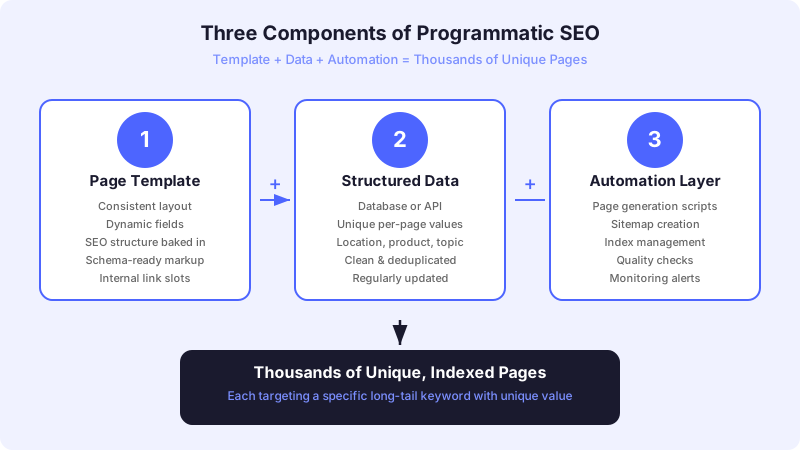
The core mechanism is straightforward. You build a page template, connect it to a structured data source, and generate unique pages for each data entry. Each page targets a specific long-tail query.
The template defines the layout. It includes static elements (navigation, CTAs, disclaimers) and dynamic slots that pull from your dataset. The quality of the template determines the floor for every page generated from it.
The data provides uniqueness. This is where most implementations succeed or fail. If your data source only changes one or two words per page, Google's crawlers will flag the output as thin content. [A travel site that created 50,000 "hotels in [city]" pages](https://www.getpassionfruit.com/blog/programmatic-seo-traffic-cliff-guide) with minimal differentiation saw Google deindex 98% of them within three months.
Automation handles the scale. Static site generation frameworks like Next.js or Nuxt pre-build pages and serve them via CDN, which keeps load times fast and crawl efficiency high. The technical infrastructure matters as much as the content strategy.
Real Examples That Actually Work
Wise currency converter pages. Wise operates 8.5 million currency converter pages that drive over 100 million monthly visits. Each page serves a specific currency pair query with proprietary exchange rate data, fee calculations, and historical charts. The pages work because the underlying data is genuinely unique and updated continuously.
TripAdvisor destination pages. Their "things to do in [city]" pages dominate search because each page aggregates real user reviews, ratings, photos, and booking data specific to that location. The data behind each page is irreplaceable, not templated filler.
Zillow property listings. Each listing page contains unique property data, valuation estimates, neighborhood statistics, and historical price trends. The template is consistent. The data makes every page substantively different.
The pattern across all successful programmatic SEO examples is the same: proprietary or deeply structured data that makes each generated page genuinely useful for its specific query. Without that, you are generating thin content at scale.
When Programmatic SEO Fails
The failure modes are predictable. Understanding them before building saves months of wasted effort.
Thin content at scale. If the only difference between your pages is a city name or product SKU swapped into the same paragraph, Google will treat them as duplicate content. In 2026, Google's AI crawlers are efficient at detecting boilerplate patterns where pages change only one or two variables.
No unique data advantage. If your data source is publicly available and already used by competitors, your pages offer no incremental value. Programmatic SEO requires a data moat. Without it, you are competing against every other site that has access to the same dataset.
Indexing and crawl budget issues. Generating 50,000 pages means Google needs to crawl and index all of them. If page quality is inconsistent, Google will selectively drop pages from the index. This is the traffic cliff phenomenon, where a site goes from ranking thousands of pages to ranking hundreds overnight.
Understanding long-tail keyword targeting is essential before planning any programmatic SEO project. Each generated page must target a query with real search volume and clear user intent.
Building a Programmatic SEO System That Lasts
If you decide programmatic SEO fits your situation, here is the build order that reduces failure risk.
Step 1: Validate your data source. Before building anything, confirm that your data creates genuine page-level uniqueness. Each page should contain information a user cannot easily find on one existing page. If your data does not pass this test, stop here.
Step 2: Build the template with quality floors. Every dynamically generated page should meet the same content quality standard as your best manually written page. Include unique introductory context, structured data markup, and navigation that connects related pages. Keyword mapping helps ensure each page targets a distinct query without cannibalizing others.
Step 3: Generate a test batch. Start with 50-100 pages, not 50,000. Monitor indexing rates, ranking performance, and user engagement metrics for 60-90 days. If Google indexes fewer than 80% of your test pages, your template or data needs work before scaling.
Step 4: Scale incrementally. Add pages in batches of 500-1,000. Monitor indexing and traffic after each batch. This approach catches quality issues before they affect your entire domain.
Step 5: Build internal linking architecture. Programmatic pages need the same internal linking rigor as editorial content. Connect related pages to each other and to your content cluster pillar pages to distribute authority effectively.
Where Programmatic SEO Fits in a Content Strategy
Programmatic SEO is a traffic acquisition tactic, not a complete content strategy. It works best for capturing high-volume long-tail queries where a template-plus-data approach can deliver genuinely useful pages. It does not replace editorial content, thought leadership, or top-of-funnel brand building.
The strongest content operations combine programmatic pages for long-tail capture with cluster-based editorial content for topical authority. The programmatic layer catches the queries. The editorial layer builds the trust. Together, they create a content system that compounds.
If you are evaluating whether programmatic SEO fits your growth plan, ClusterMagic can help you assess data viability and build the cluster architecture that supports scaled content.
Book a strategy session to map out where programmatic pages fit alongside your content clusters.
Written by Deanna S.
Recommended Posts





.svg)