

.svg)
16 Audience Engagement Tactics That Boost Rankings and Retention (2026) | ClusterMagic

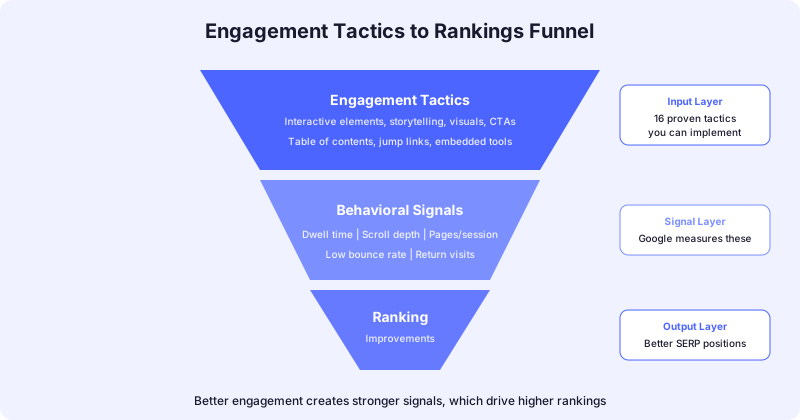
Audience engagement tactics are not just about keeping people on your page longer. They directly influence the behavioral signals Google uses to evaluate content quality. When a reader scrolls through your entire post, clicks an internal link, and returns next week, those actions tell search engines your content is worth ranking.
The connection between engagement and SEO is tighter than most content teams realize. Google measures dwell time, scroll depth, and interaction rates as part of its quality assessment. According to Google's helpful content guidelines, content must be created for people first, and engagement metrics are the clearest indicator of whether that standard is being met.
These sixteen content engagement strategies are organized by impact area. Each one connects directly to a ranking signal, an E-E-A-T factor, or a retention metric. If you want a team to implement these across your content library, book a strategy call and we will map the highest-impact tactics to your existing posts.
Tactics That Increase Dwell Time
Dwell time measures how long a visitor stays on your page before returning to search results. Longer dwell time signals that your content satisfies the searcher's intent. These five tactics directly increase it.
1. Open With a Specific, Falsifiable Claim
Generic introductions kill dwell time. Readers who see "In today's digital landscape..." bounce immediately. Instead, open every post with a specific claim that creates curiosity. State a concrete finding, challenge a common assumption, or present a data point that demands context. The reader stays to see whether you back it up.
2. Use Inline Visuals to Break Long Sections
Walls of text drive readers away regardless of quality. Insert diagrams, comparison tables, or process flows at natural break points. HubSpot's marketing research shows that visual content formats consistently outperform text-only content for engagement. An inline SVG explaining a three-step process gives readers a reason to pause, absorb, and continue.
3. Front-Load Value in Every Section
Do not bury the useful information at the bottom of a section. Put the actionable takeaway in the first sentence of each section, then explain why it works. Readers who get immediate value from each scroll are far more likely to keep scrolling. The SEO content optimization guide covers formatting patterns that keep readers moving through long-form content.
4. Embed Structured Data Points
Raw numbers without context are noise. Structured data points with context are engagement tools. Instead of "engagement rates are higher with video," write "short-form videos see a 50% average engagement rate compared to 17% for videos over 60 minutes." Specificity earns trust and keeps readers engaged because they are learning something concrete. For teams looking to push engagement further, interactive content formats like quizzes and calculators add participation that static data points can't replicate.
5. Write Scannable Paragraphs Under Five Sentences
Every paragraph over five sentences is a paragraph most readers will skip. Keep paragraphs to three or four sentences. Use bold text on key phrases so scanners can identify relevant sections without reading every word. Scannable formatting respects the reader's time and increases the total amount of content they consume.
Tactics That Strengthen E-E-A-T Signals
Google's E-E-A-T framework evaluates Experience, Expertise, Authoritativeness, and Trustworthiness. These engagement tactics build those signals into your content structure.
6. Include First-Hand Observations
Content that reads like it was assembled from other articles has no experience signal. Add at least one observation per post that could only come from someone who has done the work. Mention what surprised you, what did not work as expected, or what most guides get wrong. According to Google's quality rater guidelines update, the experience component specifically rewards this kind of demonstrated involvement.
7. Reference Specific Tools With Context
Naming a tool is not expertise. Explaining when to use it, what it does well, and where it falls short is. When you reference Semrush for content analytics or Ahrefs for keyword research, explain the specific feature and why it matters for the task at hand. This shows expertise that generic content cannot replicate.
8. Link to Primary Sources
Every claim you make should be traceable to a specific source. Link to the study, the documentation page, or the original research. Never link to a homepage when a specific page exists. This builds trust with readers and creates the external reference pattern that Google's systems associate with authoritative content.
9. Show Your Process, Not Just Your Conclusions
Readers trust content that shows how conclusions were reached. If you are recommending a content strategy approach, walk through the steps you used to evaluate it. If you are citing performance data, explain how it was measured. Transparent methodology is one of the strongest trust signals in content marketing. The content marketing ROI guide demonstrates this approach by showing exactly how to calculate and attribute returns.
10. Attribute Claims to Named Sources
"Studies show" is the weakest possible citation. Name the organization, the year, and the finding. "Content Marketing Institute's 2025 B2B research found that only 22% of marketers rate their content marketing as very successful" is a credible claim. The same finding without attribution is filler.
Tactics That Drive Return Visits and Sharing
Single-visit readers are valuable, but returning visitors compound your content's impact. These tactics turn one-time readers into an audience.
11. Create Reference-Worthy Content Structures
Posts that function as reference material get bookmarked and revisited. Checklists, frameworks, comparison tables, and step-by-step processes give readers a reason to come back. Structure at least one section of every post as a standalone reference that a reader would save for later use.
12. Internal Link to Depth, Not Just Breadth
Random internal links do not drive engagement. Strategic internal links that guide readers to a deeper exploration of the topic do. When you mention keyword research in passing, link to the advanced keyword research guide so interested readers can go deeper. According to Ahrefs' SEO research, pages with strong internal linking structures consistently outperform isolated pages.
13. End Sections With Forward Momentum
Do not end sections with summary statements. End them with a transition that previews what comes next or poses a question the next section answers. Forward momentum keeps readers scrolling from one section to the next rather than stopping at a natural break point.
14. Build Content Series, Not Standalone Posts
A single post on content strategy is useful. A five-part series covering strategy, planning, production, distribution, and measurement creates a reason to return. Content series generate higher engagement per post because readers who finish one installment seek out the next. The blog content strategy guide covers how to plan series that build on each other.
15. Include Actionable Takeaways at the End
Do not end posts with generic conclusions. End them with a specific action the reader can take immediately. "Audit your three highest-traffic posts for E-E-A-T signals this week" is an actionable takeaway. "Engagement is important for SEO" is not.
16. Respond to Comments and Questions
Content engagement does not stop at publication. Posts that accumulate comments and author responses build a community signal. Respond to every substantive comment within 48 hours. Readers who see active author engagement are more likely to comment themselves, creating a cycle that increases the page's value over time.
Measuring Engagement Impact on Rankings
Implementing these audience engagement tactics without measurement is guessing. Track these metrics to determine which tactics move rankings.
Dwell time by post. Compare average time on page for posts with inline visuals versus posts without. The content analytics guide walks through setting up this comparison in Google Analytics.
Scroll depth. What percentage of visitors reach the bottom third of your posts? If fewer than 30% reach the final section, your mid-post engagement tactics need work. Bold key phrases, add inline visuals, and tighten paragraphs in the sections where readers drop off.
Return visitor rate. Track the percentage of visitors who return within 30 days. Posts with reference-worthy structures and content series typically generate 2-3x the return rate of standalone posts.
Internal link click-through rate. Are readers clicking your internal links? Low click-through on internal links means the links are not contextually relevant or the anchor text is not compelling enough.
Organic ranking movement. After implementing engagement improvements on a set of posts, track their ranking positions weekly for 60 days. Engagement improvements typically show ranking effects within 4-8 weeks as behavioral data accumulates.
Start With Your Highest-Traffic Pages
You do not need to apply all sixteen tactics to every post at once. Start with your five highest-traffic pages and implement the tactics most relevant to each. Measure the impact over 60 days. Then expand to the next tier of pages.
The compounding effect is significant. Improved engagement on your top pages increases their ranking stability, which increases traffic, which generates more engagement data. This positive feedback loop is one of the most reliable growth mechanisms in content marketing.
If you want help identifying which engagement tactics will have the highest impact on your specific content library, schedule a strategy session and we will run the analysis together.
Recommended Posts





.svg)