

.svg)
Advanced Keyword Research: Going Beyond Search Volume (2026) | ClusterMagic

Search volume is a starting point, not a strategy. Most teams anchor their keyword research to a single number, chasing terms with thousands of monthly searches while ignoring signals that actually predict whether a page will rank and convert. Advanced keyword research means reading between the lines: interpreting intent, mapping keyword relationships, and making strategic decisions based on opportunity rather than raw demand.
This guide covers the techniques that separate keyword research done at a surface level from research that actually shapes content strategy.
What Advanced Keyword Research Actually Means
Basic keyword research is a lookup exercise. You enter a topic, filter by volume, sort by difficulty, and export a spreadsheet. Advanced keyword research is an interpretive exercise. The same dataset tells you very different things depending on the questions you ask.
The shift is from "what are people searching for?" to "why are they searching, what do they expect to find, and where does this keyword fit in a broader content architecture?" If your team is new to these concepts, the SEO fundamentals for marketers guide covers the baseline knowledge that makes advanced techniques more effective. Those questions take more time to answer, but they produce keyword lists worth building around.
Tools like Ahrefs Keyword Explorer and Semrush's Keyword Magic Tool give you data. What they don't give you is interpretation. That's where strategy comes in.
Technique 1: Prioritize Keyword Intent Over Search Volume
Search intent is the most important filter in advanced keyword analysis. A keyword with 500 monthly searches and strong commercial intent will outperform a 5,000-volume informational keyword for almost every conversion-related goal.
Google classifies intent into four categories: informational, navigational, commercial, and transactional. Your job is to identify which bucket a keyword falls into, then ask whether that intent matches your content goal and where the searcher sits in the buyer journey. For teams who want to organize their entire keyword strategy around intent from the start — grouping and clustering terms by what searchers actually want — the intent-based keyword research guide covers the full methodology.
The practical method: Search the keyword yourself and examine the top-ranking pages. Are they blog posts, product pages, comparison guides, or tools? The SERP layout tells you what Google believes users want. If every top result is a listicle and you're planning a landing page, you're fighting the intent signal, and you will lose that fight regardless of your keyword difficulty score.
Long-tail keywords deserve special attention here. They carry lower volume but often signal clearer intent, and a focused long-tail keyword optimization approach can produce faster ranking gains than competing for broad head terms. A searcher using a five-word phrase has already done some of the research and knows what they're looking for.
Technique 2: Use Keyword Clustering to Build Topical Authority
Individual keywords are not individual ranking opportunities. Many keywords share the same underlying topic, meaning a single well-constructed page can rank for dozens of related terms simultaneously. Keyword clustering is the process of grouping semantically related keywords and assigning them to single pieces of content rather than fragmenting them across separate pages.
This approach does two things. First, it prevents keyword cannibalization, where multiple pages compete against each other for the same query. Second, it signals topical depth to search engines, which is a meaningful ranking factor for sites trying to establish authority in a niche. For large-scale keyword grouping, programmatic SEO takes this concept further by automating cluster creation across hundreds or thousands of terms.
The clustering process starts with grouping by SERP overlap. If two keywords consistently surface the same ranking pages, they belong on the same page. Tools can automate much of this, but the strategic decision about which clusters to prioritize, and in what order, still requires human judgment about business relevance and content gaps.
This is exactly the kind of work that content clusters and pillar pages are built around. A well-structured cluster positions your pillar page as the authoritative resource while supporting pages capture narrower, higher-intent variations.
Technique 3: Analyze Keyword Difficulty as a Relative Score
Keyword difficulty (KD) scores are useful but widely misread. A KD of 40 does not mean the same thing for a new domain as it does for a site with 10 years of authority and thousands of backlinks. Treat KD as a relative indicator, not an absolute barrier.
A more useful frame is competitive gap analysis. Instead of asking "is this keyword too hard to rank for?", ask "who is ranking for this keyword, and what would it take to produce something better?" If the top results are outdated, thin, or poorly matched to the query, you have a real opportunity regardless of the difficulty score.
The inverse is also true. Low KD keywords on topics where you have no credibility or existing content base will still be hard to rank for because difficulty is partly a function of topical relevance, not just domain authority.
For a structured approach to finding where your content base has gaps relative to competitors, a content gap analysis is the natural next step after building your initial keyword clusters.
Technique 4: Mine Zero-Volume and Emerging Keywords
The most overlooked category in advanced keyword research is keywords that tools report as having zero or near-zero monthly search volume. These are not worthless terms; they are early signals.
Search behavior lags behind real-world conversations by months. Topics being actively discussed in forums, niche communities, LinkedIn comments, and Reddit threads often have no volume yet in traditional tools because the conversation hasn't migrated to Google at scale. Finding these terms early and building content around them positions you as the existing resource when volume eventually materializes.
Practical sources for zero-volume keyword discovery:
- Reddit and niche forums, searching for recurring questions in your topic area
- Google's "People Also Ask" and autocomplete suggestions
- Answer the Public for question-format keyword variations
- Sales and support conversations, which surface the exact language customers use before they become customers
Pair zero-volume keywords with medium-volume parent terms to give them context in your content structure. A page targeting a real cluster of related terms is more likely to gain traction than one built entirely around a single no-data keyword.
Technique 5: Map Keywords to Funnel Stages
Keyword research divorced from the sales funnel produces content that attracts traffic but doesn't move people anywhere. Advanced keyword strategy assigns every keyword cluster a funnel stage, then evaluates whether your content portfolio is proportionally covering awareness, consideration, and decision-level queries.
The diagram below illustrates how keyword intent aligns with funnel position:
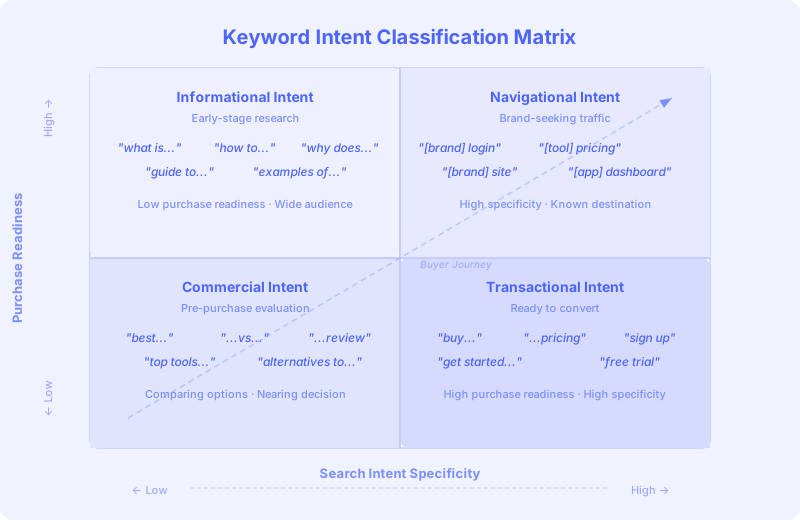
Most content teams over-invest in the top of the funnel and under-invest in the middle, where purchase decisions are actually forming. A keyword audit against your funnel map will often reveal entire categories of commercial-intent terms with no corresponding content.
Bottom-of-funnel keywords tend to have lower volume but higher conversion value. "Advanced keyword research tool" converts differently than "what is keyword research." Both deserve a place in your strategy, but they serve different moments in the customer relationship.
Technique 6: Read SERP Features as Intent Signals
Google's SERP layout is a map of how it understands a query. Featured snippets, "People Also Ask" boxes, local packs, image carousels, and video results are not decorations; they are data. Each SERP feature type tells you something specific about what format Google believes best satisfies the query.
If a keyword triggers a featured snippet, that means Google wants a direct, concise answer, which is a signal to structure your content with a clear definition or numbered steps near the top. If it triggers image results, visual content is part of what searchers expect. If it shows a video pack, YouTube optimization matters for that query.
SERP feature analysis is also a targeting opportunity. A featured snippet means one site is getting a disproportionate share of attention even if it ranks second or third by position. Displacing that snippet with a more structured answer can deliver significant traffic without needing to climb from position 5 to position 1.
Technique 7: Connect Keyword Research to Content Architecture
Keyword research without a structural plan produces silos. A keyword might be strategically important, but if it exists as an isolated page with no topical neighbors and no internal link pathways, it will underperform.
The output of advanced keyword research should be an architecture document, not just a list. That means grouping keywords into clusters, identifying which page serves as the authoritative hub for each cluster, and planning the supporting pages that will reinforce it.
This is where keyword mapping becomes essential. Assigning keywords to specific URLs prevents duplication, clarifies editorial priorities, and makes it immediately obvious where gaps exist in your existing content base.
Once your keyword clusters are mapped to pages, internal linking strategy becomes the mechanism that communicates those relationships to search engines. Pages that are well-linked within a coherent topic cluster consistently outperform isolated pages targeting the same keywords.
Putting the Techniques Together
Advanced keyword research is not a single tool or a single step. It's a sequence of decisions:
- Start with intent. Before adding any keyword to your strategy, know what the searcher is trying to accomplish and what content format matches their expectation.
- Cluster before you write. Group semantically related keywords together, assign them to pages, and map the relationships before producing any content.
- Audit your funnel coverage. Check whether your keyword portfolio has intentional presence at awareness, consideration, and decision stages, and identify which stage is most underserved.
- Mine for emerging terms. Don't limit your research to what tools currently measure. Communities, forums, and customer conversations surface real demand before volume metrics catch up.
- Read the SERP. Let the actual search results tell you what format and approach will rank, rather than guessing based on keyword text alone.
If your team is building out this kind of strategy and wants to see how ClusterMagic handles keyword clustering and topical architecture at scale, book a walkthrough to see it applied to your specific keyword set.
The Strategic Shift That Changes Results
The teams that get the most out of keyword research are not the ones with access to better tools. They're the ones who treat keyword data as evidence about their audience rather than a ranking checklist. Volume, difficulty, and competition scores describe the landscape. Intent, clustering, funnel alignment, and SERP analysis are how you navigate it.
When keyword research connects directly to content architecture, every piece of content you produce has a defined purpose, a targeted audience moment, and a structural home in your broader topic map. That's what separates content that accumulates traffic over time from content that flatlines after the initial publication spike.
Sources:
- Advanced Keyword Research for SEO in 2026: A Technical Guide
- 7 Advanced Keyword Research Strategies to Boost Your SEO Game in 2026
- Keyword Research in 2026: Advanced SEO Funnel Strategy
- Beyond search volume: Future-proofing keyword research for SEO
- 6 Advanced Keyword Research Strategies for SEO Success
- Advanced Keyword Research Techniques for 2025
Recommended Posts





.svg)